Ad. When you purchase through links we provide, we may receive an affiliate commission. Here's how it works.
Roborock vs Dreame: Which Robot Vacuum Brand to Buy (2026)
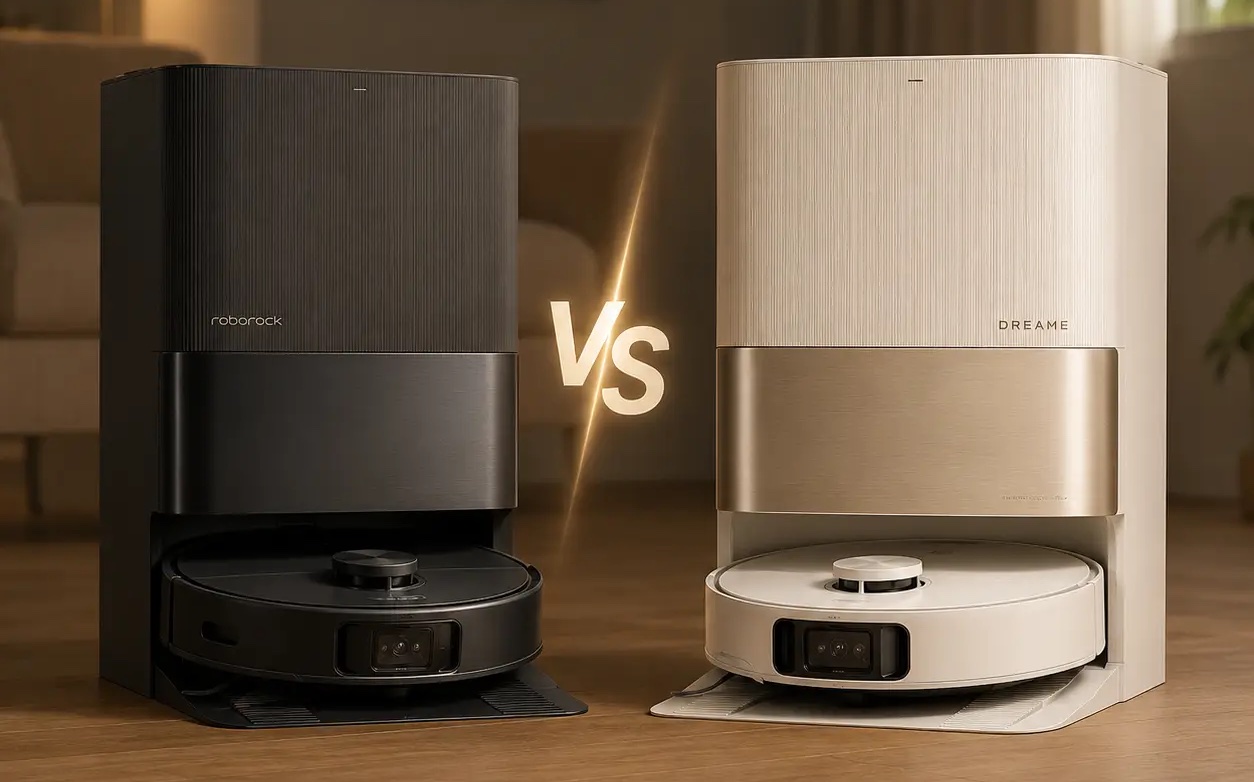
In the Roborock vs Dreame debate, Roborock is the safer long-term investment: better navigation, a best-in-class app, and proven customer support.
Dreame wins on features per dollar and edge mopping, making it the stronger pick if value is your priority and you’re comfortable with occasional firmware quirks.
Quick Verdict
Choose Roborock if:
- You want the most reliable navigation in complex or cluttered homes
- Long-term app support and responsive customer service matter to you
- You have premium hardwood or engineered wood floors and worry about moisture
Choose Dreame if:
- You want more cleaning power and corner mopping coverage at a competitive price
- You have thick carpet or heavy pet hair and want maximum suction
- You prioritize features-per-dollar over brand reliability track record
Main difference:
Roborock leads on reliability, navigation, and support.
Dreame leads on raw cleaning power, edge mopping, and value.
Bottom line:
The right choice comes down to whether you value long-term ownership security (Roborock) or maximum features at a lower cost (Dreame).
Key Takeaways
- Dreame’s flagship Dreame X60 Max Ultra Complete claims 35,000 Pa; Roborock's Saros 10R claims 22,000 Pa.
The thing is that these figures aren’t measured under the same standardized protocol, so the real world gap is smaller than the numbers suggest. - Dreame’s UltraExtend mop arm extends up to 18 cm outward to clean along baseboards; a capability Roborock’s VibraRise system doesn’t match.
- Roborock’s app supports per-room suction and mop intensity settings and has delivered active updates on models dating back to 2020.
- Dreame’s customer service has documented multi month resolution delays; Roborock’s US support averages sub-1-minute human response times.
- Both brands process data on Chinese servers; Roborock’s March 2025 privacy policy explicitly disclosed potential data sharing with affiliates.


EverydayHomeComfort Score
| Category | Roborock | Dreame |
|---|---|---|
| Cleaning Performance | 8.5/10 | 9/10 |
| Mopping | 8/10 | 9/10 |
| Navigation | 9.5/10 | 8.5/10 |
| App & Software | 9.5/10 | 7.5/10 |
| Reliability & Support | 9/10 | 6.5/10 |
| Overall Rating | 9/10 | 8/10 |
Roborock vs Dreame is one of the most common robot vacuum decisions right now, and for a good reason.
Both brands push flagship specs that would have seemed excessive three years ago, and the gap between them on paper has never been smaller.
The real differences show up after the sale: in how reliably the vacuum navigates week after week, how well the app holds up in year two, and what happens when you need support.
Key Differences at a Glance
| Spec | Roborock (Saros 10R) | Dreame (X60 Max Ultra Complete) | Winner |
|---|---|---|---|
| Claimed suction | 22,000 Pa | 35,000 Pa* | Dreame* |
| Mop lift off carpet | 20 mm | 10 mm | Roborock |
| Edge/corner mopping | Fixed pad, ~2 cm gap at walls | UltraExtend arm, extends 18 cm | Dreame |
| Hot water mop wash | 176°F dock | 212°F (boiling) dock | Dreame |
| Chassis height | 3.14” | 3.13” | Tie |
| Navigation | LiDAR + StarSight AI camera | LiDAR + AI camera | Roborock |
| App depth | Best-in-class, per-room control | Good, less granular | Roborock |
| Customer support (US) | Sub-1 min human response | Multi-month delays reported | Roborock |
| Annual consumable cost | Slightly higher | Slightly lower | Dreame |
*Pa ratings are manufacturer-claimed figures, not standardized under IEC/ASTM 62885-7. See the Suction section below.
Suction Power and Carpet Cleaning: Roborock vs Dreame
Dreame’s flagship claims 35,000 Pa against Roborock's Saros 10R at 22,000 Pa.
That gap sounds decisive but it isn’t.
Both brands use manufacturer tested figures measured under their own internal conditions, not the IEC/ASTM 62885-7 standardized robot vacuum test protocol, so the Pa numbers are not directly comparable between brands.
On hard floors and low to medium pile carpet, both deliver equivalent results for the vast majority of cleaning tasks.
Where the gap does matter:
Thick carpet and high pile rugs (30 mm or more).
Dreame’s higher motor output gives it a measurable edge where sustained suction through resistance determines whether debris gets fully pulled into the bin.
For pet owners with a shag rug and a large-breed dog, that extra power is useful after a heavy shedding weekend.
See our guide to the best robot vacuums for thick carpet for more depth on this category.
Real-world scenario:
In a 1,200 sq ft home with medium pile carpet in bedrooms and hardwood in living areas, you won’t feel the difference.
Add a high-pile area rug and a large-breed dog, that’s where Dreame’s extra motor output separates the two.
Winner:
Dreame for thick carpet and heavy debris.
Tie for hard floors and low-to-medium pile carpet.
Mopping Performance and Hardwood Floor Safety
This is where the Roborock vs Dreame comparison diverges most meaningfully, and where the right answer depends on what type of floor you have.
Dreame’s UltraExtend technology on the X60 Max Ultra Complete physically extends the mop pads up to 18 cm outward to clean along baseboards and into corners.
Roborock’s VibraRise system oscillates the pad at 4,000 times per minute for superior flat surface scrubbing, but the pad stays centered under the unit, leaving a consistent ~2 cm gap at walls.
If your main frustration is the dirty strip along the baseboard, Dreame solves it and Roborock doesn’t.
For hardwood and engineered wood floor safety, Roborock has the stronger track record.
VibraRise lifts the mop 20 mm when carpet is detected, virtually eliminating moisture transfer.
Dreame's X60 Max Ultra Complete had documented firmware issues at launch: real world reports included inconsistent pad retraction and over-saturated passes on hard floors.
Dreame’s 10 mm mop lift is also shallower, increasing moisture risk on carpet transitions.
Our guide to the best robot vacuums for hardwood floors covers this tradeoff in full.
Real-world scenario:
In a 900 sq ft apartment with engineered oak throughout and daily mopping, Roborock’s tighter moisture control is worth more than Dreame’s corner coverage.
In a kitchen with ceramic tile where the baseboard gets dirty every cycle, Dreame’s extending arm does something no other brand does.
Winner:
Dreame for corner and baseboard coverage.
Roborock for hardwood and engineered wood floor safety.
Navigation, Mapping, and Obstacle Avoidance
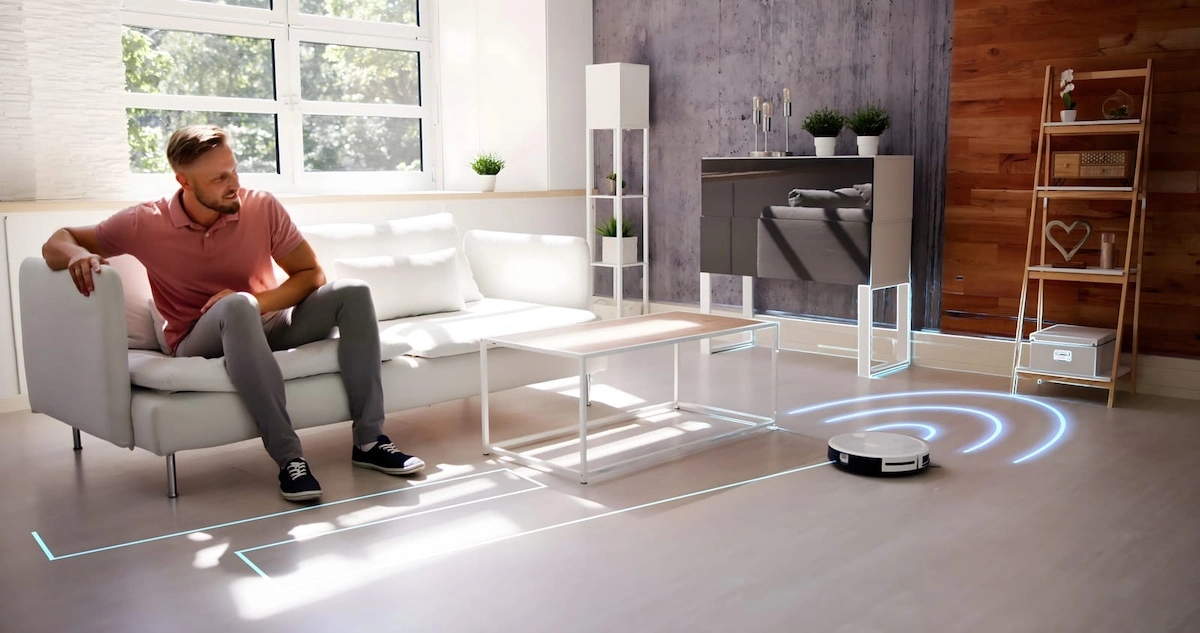
Both brands use LiDAR-based mapping with AI camera obstacle avoidance.
In practice, Roborock’s navigation is the more mature and consistent of the two.
Roborock’s StarSight system on the Saros 10R processes 60 frames per second and identifies 73 obstacle categories.
More important than the spec: mapping errors, spontaneous map resets, and missed zones are documented at lower rates for Roborock than Dreame equivalents.
Dreame’s X50 and X60 navigation is genuinely capable, but community reports include mid-job failures (spinning in place, zones re-mapped incorrectly after furniture moves, and pad-drop errors) at a higher frequency.
For multi-floor homes, Roborock supports 4 saved floor maps with a well-regarded management UI; Dreame supports multiple maps but the interface is considered less intuitive.
Our guide to the best robot vacuums for multiple floors covers both brands in detail.
Real-world scenario:
In a two-story home where the vacuum needs to dock, recharge, and resume cleaning across three rooms after detecting a cable on the floor.
Roborock handles this sequence more reliably than Dreame in user-reported experience.
Winner:
Roborock: more consistent real-world navigation with fewer software-driven failures.
App Experience and Long-Term Software Support
The Roborock app is widely considered the best in the robot vacuum category.
Per-room suction intensity and mop water flow, SmartPlan multi-task automation, real-time mapping, and detailed cleaning history are all available and maintained.
Roborock models from 2020 onward still receive active firmware updates: an unusual commitment that affects whether your vacuum stays smart in year three.
Dreame’s app handles the basics well.
Scheduling, room assignment, and suction modes are solid.
Where it falls short: SmartPlan-style automation doesn’t exist in Dreame’s current software, zone-level mopping intensity is absent on mid-range models, and Dreame’s update history is patchier: some mid-range models have lost active feature support within 18-24 months of launch.
A note on data privacy:
Both Roborock and Dreame are Chinese companies that process data on Chinese servers.
Roborock’s March 2025 privacy policy explicitly disclosed that user data may be processed in China and shared with affiliates.
An independent audit by AV-TEST (a non-commercial German security research institute) flagged Roborock’s data transmission as deficient.
Dreame has the same structural exposure but hasn’t faced the same documented controversy.
For camera-equipped models used in home offices or around children, this is worth knowing before you buy.
Winner:
Roborock on app depth and update longevity.
Both brands carry similar data privacy risk.
Reliability and What Happens When Something Goes Wrong
Specs tell you what the vacuum does on day one.
This tells you what owning it feels like in year two.
Roborock: Customer service in the US market earns consistently fast-response ratings.
Sub-1-minute human agent access is documented across multiple 2025 community reports.
Hardware defect claims are typically resolved within 2-4 weeks.
Dreame: Customer service is the most consistent complaint across its Trustpilot and Reddit presence.
Multiple verified reports describe broken units sitting unresolved for 2+ months with poor inter-department communication.
An independent review of the Dreame X60 Max Ultra Complete (its current flagship) documented mopping failures, navigation crashes, and water waste on launch firmware.
Dreame has pushed fixes but the pattern of quality control inconsistency persists in recent reviews.
For long-term consumable availability, Roborock replacement parts (main brush, HEPA filter, side brush) are widely stocked on Amazon for models going back several years.
Dreame consumables are available but harder to source for older mid-range models.
The EPA notes that fine particles under 10 microns can reach deep into the lungs: a reminder that filter replacement on schedule isn’t optional, so it pays to follow a regular maintenance schedule.
Winner:
Roborock: if something breaks in year two, Roborock’s support infrastructure is more likely to resolve it without a months-long dispute.
Pros and Cons
Roborock
Pros
- Best navigation in the category: fewer mapping errors, more consistent room coverage
- Best app in the category: deep per-room control and multi-year firmware support
- Stronger hardwood floor safety: VibraRise 20 mm lift, tighter moisture control
- Fastest customer service response in the US market
- Category-first mechanical arm technology on Saros Z70 (promising, not yet daily-use mature)
Cons
- Flagships priced higher than Dreame equivalents at comparable spec tiers
- 2025 privacy policy update disclosed potential data sharing with affiliates
- VibraRise leaves a ~2 cm gap at walls: corners and baseboards never get fully cleaned
Dreame
Pros
- Best edge and corner mopping in the category: MopExtend/UltraExtend is genuinely unique
- More features per dollar: flagships consistently undercut Roborock on equivalent specs
- Higher raw suction at flagship tier (35,000 Pa X60 vs 22,000 Pa Saros 10R)
- ProLeap threshold climbing on L50 series (up to 42 mm); best for multi-threshold homes
Cons
- Customer service has documented multi-month resolution delays for warranty claims
- Firmware instability at launch: X50 and X60 series had real-world mopping and navigation bugs
- Moisture control on mopping is less consistent: a risk for hardwood and engineered wood
Common Mistakes When Choosing Between Roborock and Dreame
- Treating Pa numbers as a direct comparison:
Neither brand publishes IEC/ASTM 62885-7 standardized results.
Dreame’s 35,000 Pa vs Roborock’s 22,000 Pa doesn’t mean Dreame cleans 59% better.
The figures are measured under different internal conditions.
For a reliable suction comparison, look at independent carpet cleaning results, not the spec sheet. - Buying the flagship dock tier without checking what you actually need:
Both brands offer multiple dock configurations: base self-empty, mid-tier mop wash, and top-tier hot water + auto-refill.
Many buyers pay for the Complete dock and discover the auto-refill isn’t useful for their cleaning frequency.
Know what the dock includes before committing to the top tier. - Ignoring customer service when buying at premium price points:
A broken premium robot vacuum is a customer service problem, not just a product problem.
Dreame’s documented support delays are a real factor, not a dealbreaker, but worth weighing before choosing their flagship over Roborock’s. - Underestimating how much the app matters for daily use:
People spend 10 minutes buying a robot vacuum and 3 years using the app.
Roborock’s app advantage isn’t about the first setup, it’s about zone-level settings and reliable updates two years from now.
If you want different rooms on different suction levels, only Roborock makes that effortless. - Shopping by brand instead of by model tier:
Both brands have excellent mid-tier models and weaker budget entries.
A Dreame L50 Ultra outperforms a Roborock S8 Max for corner mopping at a lower price point.
Compare specific models, not brand names.
What Happens If You Choose Wrong
- If you choose Dreame for premium hardwood floors because the mopping specs look better, you may encounter inconsistent moisture control from early firmware versions, risking floor damage that could void your flooring warranty.
- If you choose Roborock expecting the best corner and baseboard mopping, you’ll notice a consistent ~2 cm gap at walls that VibraRise doesn’t close.
Corners stay dirty on every run. - If you choose Dreame and have a hardware failure in year one, you may wait 2–3 months for resolution while cleaning manually in the interim.
- If you choose Roborock expecting the highest raw suction for thick-pile carpet, you’ll be satisfied on most surfaces, but Dreame’s extra motor power handles heavy-shedding scenarios with more margin.
Which One Is Right for You?
- If you have premium hardwood or engineered wood floors: buy Roborock
- If you care most about corner and baseboard mopping: buy Dreame
- If you have thick-pile carpet or heavy pet hair: buy Dreame
- If long-term reliability and responsive support are your priorities: buy Roborock
- If you want the deepest app customization and multi-room automation: buy Roborock
- If you want maximum features at a more competitive price: buy Dreame
- If you have a multi-level home with raised thresholds: buy Dreame L50 Ultra (ProLeap, up to 42 mm)
- If camera data privacy is a concern: opt for a LiDAR-only model from either brand to reduce exposure
How We Compared Them
We reviewed manufacturer spec sheets for both brands’ 2025–2026 lineup, cross-referenced independent user reports from r/robotvacuums and verified Trustpilot reviews, analyzed AV-TEST’s 2024 robot vacuum security audit, and reviewed independent analysis from technology publications and community-tested comparisons.
EverydayHomeComfort researches, analyzes, and synthesizes data from the sources above to give you a grounded view of what each brand delivers in real homes.
For technical background on how robot vacuums navigate, Wikipedia’s robotic vacuum cleaner article is a useful primer.
For our full method and scoring rubric, see our review methodology.
Frequently Asked Questions
No.
Roborock and Dreame are separate, independently operated companies.
Roborock was founded in 2014 and launched its first product in partnership with Xiaomi, but has operated as a standalone publicly listed brand since 2017.
Dreame Technology was founded in 2017 and received early investment from Xiaomi’s ecosystem fund, an investment and distribution relationship, not shared ownership.
Both brands are headquartered in China, both process user data on Chinese servers, and both carry a historical Xiaomi connection.
That connection describes investment and early distribution, not shared product teams or engineering.
In practice, Roborock and Dreame have entirely different navigation systems, app platforms, dock technology, and customer service operations.
The Xiaomi ecosystem link also means both brands compete aggressively on price in international markets — a legacy of Xiaomi’s go-to-market strategy that benefits buyers.
When comparing Roborock vs Dreame, focus on the specific model and tier you’re considering rather than brand origin.
The differences that matter in your home, navigation reliability, app depth, mopping coverage, are specific to each brand’s engineering choices, not their corporate histories.
For a mixed home (carpet in the bedrooms, hardwood or LVP in the living areas) Dreame has the edge for raw cleaning power while Roborock has the edge for floor safety.
Dreame’s flagship suction (20,000–35,000 Pa across their lineup) handles embedded pet hair in medium-to-high pile carpet better than Roborock’s 18,000–22,000 Pa flagships.
Pet hair gets trapped deep in carpet pile, and higher sustained suction genuinely helps here, especially after a heavy-shedding weekend with a large-breed dog.
On hard floors, however, Roborock’s VibraRise system with 20 mm carpet lift is safer for engineered wood and hardwood.
Dreame’s MopExtend system cleans corners better, but firmware issues on early X50 and X60 models introduced moisture over-application risks on hard surfaces, a documented problem across multiple verified user reports.
For pet owners who prioritize maximum suction for carpet and are less concerned about hardwood floor protection, Dreame delivers better value.
If expensive flooring is in the picture and you’d rather not risk moisture damage, Roborock’s floor safety track record tips the balance.
For specific model picks, see our best robot vacuums for pet hair guide.
Dreame is better for corner and baseboard mopping, and it’s not close for that specific use case.
Dreame’s MopExtend technology (L-series) and UltraExtend dual-arm system (X60 Max Ultra Complete, which extends the mop pad up to 18 cm outward) physically move the pad to reach wall edges and skirting boards that a fixed-position mop simply can’t cover.
Roborock’s VibraRise system oscillates the pad at 4,000 times per minute for superior flat-surface scrubbing, but the pad stays centered under the unit, leaving a consistent ~2 cm gap at walls.
If your main frustration is the dirty strip along the baseboard that every previous robot vacuum has left behind, Dreame solves that problem and Roborock doesn’t.
The caveat is moisture: Dreame’s extending system applies more water per pass than Roborock’s fixed pad. On tile, LVP, or stone flooring, this is a non-issue and Dreame’s edge cleaning is a clear win.
On hardwood or engineered wood, especially on models with early firmware, the extra moisture volume is worth monitoring.
Roborock has the better app, and yes, it matters significantly more than most buyers expect.
The Roborock app supports per-room suction intensity and mop water flow settings, SmartPlan multi-task automation, real-time mapping with live position tracking, and persistent floor maps for up to 4 levels.
More importantly, Roborock maintains active firmware updates on models going back to 2020, which means the app you use in year three is functionally richer than the one you downloaded at setup.
Dreame’s app handles the basics well, scheduling, room assignment, suction modes, but lacks customization depth.
Zone-level mopping intensity control is absent on mid-range models, and SmartPlan-style automation doesn’t exist in Dreame’s current software.
Dreame’s update history is also patchier, with some mid-range models losing active feature support within 18–24 months of launch.
Where this plays out daily: a busy parent who wants the vacuum to run the kitchen on high suction on weekdays while running bedrooms on quiet mode gets that from Roborock with a few taps.
With Dreame, they’re setting one mode for the whole floor.
Over three years of daily use, that gap in control compounds into real differences in floor cleanliness and battery efficiency.
At the flagship tier, Roborock and Dreame are in the same price range, the Dreame X60 Max Ultra Complete and Roborock Saros 10R are comparably positioned.
At mid-range, Roborock is typically 20–40% more expensive for broadly comparable specs.
Whether that premium is worth it depends on three factors: floor type, support expectations, and how long you plan to keep the vacuum.
If you have hardwood floors, plan to keep the vacuum for 3+ years, and would be seriously inconvenienced by a 2-month warranty dispute: Roborock justifies the premium.
You’re paying for more reliable navigation, a better app with longer update support, and customer service that resolves issues in days rather than months.
If you have tile or carpet only, plan to upgrade in 2 years, and want the best mopping for your budget: Dreame gives you more cleaning capability per dollar.
The honest answer: Roborock’s premium is clearly justified for buyers with expensive floors and low tolerance for ownership hassle.
It’s debatable for cost-conscious buyers who just want clean floors.
For pet owners who want maximum suction and good mopping, Dreame may actually deliver better value at the same spend.
See our best robot vacuums guide for a side-by-side look at specific models from both brands.
Roborock is the safer choice for premium hardwood and engineered wood floors.
Three factors make this clear.
First, Roborock’s VibraRise system lifts the mop pad 20 mm when transitioning onto carpet, virtually eliminating the risk of dragging a wet pad across a hard floor boundary.
Dreame’s mop lift operates at 10 mm and has had documented calibration inconsistencies, early X50 and X60 Ultra owners reported wet carpet after transition passes, indicating the mop didn’t fully retract.
Second, Roborock’s sonic mopping uses less water per pass than Dreame’s extending-arm system.
Less moisture on wood is always safer, particularly on engineered wood where repeated over-wetting causes delamination over time.
Third, Roborock’s track record with hardwood-specific use is longer and better documented in user communities.
The practical guidance: if your floors cost thousands to install and moisture damage would void the flooring warranty, the lower-risk choice is Roborock.
If you have LVP or ceramic tile throughout and the concern is scratch damage rather than moisture; both brands are safe.
Roborock is significantly easier to deal with when something goes wrong.
Roborock’s US customer service is documented with sub-1-minute human agent access times across multiple 2025 community reports.
Hardware defect claims are typically resolved within 2–4 weeks.
Dreame’s customer service is the most consistently cited weakness across its customer base.
Multiple verified Trustpilot and Reddit reports from 2024–2025 describe broken units sitting unresolved for 2+ months with poor inter-department communication and frontline agents unable to escalate.
An independent review of the Dreame X60 Max Ultra Complete documented mopping failures, navigation crashes, and water waste and described the ownership experience in strongly negative terms.
Dreame has acknowledged these service issues and committed to improvement, but the pattern persists in recent verified reviews.
The practical implication: if you buy a premium robot vacuum and the main brush motor fails 14 months in, just past the standard 1-year warranty, you are negotiating with customer service for a resolution.
With Roborock, that process is typically fast and documented.
With Dreame, the outcome is less predictable.
This factor is worth weighing heavily when comparing brands at the premium tier.
You can find both brands’ reviewed models on our vacuum cleaners category page.
Both brands collect data.
Any connected robot vacuum with a camera creates a map of your home and, depending on the model, captures visual data while navigating.
Both Roborock and Dreame are Chinese companies that process data on Chinese servers, where data is subject to Chinese law, including government access frameworks that differ significantly from GDPR or US legal standards.
Roborock’s March 2025 privacy policy explicitly disclosed that user data may be processed in China and shared with affiliates.
AV-TEST, an independent German security research institute, flagged Roborock’s data transmission practices as deficient in their 2024 robot vacuum security audit.
Dreame has the same structural exposure but hasn’t faced equivalent documented disclosure incidents.
The practical question is risk tolerance, not binary safety.
If you use a camera-equipped model in a home office, near sensitive areas, or in rooms with children, the risk is real.
Practical steps: enable local-only map storage where available (Roborock offers this on select models), disable the AI camera when cleaning privacy-sensitive rooms, and review privacy settings at initial setup.
If camera data is a dealbreaker, a LiDAR-only model from either brand reduces your exposure significantly while maintaining strong navigation performance.
Final Recommendation: Roborock vs Dreame
Roborock vs Dreame is a genuine choice between two excellent brands, not a case of one clear winner for everyone.
Roborock is the safer long-term investment: better navigation, the best app in the category, proven customer support, and a stronger safety record for hardwood floors.
Dreame is the better value buy: more raw suction, the best corner mopping in the category, and flagship-level features at more competitive price points.
For most buyers choosing their first premium robot vacuum, especially those with expensive floors or limited patience for support delays, Roborock is the lower-risk choice.
If your priority is maximum cleaning capability and you’re comfortable managing the occasional firmware update, Dreame delivers more feature density at every tier.
If you’re still working out which specs to prioritize before comparing brands, start with our robot vacuum buying guide.
For more help narrowing it down, our guides to the best robot vacuums overall and the best robot vacuums for pet hair cover both brands side by side.