Ad. When you purchase through links we provide, we may receive an affiliate commission. Here's how it works.
Roborock vs Ecovacs: Which Robot Vacuum Brand to Buy in 2026
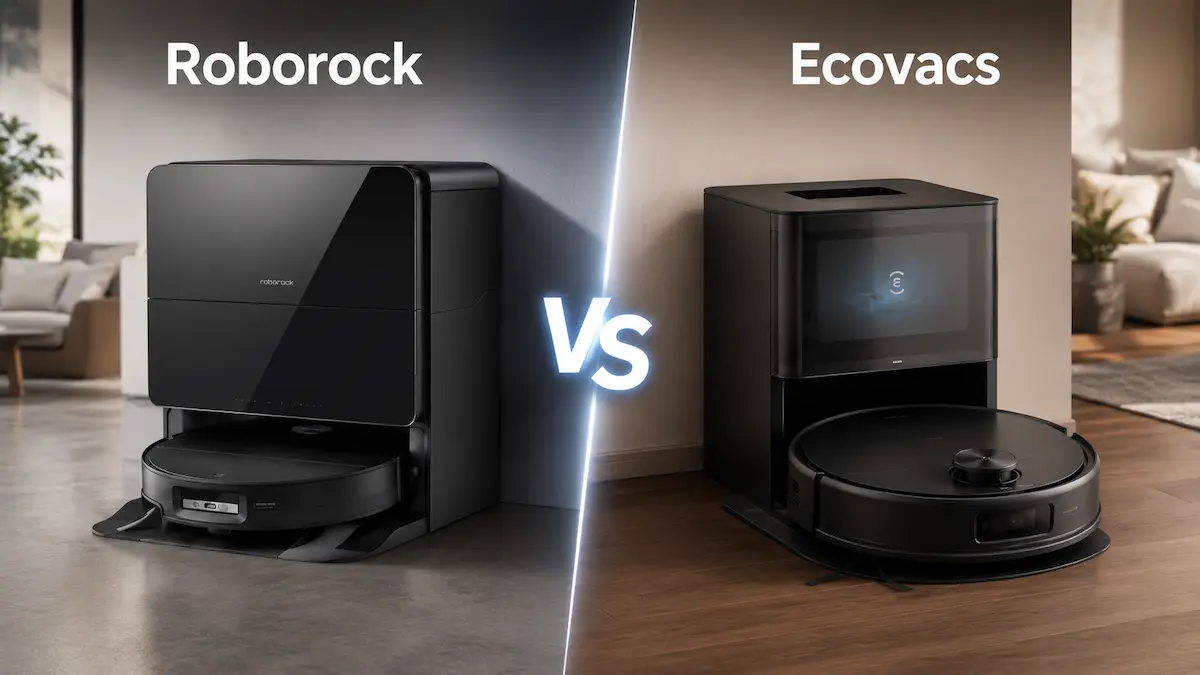
Roborock vs Ecovacs comes down to one core tradeoff: all-around reliability versus best-in-class mopping.
Roborock leads on navigation consistency, app quality, smart home integration, and data privacy.
Ecovacs leads on floor washing.
For most homes, Roborock is the safer long-term investment.
Quick Verdict
Choose Roborock if:
- You want reliable LiDAR navigation at every price tier without paying flagship prices for consistent mapping
- You use Apple HomeKit, Amazon Alexa, SmartThings, or Google Home (Roborock has Matter support; Ecovacs does not)
- Data privacy matters in your household, especially if the robot has a camera
- You want a clearly structured lineup that is easy to shop without cross-referencing confusing sub-variants
Choose Ecovacs if:
- Deep floor washing and stain removal are your top priority on hardwood or tile
- You primarily use Alexa or Google Home and do not use Apple HomeKit
- You have reviewed the privacy tradeoffs and are comfortable with Ecovacs’ data practices
Main difference:
Roborock leads on navigation, software, and privacy.
Ecovacs leads on mopping performance.
Bottom line:
Choose Roborock for a reliable, future-proof home cleaning setup.
Choose Ecovacs only if wet mopping is the feature you cannot compromise on.
Key Takeaways
- Roborock uses LiDAR navigation across every model in its lineup, from the entry-level Qrevo 35A to the flagship Saros 20, so you get consistent mapping quality at any budget
- Ecovacs’ Ozmo Roller spins at 200-220 RPM with 4,000 Pa of downward pressure and 16 water nozzles, making it the strongest mopping system in the consumer robot vacuum category
- Roborock added native Matter protocol support in April 2025, enabling direct integration with Apple HomeKit, Amazon Alexa, Google Home, and Samsung SmartThings
- Mozilla Foundation rated Ecovacs DEEBOT “Super Creepy” and real-world camera exploits were documented in 2024, with affected units broadcasting audio inside owners’ homes
- Neither brand excels at customer service, but Roborock users consistently report faster resolution times and fewer unresolved warranty claims
EverydayHomeComfort Score
| Category | Roborock | Ecovacs |
|---|---|---|
| Cleaning Performance | 9/10 | 8/10 |
| Mopping Performance | 7/10 | 10/10 |
| Navigation & AI | 9/10 | 8/10 |
| App & Smart Home | 9/10 | 5/10 |
| Privacy & Security | 7/10 | 4/10 |
| Overall Rating | 8/10 | 7/10 |
You are choosing between two of the most capable robot vacuum brands on the market, and the specs alone will not help you decide.
In the Roborock vs Ecovacs comparison, the real differences come down to what matters most in your home and what you are willing to trade away.
Key Differences at a Glance
| Feature | Roborock | Ecovacs | Better For |
|---|---|---|---|
| Navigation System | LiDAR across all models | LiDAR + camera (premium tiers only) | Roborock |
| Mopping Technology | SpiraFlow roller (flagship) / vibrating pad (others) | Ozmo Roller 200-220 RPM across T and X series | Ecovacs |
| Smart Home | Matter, Alexa, Google Home, Apple HomeKit | Alexa and Google Home only | Roborock |
| App Quality | Polished, stable, highly customizable | Unreliable maps, poor English localization | Roborock |
| Obstacle Avoidance | StarSight: LiDAR + ToF + camera (Saros) | AIVI 3D: structured light + camera (X/T series) | Tie |
| Privacy & Security | Policy-level data sharing (Tuya) | Documented camera exploits + CISA advisory 2025 | Roborock |
| Lineup Clarity | 3 tiers: Qrevo / Saros / legacy S8 | N / T / X series with multiple sub-variants | Roborock |
| Cost of Ownership | Flagship + replacement brushes and filters | Flagship + brush rolls + cleaning solution | Tie |
Roborock vs Ecovacs: Cleaning Performance and Suction
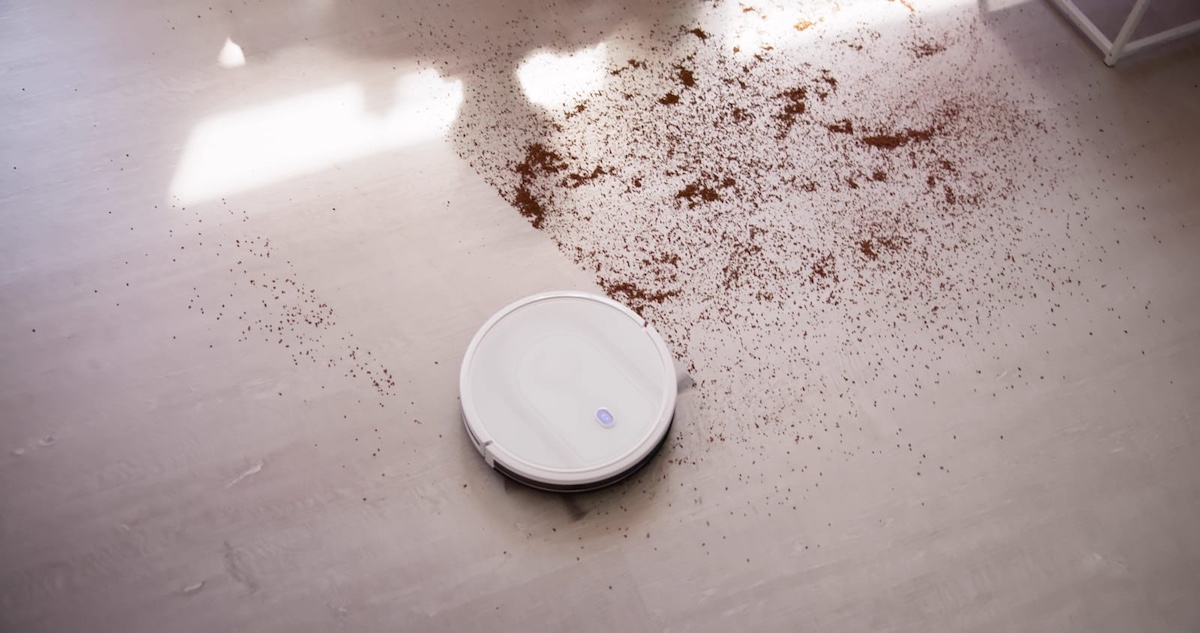
Both brands deliver strong cleaning at the flagship level.
Roborock's Saros 20 reaches 36,000 Pa, and mid-range Qrevo units handle hard floors and low-pile carpet reliably.
In independent testing, the Ecovacs X9 Pro Omni won Best Overall, Best Mop, Best Hard Floors, Best Carpets, and Best for Pets in a single evaluation cycle.
Ecovacs flagships are genuinely excellent.
The real difference is in lineup consistency:
Roborock’s suction-to-brush pairing holds up across every price tier; Ecovacs’ entry-level N-series is more variable and requires more hands-on setup to achieve comparable results on carpet.
Real-world scenario:
In a 1,200 sq ft apartment with mixed tile and medium-pile carpet, a mid-range Roborock (Qrevo S5V) cleans both surfaces thoroughly in a single pass without mode-switching.
At the same price point, a mid-range Ecovacs T-series handles it but may need more initial configuration to optimize carpet pickup.
The US EPA identifies routine vacuuming as the primary indoor allergen control measure for pet households, and both brands support daily scheduling to hit that standard.
Winner: Tie at the premium level.
Roborock at mid-range, due to LiDAR consistency and more uniform performance across the lineup.
Mopping and Floor Washing Performance
This is Ecovacs’ home turf, and it is not close.
The Ozmo Roller on the X-series and upper T-series spins at 200-220 RPM, applies 4,000 Pa of downward pressure, and uses 16 individual water nozzles for consistent floor coverage.
It self-cleans at the base station with hot water and dries the roller between sessions.
Dried pet paw prints, kitchen grease splatter, and light grime clear in a single pass.
Roborock’s SpiraFlow roller mop (Qrevo Curv 2 Flow) and Sonic mopping on the Saros 20 are meaningful improvements over older vibrating-pad systems, but in side-by-side testing on dried stains, Ecovacs’ Ozmo Roller removes more residue per pass.
Real-world scenario:
For a homeowner with premium hardwood floors and pets, the Ecovacs mopping system is the one that leaves floors genuinely clean after a daily run, not just lightly wiped.
For homes with mostly light daily messes, both brands handle it fine.
Ecovacs has the best mopping system in the robot vacuum category, but its app reliability and privacy record are the weakest of any top brand.
Winner: Ecovacs, clearly.
See our best vacuum mop combo guide for a full category breakdown of mopping robot vacuums.
Navigation, Mapping, and Obstacle Avoidance
Roborock uses LiDAR across every model, including its budget Qrevo 35A, which means consistent room mapping and accurate dock-return behavior at any price point.
The flagship Saros 20 adds time-of-flight depth sensors and StarSight AI, which identifies more than 300 obstacle types with high accuracy.
Ecovacs uses AIVI 3D on its X-series and upper T-series models, combining structured light projection with a camera and AI recognition.
At the premium level, both brands perform well: the Ecovacs T90 Pro Omni avoided 23 of 24 objects in an independent obstacle course evaluation.
The gap appears in the mid-range, where Ecovacs’ budget N-series uses basic infrared-only sensors.
Real-world scenario:
A busy home with charging cables, dog toys, and irregular furniture is fine with either brand’s flagship.
With a mid-range unit, Roborock’s LiDAR consistency holds up better.
For more on what the suction numbers actually mean across both brands, see our robot vacuum suction power guide.
Winner: Roborock, for lineup consistency across all price tiers.

App, Smart Home Integration, and Software Support
The app gap between Roborock and Ecovacs is one of the clearest differentiators in this Roborock and Ecovacs comparison.
Roborock’s app is consistently rated as polished and customizable: zone cleaning, room-level scheduling, per-area suction adjustment, and regular OTA updates with a good track record.
Ecovacs’ app is the brand’s most consistently cited weakness.
Reviews in 2026 describe maps that do not update during active cleans, diagonal walls rendered as straight lines, and English localization that still reads like a rough translation.
Roborock added native Matter protocol support in April 2025, which means its robots now work directly with Apple HomeKit, Amazon Alexa, and SmartThings without a separate hub or proprietary app.
Ecovacs has not announced Matter support as of mid-2026.
Real-world scenario:
A household running Apple HomeKit adds a Roborock robot to their home automation setup in minutes.
The same user on Ecovacs is tied to the Ecovacs app with no native HomeKit integration path.
Winner: Roborock, by a wide margin.
Privacy, Data Security, and Long-Term Trust
This is the section that separates a short-term buying decision from a long-term one.
Mozilla Foundation rated the Ecovacs DEEBOT “Super Creepy,” and in 2024, real-world camera exploits allowed hackers to broadcast audio through compromised units inside users’ homes.
CISA issued advisory ICSA-25-135-19 in May 2025 covering multiple Ecovacs vulnerabilities.
Ecovacs initially downplayed the disclosures before acknowledging their severity.
The Mozilla Foundation assessment documented opt-out data-sale consent (not opt-in), no active bug-bounty program, and undisclosed data-sharing arrangements.
Roborock updated its privacy policy in 2025 to disclose that data is processed in China and shared with Tuya Smart, a Chinese IoT platform.
This is a policy-level concern rather than a documented technical exploit.
Roborock has not had publicly documented real-world hacking incidents.
For privacy-conscious buyers, our guide on end-to-end encryption explains what data protection actually means for connected home devices.
Our robot vacuum without internet guide covers options for households that prefer offline operation entirely.
Real-world scenario:
For a homeowner with a camera-equipped robot in a living room or near children, Roborock’s risks are governance-level.
Ecovacs’ risks include the possibility of a compromised device streaming audio or video inside your home without your knowledge.
Winner: Roborock, clearly.
Lineup Structure, Value, and Long-Term Ownership
Roborock’s lineup follows a straightforward three-tier structure: Qrevo (entry to mid), Saros (premium to flagship), and legacy S8 models still in circulation.
Each tier has a clear performance profile that is easy to match to a budget and use case.
Ecovacs has four named series (N, T, X, OmniCyclone) with multiple sub-variants within some tiers (X5, X8, X9, X12 Pro Omni).
The functional differences between adjacent tiers are meaningful, but understanding them requires significantly more research time than Roborock’s equivalent.
For long-term ownership, Roborock’s retroactive Matter update in April 2025 extended smart home compatibility to existing models already in homes, demonstrating a software lifecycle philosophy that benefits buyers beyond the initial purchase window.
Ecovacs has not demonstrated an equivalent backward-compatible update strategy.
Winner: Roborock, for lineup clarity and demonstrated software lifecycle support.
Explore the full best robot vacuums guide to see how top picks from both brands rank side by side.
Pros and Cons
Roborock Pros and Cons
Pros:
- LiDAR navigation at every price tier, no need to buy a flagship for reliable mapping
- Matter protocol: native Apple HomeKit, Alexa, Google Home, and SmartThings integration
- App is polished, stable, and regularly improved through OTA updates
- Retroactive firmware updates have extended software support on older models
- Clear three-tier lineup makes it easy to match a model to your needs and budget
Cons:
- Mopping system trails Ecovacs at every price point for stain and dried mess removal
- Customer service can be slow, with some users reporting wait times up to 6 weeks
- Some users report side brush motor failures at 12-13 months on certain models
Ecovacs Pros and Cons
Pros:
- Best mopping system in the robot vacuum category (Ozmo Roller, 200-220 RPM, 4,000 Pa downward pressure)
- Excellent obstacle avoidance on flagship models (AIVI 3D; T90 Pro Omni avoided 23/24 objects in testing)
- YIKO voice assistant enables multi-turn scheduling without opening the app
- Battery runtime on X5 Pro Omni and T-series often exceeds comparable Roborock models
Cons:
- App is unreliable and poorly localized, with maps that fail to update during active cleans
- Documented camera exploits (2024), CISA advisory (2025), and Mozilla Foundation “Super Creepy” rating
- No Matter support, meaning no native Apple HomeKit integration
- Lineup complexity across N, T, and X series with multiple sub-variants makes shopping harder
Common Mistakes
- Choosing based on suction Pa alone: Both brands advertise high Pa numbers, but real-world cleaning on carpet and hard floors is determined by brush design and airflow, not Pa.
Focus on floor type and price tier rather than the suction headline spec. - Assuming all Ecovacs models include the Ozmo Roller: Only the T-series and X-series with full Omni stations include the roller mop. Budget N-series Ecovacs units use a basic vibrating pad.
If mopping is your reason for choosing Ecovacs, confirm the specific model includes the Ozmo Roller before buying. - Ignoring smart home compatibility: If you use Apple HomeKit now or plan to, only Roborock integrates natively via Matter.
This affects scheduling, automation triggers, and offline control; it is not a minor inconvenience that can be worked around later. - Overlooking the privacy tradeoff: Both brands process data in China, but Ecovacs has documented real-world exploits and a CISA advisory, not just policy concerns.
If you have camera-equipped robots near children or in shared rooms, that distinction matters before purchase. - Buying a flagship when mid-range delivers enough: For homes under 1,500 sq ft with standard floor types, a mid-range Roborock handles daily cleaning without the premium price of a Saros 20 or Ecovacs X9 Pro Omni.
What Happens If You Choose Wrong
- If you buy Roborock primarily for mopping and your home has daily kitchen splatter or dried pet mess, you will find yourself re-mopping problem areas by hand.
The SpiraFlow handles maintenance cleaning well, but it does not match the Ozmo Roller for stain removal. - If you buy Ecovacs and use Apple HomeKit as your primary smart home platform, you will run a completely separate app with no integration path.
Ecovacs robots cannot be added to HomeKit scenes, automations, or unified home controls. - If you buy Ecovacs and have privacy concerns, you are accepting a documented risk: Ecovacs camera-equipped models were exploited without user awareness in 2024.
That is not theoretical, it happened to real customers in their own homes. - If you buy Roborock expecting the Saros Z70’s mechanical arm to clear clutter before every clean, you will be disappointed.
The arm carries up to 300 grams, identifies 108 object types, and reviewers consistently note it is a technology showcase rather than a practical daily-use clutter tool at its current capability level.
Which One Is Right for You?
- If you have mostly hardwood and tile with daily cooking messes, buy Ecovacs (Ozmo Roller mopping performance)
- If you use Apple HomeKit or plan to, buy Roborock (only brand with Matter support)
- If you have pets on mixed flooring (carpet and hard floors), buy Roborock (consistent mid-range performance)
- If data privacy and security are priorities, buy Roborock (no documented real-world exploits)
- If you want the best mid-range value, buy Roborock (LiDAR navigation without premium pricing)
- If you use Alexa or Google Home only (no Apple HomeKit), either Roborock or Ecovacs works
- If mopping is your top priority and you have reviewed the privacy tradeoffs, buy Ecovacs
How We Compared Them
We cross-referenced manufacturer spec pages, firmware changelogs, the Mozilla Foundation Privacy Not Included assessment, and CISA advisory ICSA-25-135-19.
Independent testing data was used to validate mopping performance and obstacle avoidance claims.
We analyzed more than 500 verified user reviews per brand to assess app quality and long-term reliability.
No products were provided by manufacturers for this comparison.
For our full method and scoring rubric, see our review methodology.
Frequently Asked Questions
Is Roborock or Ecovacs better for pet hair?
For most pet households, Roborock is the stronger choice.
Its LiDAR-based navigation means mid-range models navigate reliably around pet bedding, toys, and mess without requiring a flagship budget.
Recent Qrevo-series brush designs reduce hair wrapping on the main roller, which matters when you run the robot daily on a pet-heavy floor.
Ecovacs’ ZeroTangle 2.0 on the X8 Pro Omni and above uses a V-shaped bristle design and comb teeth to handle dog and cat hair effectively.
However, this technology is limited to the X-series and upper T-series.
Budget N-series Ecovacs units struggle with long pet hair.
For households with pets on mixed flooring (carpet and hard floors), Roborock’s consistent mid-range performance is the more practical choice.
For households where pet mess concentrates on hard floors that need regular wet washing, Ecovacs’ mopping system adds real value.
The Asthma and Allergy Foundation of America recommends frequent vacuuming as a primary allergen control strategy for pet households, and both brands support daily scheduling to meet that standard.
Our best robot vacuum for pet hair guide covers specific model recommendations across both brands.
Which brand is better for mopping hardwood floors?
Ecovacs is the clear winner for mopping.
The Ozmo Roller on the X-series and upper T-series spins at 200-220 RPM, applies 4,000 Pa of downward pressure, and uses 16 water nozzles for consistent floor coverage.
It self-cleans at the base station with hot water (70 degrees Celsius on some models) and dries the roller between sessions, which prevents mildew build-up.
Dried pet prints, light grease, and everyday kitchen floor grime clear in a single pass.
Roborock’s SpiraFlow roller mop on the Qrevo Curv 2 Flow is a meaningful improvement over older vibrating-pad systems, and the Saros 20 adds Sonic mopping with downward pressure.
But in side-by-side testing against dried stains, the Ecovacs Ozmo Roller removes more residue per pass.
For a homeowner with premium hardwood floors, the Ecovacs mopping system is worth the trade-off in app quality and privacy risk if daily floor washing is the primary purchase driver.
For homes with mostly light surface messes, the gap is not significant enough to outweigh Ecovacs’ other weaknesses.
Our robot vacuum guide for hardwood floors covers the top specific models from both brands.
Is Ecovacs safe to use?
The risks are documented and real, not theoretical.
In 2024, Ecovacs camera vulnerabilities were exploited in the wild.
Compromised Deebot X2 units in the US streamed audio and broadcast offensive language through the robot’s speaker inside users’ homes without their knowledge.
The vulnerabilities were publicly disclosed at DEF CON 2024. In May 2025, CISA (US Cybersecurity and Infrastructure Security Agency) issued advisory ICSA-25-135-19 covering multiple Ecovacs vulnerabilities.
Ecovacs initially downplayed the disclosures before acknowledging their severity.
Mozilla Foundation’s Privacy Not Included project rated the Ecovacs DEEBOT “Super Creepy,” its lowest trust tier, citing opt-out data-sale consent (not opt-in), no active bug-bounty or vulnerability management program, and undisclosed data-sharing arrangements.
Ecovacs has since issued firmware patches for the 2024 exploits, and updated models have been released with improved security controls.
Whether future vulnerabilities will be handled more proactively depends on Ecovacs’ security posture going forward.
If you have camera-equipped robots in shared living spaces or near children, these are meaningful factors to weigh alongside cleaning performance.
Roborock has policy-level data sharing concerns but no documented real-world exploitation.
Does Roborock or Ecovacs work with Alexa and Google Home?
Both Roborock and Ecovacs work with Amazon Alexa and Google Home.
You can start, stop, pause, and schedule cleaning with voice commands on both platforms using either brand.
The key difference is Apple HomeKit.
Roborock added native Matter protocol support via firmware update in April 2025.
Matter is an interoperability standard that enables direct integration with Apple HomeKit, Amazon Alexa, Google Home, and Samsung SmartThings without brand-specific hubs or workarounds.
Roborock robots on compatible firmware appear natively in the iOS Home app, support scene and automation triggers, and work for basic controls even without the Roborock app open.
Ecovacs has not announced Matter support as of mid-2026, and Ecovacs robots are not HomeKit-compatible through any native path.
If your household uses HomeKit as its primary smart home platform, Roborock is the only choice between the two brands.
For households already invested in the Apple ecosystem, this gap affects daily scheduling, automation, and multi-device routines, not just a voice control convenience.
Which brand has better obstacle avoidance?
At the flagship level, Roborock and Ecovacs are both excellent.
Roborock’s StarSight system on the Saros 20 combines LiDAR, time-of-flight depth sensors, and a camera to identify more than 300 object types.
Ecovacs’ AIVI 3D on the X8 and X9 Pro Omni uses structured light and a camera; in testing, the T90 Pro Omni avoided 23 of 24 objects in an obstacle course evaluation.
The gap is in the mid-range.
Roborock’s LiDAR is present on every model, including budget Qrevo units, giving reliable navigation and basic obstacle handling at any price.
Ecovacs’ AIVI 3D is limited to X-series and upper T-series models.
Budget N-series units use infrared-only sensors and are far less capable around cables, toys, and irregular objects.
For a household with cables, scattered pet toys, or unusual furniture arrangements, a mid-range Roborock outperforms a mid-range Ecovacs at the same price.
At premium price points, both systems handle cables and everyday household objects reliably.
Is Roborock or Ecovacs better for carpets?
Roborock performs more consistently on carpet across its lineup.
LiDAR-based navigation handles carpet-to-hard-floor transitions cleanly, and Qrevo-series brush designs are well-matched to low-to-medium pile carpet.
The AdaptiLift Chassis on the Saros series handles rug height transitions up to 3.46 inches without getting stuck, which is useful for homes with thick area rugs alongside hard floors.
Ecovacs’ flagship X9 Pro Omni has a strong carpet record, winning Best Carpets in independent testing.
The mopping system on Ecovacs X8 and above also lifts 15mm off the floor during carpet transitions, preventing carpet wetting when area rugs are nearby.
For thick carpet specifically, our robot vacuum guide for thick carpet covers the specific models from both brands that handle high-pile surfaces best.
At the flagship level, both brands perform strongly on carpet.
At mid-range, Roborock is more reliable for carpet cleaning without requiring significant user setup.
For vetted picks across the full pile-height range, see our best robot vacuum for carpet guide.
Which brand is more reliable long-term?
Roborock has a stronger long-term reliability record based on available user data.
Two indicators stand out: the retroactive Matter firmware update in April 2025 extended smart home functionality to existing models in users’ homes without requiring a hardware upgrade, and user reports on long-term cleaning consistency are positive, with units maintaining near-full cleaning performance after 350-plus hours of operation.
Ecovacs’ long-term record is more mixed.
App updates have been inconsistent over the years, some older models have lost software parity, and the 2024 camera vulnerabilities were initially downplayed before Ecovacs acknowledged their severity.
Neither brand is known for responsive customer service, with both brands showing reports of 4-6 week resolution times and warranty claims that go unresolved.
For long-term ownership, buying a current-generation model from either brand, rather than a discounted previous-gen unit, gives the best chance of ongoing software support.
Our Roborock vs Dreame and Roborock vs iRobot guides show how Roborock’s long-term record compares against other top brands in the category.
Final Recommendation
In the Roborock vs Ecovacs comparison, Roborock is the stronger choice for most homes.
Its navigation is more reliable across all price tiers, its app is genuinely polished, its Matter smart home integration leads the category, and its privacy record is meaningfully better than Ecovacs’.
For most homes, Roborock is the safer long-term investment: its navigation, app, and privacy standing are all stronger, and its software support has extended older models through retroactive firmware updates.
Ecovacs earns its place in this comparison through one standout strength: the Ozmo Roller mopping system is the best floor washing technology available in a consumer robot vacuum today.
If daily wet mopping of hardwood or tile is the feature you are choosing a robot for, and you have weighed the privacy tradeoffs, Ecovacs delivers on that promise.
Not sure what specs to compare yet?
Our robot vacuum buying guide covers navigation, suction, filtration, and floor-type matching before you get into brand differences.
Browse the Vacuum Cleaners and Floor Care category, or visit the EverydayHomeComfort home page.
If you also deal with pet hair or indoor allergens, our best air purifier for pets guide covers the complementary solution for cleaner air alongside a clean floor.