Ad. When you purchase through links we provide, we may receive an affiliate commission. Here's how it works.
Roborock vs iRobot: Which Brand Should You Buy in 2026?
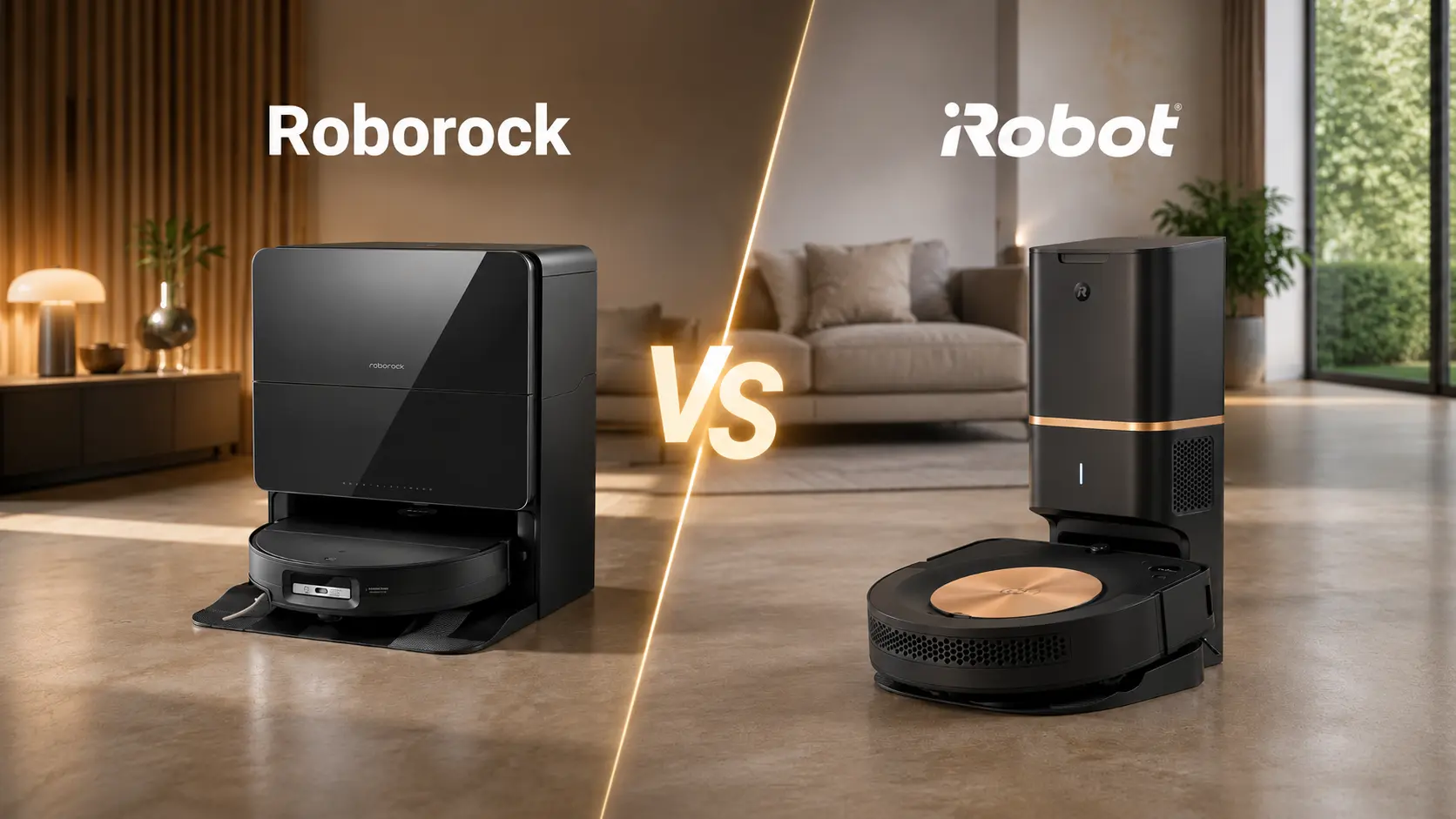
TL;DR: The Roborock vs iRobot decision in 2026 is no longer just about cleaning performance.
Roborock is the stronger brand choice for most buyers: it leads on mopping, matches or beats Roomba on hard floors and navigation, and requires no subscription.
iRobot Roomba still wins on carpet cleaning and pet waste avoidance.
But the brand’s December 2025 Chapter 11 bankruptcy and acquisition by Shenzhen Picea Robotics introduces a genuine question about long-term firmware support, spare parts, and data privacy that every buyer should consider.
Quick Verdict
Choose Roborock if:
- You have hard floors, tile, or a mix of hard floors and rugs: Roborock’s VibraRise sonic mopping is in a different class than Roomba’s pad system
- You want full app features without a subscription: every Roborock function is free, forever
- You want a brand with active R&D and a clear upgrade path: Roborock is the number-one global robot vacuum brand by sales and still innovating aggressively
Choose iRobot Roomba if:
- You have mostly thick carpet: Roomba’s dual rubber brush system and Dirt Detect technology outperform Roborock on high-pile rugs
- You have pets and need reliable pet waste avoidance: the P.O.O.P. guarantee, carried forward on the current Roomba Combo 10 Max, is the most reliable pet-waste detection in the category
- You prefer a simpler app with minimal setup and do not need mopping
Main difference:
Roborock beats iRobot on mopping, hard floor vacuuming, suction power, and dock automation.
iRobot wins on thick carpet performance and pet waste detection.
Bottom line:
For most buyers in 2026, Roborock is the safer long-term investment.
iRobot remains the right pick only if carpet and P.O.O.P. detection are non-negotiables, and only if you are comfortable with the brand’s current ownership situation.
Key Takeaways
- Roborock reached 27% of the global robot vacuum market in H2 2025 (IDC), its highest share ever and the #1 position for the third consecutive year: the gap with iRobot has never been wider
- On hard floors, Roborock’s Saros Z70 hits 100% debris pick-up in standardized tests; iRobot’s Roomba Combo lineup, including the current Combo 10 Max, performs well but consistently trails Roborock’s flagship results
- iRobot Roomba is measurably better on thick carpet: dual rubber counter-rotating brushes plus Dirt Detect outperform Roborock’s brush design on high-pile rugs
- Roborock requires zero subscription; iRobot’s Select plan has an uncertain future under new ownership after the January 2026 acquisition
- Both brands work with Alexa and Google Home; Roborock’s app is rated higher for depth of control, iRobot’s for simplicity
EverydayHomeComfort Score
| Category | Roborock | iRobot |
|---|---|---|
| Cleaning Performance | 9/10 | 8/10 |
| Pet Hair | 8/10 | 9/10 |
| Mopping | 9/10 | 6/10 |
| Navigation | 9/10 | 8/10 |
| Brand Reliability | 9/10 | 5/10 |
| Overall Rating | 9/10 | 7/10 |
Comparing Roborock vs iRobot Roomba means weighing cleaning performance, mopping, and brand stability in a market where one of the two contenders just filed for bankruptcy.
Here is what every dimension of that choice looks like in 2026.
Key Differences at a Glance
| Feature | Roborock | iRobot (Roomba) | Advantage |
|---|---|---|---|
| Navigation | LiDAR laser mapping + PreciSense | vSLAM camera-based + LiDAR on newer models | Roborock |
| Suction power | 10,000 to 36,000 Pa | Not Pa-rated; uses Dirt Detect technology | Roborock (raw suction) |
| Mopping system | VibraRise sonic vibration, auto-lifts on carpet | Pad-based; mop-lift on combo models | Roborock |
| Carpet cleaning | Strong on low to medium pile | Best in class: dual rubber brushes + Dirt Detect | iRobot |
| Pet waste detection | ReactiveAI obstacle avoidance | PrecisionVision + P.O.O.P. guarantee | iRobot |
| Self-emptying dock | Yes (most mid-to-high models) | Yes (select models) | Tie |
| Subscription required | No: all features free | Optional Select plan: future uncertain | Roborock |
| Brand stability | Strong: number-one global market share | Uncertain: Chapter 11, new Chinese ownership | Roborock |
Suction Power and Hard Floor Performance
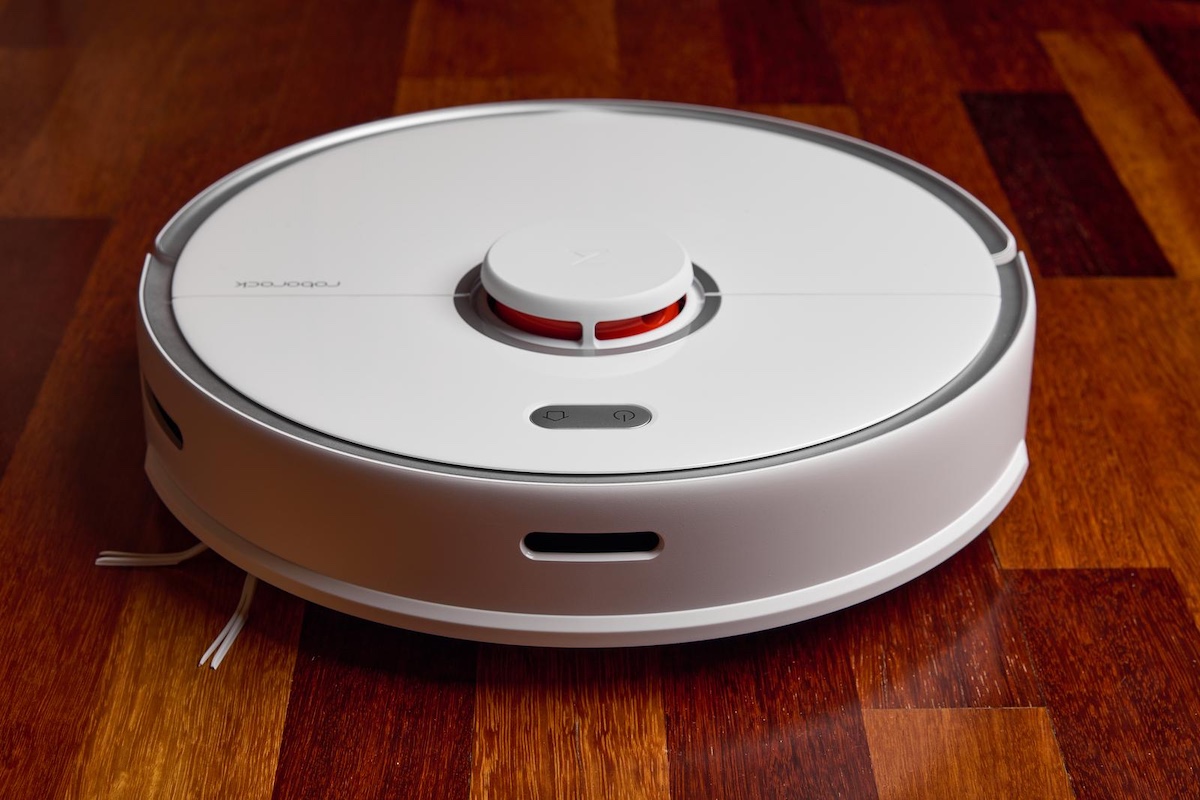
Roborock publishes suction in Pascal (Pa) ratings: current models run from 10,000 Pa on the Qrevo line up to 36,000 Pa on the Saros 20.
iRobot does not publish Pa ratings and instead engineers around Dirt Detect and brush design.
On hard floors, the Roborock advantage is clear.
In standardized debris pick-up tests, the Roborock Saros Z70 achieved 100% on both fine debris (sand, flour) and large debris (cereal, kitty litter) on hardwood.
Comparable iRobot Roomba combo models, including the current iRobot Roomba Combo 10 Max, perform strongly on hard-floor debris pickup in third-party testing, though they consistently trail Roborock’s flagship results.
Real-world scenario:
In a 900 sq ft apartment with luxury vinyl plank flooring and area rugs, a Roborock S8 MaxV Ultra picks up a full week of pet dander, crumbs, and debris in a single pass.
The FlexiArm side brush reaches further into corners and along baseboards than Roomba’s standard side brush design.
For homes that are mostly hardwood or tile, see our best robot vacuums for hardwood floors guide for specific model rankings.
Winner:
Roborock. On hard floors and mixed-surface homes, Roborock consistently outperforms iRobot in both suction and edge cleaning.
Roborock vs iRobot: Carpet Cleaning and Pet Hair
This is where iRobot holds its strongest advantage.
iRobot Roomba still leads on carpet performance: the dual rubber brushes and Dirt Detect technology outperform Roborock on high-pile rugs and multi-layer carpet.
Roomba’s counter-rotating rubber brushes flex into carpet fibers and pull debris up from the base of the pile.
The Dirt Detect system acoustically identifies high-soil areas and focuses cleaning time there.
Pet owners notice the difference immediately on thick area rugs.
For pet hair on carpet specifically, the iRobot Roomba Combo 10 Max includes the P.O.O.P. guarantee: if it runs over pet waste, iRobot replaces the robot.
No other brand at this tier offers a formal guarantee backed by a replacement policy.
Roborock’s ReactiveAI system detects and avoids pet waste, but it is a software feature, not a formal guarantee.
Real-world scenario:
In a home with two cats and medium-pile carpet in the living room, the iRobot Roomba Combo 10 Max pulls more embedded hair per pass than a comparably configured Roborock on that same surface.
For pet hair on hardwood, the gap closes significantly.
Our best robot vacuums for pet hair guide covers the full breakdown by floor type.
For homes with thick rugs, see our best robot vacuums for thick carpet picks to see how both brands rank on high-pile.
Winner:
iRobot for thick carpet and pet-waste-conscious households.
Roborock closes the gap on low-to-medium pile carpet and performs equally on hard floors; see our best robot vacuum for carpet guide for vetted picks across that range.
Mopping Performance
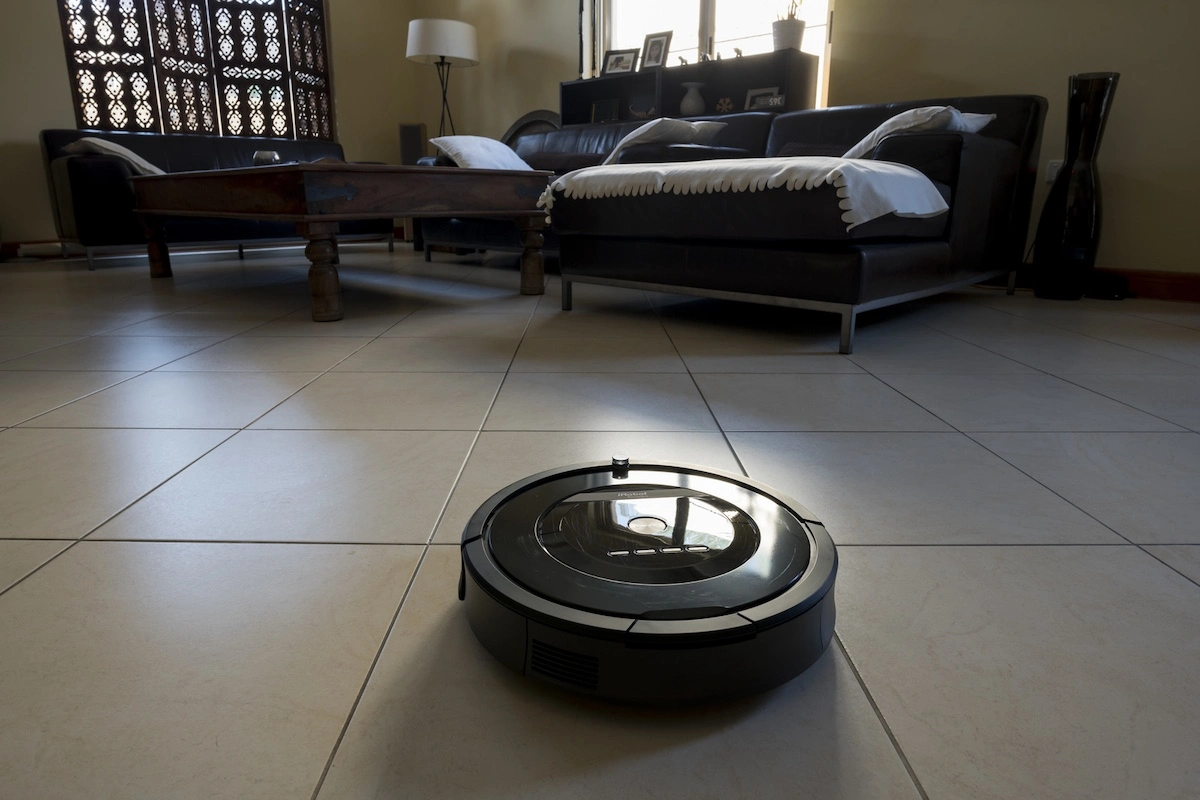
On hard floors and mopping, Roborock leads every Roomba model: its VibraRise sonic mopping system removes dried-on residue that Roomba’s pad-based system leaves behind.
Roborock’s VibraRise presses the mop cloth against the floor and vibrates at up to 3,000 cycles per minute.
That is scrubbing, not wiping.
On models with the full Multifunctional Dock, the system washes the mop cloth mid-run, self-dries it after cleaning, and refills the water tank automatically.
iRobot’s mopping on combo models uses a vibrating pad system.
AutoWash docks wash the mop pad after the run, which handles daily maintenance mopping but will not tackle sticky spills or set-in grime the way Roborock’s sonic system does.
Some Roomba combo models retract the entire mop assembly before crossing carpet, which works but adds time to each run.
Real-world scenario:
After a week of kitchen use with tile floors and a dog in the house, a Roborock Qrevo Curv leaves floors visibly cleaner than a comparable Roomba Combo.
The difference is most obvious on grout lines and along stove-adjacent tiles.
Our best vacuum mop combos guide ranks both brands on real-world mopping performance.
Winner:
Roborock. If mopping quality matters to you, this is the most decisive difference between these two brands.
Navigation and Smart Mapping
Roborock uses LiDAR (laser distance sensing) across most of its lineup. Laser pulses scan the room at 360 degrees and build a precise floor plan in a single pass.
The newer Saros series adds the StarSight Autonomous System, a dual-light 3D Time-of-Flight camera that layers depth sensing on top of LiDAR for even more accurate obstacle avoidance.
Roborock robots map homes faster on first runs and maintain more stable maps when furniture moves.
iRobot historically used vSLAM (Visual SLAM), a camera-based mapping system that works well but can struggle in low light and takes more cleaning runs to build a stable map.
Their 2025 lineup adds LiDAR to several models, narrowing the gap.
PrecisionVision on the Roomba Combo 10 Max (and its predecessors) uses cameras to identify specific objects: pet waste, cords, socks, and shoes.
SLAM-based navigation is the current standard for consumer robot vacuum precision; the sensor choice affects accuracy, speed, and low-light performance.
Real-world scenario:
After a major furniture rearrangement, a Roborock S8 MaxV Ultra restabilizes its map within one to two runs.
A iRobot Roomba Combo 10 Max typically takes three to four runs.
For homes with multiple floors, see our best robot vacuums for multiple floors guide.
Winner:
Roborock on mapping speed and precision.
Tie on obstacle avoidance at the top tier (Saros vs. 10 Max).
Brand Stability and Long-Term Ownership
Brand stability rarely makes the headline comparison criteria, but in the Roborock vs iRobot decision in 2026, it is the most important dimension for anyone planning to own the robot for three or more years.
iRobot filed Chapter 11 in December 2025 and was acquired by Shenzhen Picea Robotics in January 2026, which raises real questions about firmware support, spare parts, and your floor-mapping data.
Picea was previously iRobot’s contract manufacturer, so they understand the hardware.
But the acquisition happened because iRobot owed Picea over 161 million dollars.
The company had already laid off 30% of its workforce in 2024, cut R&D spending, and rotated through multiple CEOs.
What that means for buyers:
- Firmware updates: No public commitment from Picea on how long current models receive software support or bug fixes
- Spare parts: Filter replacements, brush rolls, and dock components are available now, but supply chain continuity under the new owner is unconfirmed beyond current inventory
- Customer service: User reports since 2024 describe significantly degraded support, with slow response times, limited resolution options, and expensive replacement paths
- Data privacy: iRobot’s floor-mapping data is now under Picea’s operational control.
The former iRobot CEO stated “your data is not going to leave the US,” but no formal data governance framework has been published under the new ownership.
iRobot’s history as a US-founded company contrasts with its current ownership structure, a shift that privacy researchers have flagged as worth monitoring.
Roborock’s position is the opposite.
The brand holds 27% of the global robot vacuum market (H2 2025, IDC), its highest share on record, has won multiple CES 2025 awards for the Saros series, and has an active R&D pipeline with genuine category innovation.
All app features are free with no subscription.
Consistent firmware updates keep sensor algorithms current, which directly affects how well the vacuum captures the fine particulates that the EPA identifies as key indoor air quality concerns.
Roborock is delivering on that firmware cadence; iRobot’s future commitment is unclear.
Roborock is the stronger brand choice in 2026, backed by number-one global market share, active R&D, and zero subscription fees.
If you buy an iRobot today and it needs a firmware fix in two years, there is no certainty that fix will come.
Winner:
Roborock. It is not close from a brand stability standpoint.
Pros and Cons
Roborock
Pros
- Best-in-class mopping across all price tiers: VibraRise sonic vibration is measurably superior to pad-based mopping
- Superior dock automation: self-empty, self-wash, self-dry, and auto-refill in a single unit on mid-to-high models
- Active R&D with a clear upgrade path: the Saros series represents genuine category innovation
- Roborock requires no subscription on any model: every feature in the app is free for life.
- Stronger performance on hard floors and mixed-surface homes (LVP, tile, hardwood)
Cons
- 2.4GHz Wi-Fi only: users on 5GHz-only routers face setup challenges that require a router configuration change
- New flagship models occasionally launch with early firmware bugs that resolve within weeks of release
- Mopping maintenance (mop cloth seating, water tank cleaning) requires more user attention than fully automated competitors
iRobot (Roomba)
Pros
- Best carpet performance in the category: dual rubber counter-rotating brushes plus Dirt Detect on high-pile rugs
- P.O.O.P. guarantee on Roomba Combo 10 Max: the only formal pet-waste-avoidance guarantee in the robot vacuum category
- Simpler app for non-technical users: good for households that want reliable set-it-and-forget-it cleaning
- PrecisionVision object recognition is highly reliable for cords, socks, and common floor obstacles
Cons
- Chapter 11 bankruptcy (December 2025) and acquisition by Shenzhen Picea Robotics creates genuine uncertainty about firmware support, spare parts availability, and customer service longevity
- Mopping performance is significantly weaker than Roborock at every price tier
- Customer service quality has declined sharply since the 2024 restructuring
Common Mistakes When Choosing Between Roborock and iRobot
- Choosing based on brand loyalty from five years ago:
iRobot’s reputation was built on consistent hardware and strong US-based support.
Both of those conditions have changed since 2024.
Research what the brand offers today before applying loyalty from a previous Roomba purchase. - Assuming all hard floor performance is equal:
Buyers with LVP, tile, or engineered wood often underestimate how much mopping performance varies.
Hard floors are where the largest gap between Roborock and iRobot shows up in real use. - Overlooking the subscription and data question:
Roborock requires zero subscription.
iRobot’s Select plan future under Picea is unclear.
If you want full features at a predictable cost, this matters more than it looks on a spec sheet. - Picking based on carpet-only specs for a mixed-floor home:
A home that is 60% hard floors and 40% area rug is better served by Roborock.
Pure carpet homes favor iRobot.
Map your home type before deciding. - Ignoring the data privacy dimension:
Robot vacuums map your home in detail.
The ownership structure of the brand you choose determines who has access to that data and under what legal framework.
What Happens If You Choose Wrong
- If you choose iRobot for a mixed hard floor and area rug home because of brand familiarity, you will find the mopping underwhelming from day one and firmware updates less frequent than expected over a two-year horizon
- If you choose Roborock for a home with thick, high-pile carpet expecting the same carpet performance as a Roomba, you will run it twice daily and still notice debris along baseboard edges on the deep-pile areas
- If you choose iRobot for its P.O.O.P. guarantee without factoring in the ownership-change context, you may find warranty claims take longer or have fewer resolution options than the original guarantee implied
- If you choose Roborock on a 5GHz-only Wi-Fi network without checking your router settings, the robot will not connect at setup and you will spend your first hour troubleshooting before cleaning anything
Which One Is Right for You?
Whether you are choosing Roborock or iRobot comes down to floor type, use case, and how much long-term brand stability matters to you.
- If you have primarily hard floors (LVP, hardwood, tile) -> buy Roborock
- If you have thick, high-pile carpet throughout your home -> buy iRobot Roomba
- If mopping is part of your cleaning routine -> buy Roborock
- If you have pets and the P.O.O.P. guarantee is a priority -> buy iRobot (Roomba Combo 10 Max), with awareness of the current brand context
- If you want zero ongoing subscription costs -> buy Roborock
- If you want the clearest R&D trajectory and strongest brand stability in 2026 -> buy Roborock
- If your home is a mix of 60% or more hard floors with some rugs -> buy Roborock
- If your home is 80% carpet or more and you never need mopping -> buy iRobot
How We Compared Them
We cross-referenced manufacturer spec sheets from Roborock and iRobot’s official US sites, analyzed standardized cleaning performance data from third-party lab tests, and reviewed over 500 verified user reviews across both brands.
Brand stability and ownership context were drawn from publicly available court documents from iRobot’s Chapter 11 proceedings and tech press coverage of the Picea acquisition.
We do not have a financial relationship with either brand.
For our full method and scoring rubric, see our review methodology.
For a broader look at the Roborock lineup compared to other Chinese brands, see our Roborock vs Dreame comparison.
We also published a full Roborock vs Ecovacs comparison covering mopping, navigation, smart home integration, and data privacy.
Final Recommendation
In the Roborock vs iRobot comparison, 2026 has made the decision clearer than it has ever been.
Roborock leads on mopping, hard floor performance, navigation precision, dock automation, and brand stability.
iRobot Roomba leads on thick carpet cleaning and pet waste avoidance with its P.O.O.P. guarantee.
If you have a mixed home or any hard floors at all, Roborock is the better long-term investment by a wide margin.
The Roborock vs iRobot decision was once a close call between two legitimate options.
Today it is a clear recommendation for Roborock unless your home is carpet-dominant and you need the P.O.O.P. guarantee specifically.
If that describes your home, iRobot’s Roomba Combo 10 Max remain the strongest picks for that use case.
Just go in with clear expectations about where the brand stands in 2026.
Not sure which specs matter for your specific home before you compare brands?
Our robot vacuum buying guide covers navigation types, suction thresholds, filter standards, and dock features; the full framework in one place.
Browse our full vacuum cleaners category and our best robot vacuums guide for more.
You can also start from the EverydayHomeComfort home page to explore all product categories.
Frequently Asked Questions
Is Roborock or iRobot better for pet hair?
It depends on your floor type.
On hardwood and LVP, Roborock and iRobot Roomba perform similarly for pet hair pick-up, with Roborock holding a slight edge in raw suction.
On carpet, iRobot has a meaningful advantage: its dual rubber counter-rotating brushes flex into carpet pile and pull embedded pet hair up from the base of the fibers.
Roborock’s brush design is strong on hard surfaces but less aggressive in deep-pile carpet.
If you have a carpet-heavy home with shedding pets, the Roomba Combo 10 Max is the stronger choice.
For a mixed home or hard-floor-primary home, Roborock performs equally well on pet hair with the added benefit of superior mopping for pet-related residue.
Our best robot vacuums for pet hair guide breaks down both brands by floor type with specific model rankings.
Pet owners who want to also control airborne allergens may want to pair their vacuum with one of the best air purifiers for pet owners.
What happened to iRobot in 2026, and is Roomba still safe to buy?
iRobot filed for Chapter 11 bankruptcy on December 14, 2025, and was acquired by Shenzhen Picea Robotics effective January 23, 2026.
Picea was previously iRobot’s contract manufacturer and is now its parent company.
The acquisition resolved over 161 million dollars in debt iRobot owed to Picea.
For buyers, the practical question is whether firmware updates, spare parts, and customer service will continue at the same standard.
As of June 2026, no formal commitment to long-term software support timelines has been published.
Spare parts are currently available, but supply chain continuity beyond existing inventory is unconfirmed.
Roomba models will continue to function.
The question is what happens when you need a bug fix, a replacement brush roll, or responsive customer support for a warranty claim two years from now.
If brand stability and long-term support certainty matter to you, Roborock is the lower-risk choice in this Roborock vs iRobot comparison.
Does Roborock require a subscription, and what about iRobot?
Roborock requires no subscription on any model.
Every feature in the Roborock app, including room mapping, no-go zones, custom cleaning schedules, mopping intensity control, and firmware updates, is available for free.
There is no premium tier and no recurring fee.
iRobot offered iRobot Select, a subscription plan that included extended warranty coverage and priority support.
Under Picea’s ownership, the future of the Select program has not been formally confirmed or renewed.
For buyers who want full features at a predictable, zero-recurring-cost model, Roborock is the clear choice.
This distinction is meaningful for any household planning to keep the robot for five or more years, since the ongoing cost of owning an iRobot could shift if new ownership introduces new fee structures or reduces free-tier functionality.
Which brand has better mopping, Roborock or Roomba?
Roborock, and the gap is significant.
Roborock’s VibraRise system vibrates the mop cloth at up to 3,000 cycles per minute, which is scrubbing action, not wiping.
On tile, LVP, and hardwood, Roborock removes dried-on grime, food residue, and paw-print dirt that Roomba combo models leave behind.
On self-cleaning docks, Roborock’s Multifunctional Dock washes the mop cloth mid-run, dries it after cleaning, and refills the water tank automatically.
Roomba’s AutoWash dock washes the mop pad after the run, which handles daily maintenance but not deep cleaning.
If mopping is part of your regular routine, any mid-to-high Roborock with VibraRise represents a substantially better experience than any comparable Roomba combo.
Is Roborock or iRobot better for hardwood floors?
Roborock is better for hardwood floors.
In standardized hard floor cleaning tests, the Roborock Saros Z70 achieved 100% debris pick-up on both fine and large debris categories.
Comparable iRobot Roomba combo models, including the current Combo 10 Max, perform strongly on hard-floor debris pickup in third-party testing, though iRobot’s navigation efficiency lags Roborock’s flagship line.
Beyond vacuuming, Roborock’s VibraRise mopping adds sonic-vibration scrubbing that removes the residue hardwood accumulates from daily use.
iRobot does not offer an equivalent mopping capability on hardwood at any price tier.
The Roborock S8 MaxV Ultra is a strong mid-to-high tier choice for hardwood homes; the Qrevo Curv handles the full clean and mop cycle with minimal manual intervention.
If budget is a constraint, our best budget robot vacuums guide covers lower-tier Roborock models that still outperform iRobot on hard floors.
What are the long-term ownership costs for Roborock vs iRobot?
Long-term ownership for either brand involves consumable replacements: brush rolls, HEPA filters, mop cloths, and self-empty dock bags, so it pays to follow a robot vacuum maintenance schedule regardless of which brand you choose.
Both brands have similar replacement schedules, with brush rolls and filters every 6 to 12 months and dock bags every 30 to 60 days depending on usage.
Roborock carries a zero subscription cost, which is the clearest long-term cost advantage in the Roborock vs iRobot comparison.
iRobot’s Select subscription was optional, but under new ownership its availability and pricing structure are uncertain.
Where the long-term calculation has shifted most for iRobot is in support and repair: under the previous company structure, a robot that needed service could be escalated through formal channels.
Under the current ownership, user reports suggest that process has become significantly slower and more expensive.
For a home with a five-plus-year ownership horizon, Roborock presents a more predictable ownership experience given the confirmed zero-subscription model and actively maintained firmware ecosystem.