Ad. When you purchase through links we provide, we may receive an affiliate commission. Here's how it works.
Best Robot Vacuum for Large House (2026 Picks)

TL;DR: The best robot vacuum for large house cleaning is the Roborock Saros 20: it recharges and resumes where it left off, maps multiple floors, climbs thresholds up to 4.5 cm, and its dock empties, refills, and hot-water washes the mop on its own. If pet hair is your bigger concern, the Ecovacs Deebot X9 Pro Omni can run up to 150 days between manual empties.
Quick Picks: Top Robot Vacuums for Large Homes
- Roborock Saros 20: best overall for large homes; recharge-and-resume, multi-floor mapping, and a fully automated hot-water dock.
- Ecovacs Deebot X9 Pro Omni: best for large homes with pets; anti-tangle brush and a 150-day auto-empty interval.
- Dreame L40 Ultra: best coverage per charge, up to 1,948 sq ft in a single run.
- Roborock Qrevo Curv 2 Flow: best for mopping large homes that mix hard floors and area rugs.
- Eufy Omni C20: best value pick that still meets the large-home feature bar.
Key Takeaways
- Advertised “coverage per charge” numbers vary widely: some models cover under 800 sq ft in real-world use while others clear nearly 2,000 sq ft, even with similar battery ratings.
- Auto-empty dock capacity is the real large-home differentiator, with top models ranging from 60 days to 150 days between manual emptying.
- All five robots in this guide use LiDAR navigation rather than camera-only vSLAM, which is what allows them to store multiple floor maps reliably.
- Auto-recharge-and-resume is a non-negotiable feature for any home over roughly 1,500 sq ft on a single level, since no robot on this list finishes that much space in one charge without pausing.
If you’re staring at 2,500+ square feet of open floor plan or a three-story layout and wondering whether any robot vacuum can actually keep up, you’re asking the right question.
The best robot vacuum for large house cleaning isn’t just the one with the biggest suction number on the box, it’s the one that can map your whole home accurately, cover the most ground per charge, and go the longest between you having to empty its bin.
Here’s how the five best options for big homes compare, and how to pick the right one for your layout.
How to Choose the Best Robot Vacuum for a Large House
Picking the best robot vacuum for a large house comes down to three things: how much floor space it can cover before needing a recharge, how long it can run before you have to empty it, and whether its navigation can handle multiple rooms and floors without getting confused.
Suction power matters less than you’d think once a robot is already strong enough to lift embedded debris.
- Match coverage claims to your actual square footage, not the number on the box.
Manufacturers test in open, obstacle-free rooms; real homes have furniture, rugs, and doorways that slow a robot down. - Prioritize auto-recharge-and-resume so the robot finishes the whole home in one cleaning cycle instead of stopping partway through.
- Check how many floor maps the robot can store if you live in a multi-level home.
Three to four saved maps is the practical minimum. - Look at dock capacity in days, not liters. A 60-day interval versus a 150-day interval is the difference between monthly and twice-a-year maintenance.
Read our guide if you are interested in understanding how robot vacuum suction power actually works.
How Much Square Footage Can a Robot Vacuum Actually Cover?
This is the number that matters most for a large house, and it’s also the number brands are least consistent about reporting.
Two robots with nearly identical battery capacity can cover wildly different amounts of floor space depending on suction mode, mopping usage, and how much of the home is carpet versus hardwood.
- Under 1,500 sq ft, single level: almost any of the five picks here will finish in one charge.
- 1,500 to 2,500 sq ft, single level: look for auto-recharge-and-resume plus a high coverage-per-charge figure, like the Dreame L40 Ultra’s 1,948 sq ft.
- 2,500+ sq ft or multiple levels: plan on the robot recharging and resuming at least once per full cleaning cycle, and make sure it stores a separate map per floor.
Real-world coverage per charge varies dramatically between models with similar advertised runtimes, so a robot rated for 200 minutes can still cover less floor space than one rated for 194.
The Dreame L40 Ultra, for example, reaches up to 1,948 sq ft on a single charge, while the Ecovacs Deebot X9 Pro Omni, despite a longer advertised runtime, has been measured closer to 500 to 800 sq ft per charge in real-world use.
Why this matters: if you only check the advertised runtime in minutes, you can end up with a robot that stops mid-cleaning far more often than you expected.
Why Auto-Empty Dock Capacity Matters More Than Suction in Big Homes
A large house generates more dust, hair, and debris per cleaning cycle simply because there’s more floor to cover.
That fills the onboard dustbin faster, which means the auto-empty dock’s capacity, not the robot’s suction rating, decides how often you’re involved in the process.
Dustbin and auto-empty dock capacity matter more than raw suction power in a large house, because the real bottleneck is how often you have to touch the robot, not how strong one pass feels.
The Ecovacs Deebot X9 Pro Omni’s dock holds enough debris to go up to 150 days without emptying, while the Eufy Omni C20 needs attention roughly every 60 days.
Both will pick up dirt effectively; the difference is entirely about how much time you get back.
Check our best self-emptying robot vacuums guide to get deeper on this topic.
LiDAR vs. vSLAM Navigation for Multi-Room, Multi-Floor Homes
Robot vacuums navigate using one of two main technologies: LiDAR, which uses laser pulses to build a precise map of the room, or camera-based vSLAM (visual simultaneous localization and mapping), which relies on a camera and visual landmarks. Both can work in a single small room.
Large, multi-room, multi-floor homes are where the difference shows up.
LiDAR navigation is effectively a requirement for large homes, since it is the only mapping technology reliable enough to store and switch between multiple floor plans without re-mapping.
All five robots in this guide use LiDAR for this reason.
If your home spans more than one level, prioritize a model that stores at least 3-4 separate floor maps so you are not re-mapping every time you carry the robot upstairs.
The Dreame L40 Ultra can store up to four floor maps, which covers most three-story homes with room to spare.
Robot Vacuum Comparison for Large Homes
| Product | Best For | Key Spec | Auto-Empty Interval |
|---|---|---|---|
| Roborock Saros 20 | Best overall for large homes | 6,400mAh battery, recharge-and-resume, multi-floor mapping, 4.5 cm threshold climbing | Not stated in Roborock’s manual or help center |
| Ecovacs Deebot X9 Pro Omni | Best for large homes with pets | 16,600Pa suction, ZeroTangle anti-hair-wrap | Up to 150 days |
| Dreame L40 Ultra | Best coverage per charge | Up to 1,948 sq ft per charge, 4 stored floor maps | Not disclosed publicly |
| Roborock Qrevo Curv 2 Flow | Best for mopping mixed floors and rugs | 20,000Pa suction (manufacturer claim), roller mop with 15 N downward pressure, maps up to 4 floors | Up to 65 days |
| Eufy Omni C20 | Best value pick | 7,000Pa suction, auto-recharge-and-resume | Up to 60 days |
Roborock Saros 20: Best Overall for Large Homes

Roborock Saros 20
- 𝗜𝗻𝗱𝘂𝘀𝘁𝗿𝘆-𝗟𝗲𝗮𝗱𝗶𝗻𝗴 𝗢𝗯𝘀𝘁𝗮𝗰𝗹𝗲-𝗖𝗿𝗼𝘀𝘀𝗶𝗻𝗴 𝗣𝗼𝘄𝗲𝗿: AdaptiLift Chassis 3.0 dynamically…
- 𝗨𝗹𝘁𝗿𝗮-𝗣𝗿𝗲𝗰𝗶𝘀𝗲 𝗡𝗮𝘃𝗶𝗴𝗮𝘁𝗶𝗼𝗻 𝘄𝗶𝘁𝗵 𝗙𝗲𝘄𝗲𝗿 𝗠𝗶𝘀𝘀𝗲𝗱 𝗦𝗽𝗼𝘁𝘀: Powered by…
- 𝗖𝗹𝗲𝗮𝗻𝘀 𝗨𝗻𝗱𝗲𝗿 𝟯.𝟭𝟯 𝗶𝗻 𝗙𝘂𝗿𝗻𝗶𝘁𝘂𝗿𝗲 𝘄𝗶𝘁𝗵 𝗘𝗮𝘀𝗲: With its ultra-slim design, Saros 20 glides under…
A flagship Roborock robot vacuum and mop built for the three things a big house demands: finishing the job across recharges, keeping track of more than one floor, and maintaining itself between runs. It also leads our best robot vacuum for carpet guide.
Why we picked it:
- Recharge-and-resume is built in: according to the Saros 20 user manual, the robot returns to the dock when the battery runs low and picks up where it left off, running on a 14.4 V, 6,400mAh battery.
- 3D time-of-flight laser navigation (solid-state, with no spinning turret) recognizes over 300 obstacle types, and SmartPlan 3.0 supports multi-floor mapping (per Roborock’s Saros 20 help center).
- The AdaptiLift Chassis 3.0 climbs single thresholds up to 4.5 cm and double-layer thresholds up to 4.5 + 4.3 cm (manufacturer claim), which matters in big homes with many room-to-room transitions.
- The dock auto-empties, refills water, doses detergent, washes the mops with 100°C (212°F) water, and hot-air dries them at 55°C (131°F) (manufacturer claim).
Roborock does not publish a runtime, coverage-per-charge figure, or saved-map count for the Saros 20, so plan on at least one recharge-and-resume stop in a large home. If single-charge coverage is your deciding factor, the Dreame L40 Ultra below is the better match.
Real-world scenario:
You’ve got a 2,800 sq ft two-story colonial with hardwood on the main floor, carpet upstairs, and raised thresholds between rooms. The Saros 20 keeps a map for each floor, rolls over the transitions, and heads back to the dock mid-job to recharge before finishing the main floor. Upstairs, you carry it up and start the run yourself, since a single dock serves only one floor.
Pros:
- The dock automates emptying, refilling, detergent dosing, hot-water mop washing, and drying.
- Owners consistently praise its mapping and room splitting, the part that matters most across many rooms.
- Tall threshold climbing means fewer stuck-robot rescues between rooms.
Cons:
- No published runtime, coverage, or saved-map count, so you can’t size it against your square footage on paper.
- A recurring pattern in owner reviews: error messages and mop-module faults showing up in the first weeks to months.
- Some owners report it getting stuck on new or thick carpet, and the auto-empty cycle is loud.
Best for: Homeowners with premium floors who want the most hands-off large-home setup available, and busy professionals who want to interact with the robot as little as possible.
Already own the Roborock S8 MaxV Ultra? It still handles large homes well, and our Roborock S8 MaxV Ultra review stays up for owners.
Ecovacs Deebot X9 Pro Omni: Best for Large Homes with Pets

Ecovacs Deebot X9 Pro Omni
- 𝟭𝟲,𝟲𝟬𝟬𝗣𝗮 𝗕𝗟𝗔𝗦𝗧 𝗦𝗨𝗖𝗧𝗜𝗢𝗡 — 𝗗𝗘𝗘𝗣𝗘𝗥 𝗖𝗔𝗥𝗣𝗘𝗧 𝗖𝗟𝗘𝗔𝗡𝗜𝗡𝗚: Tackle embedded dust, crumbs and…
- 𝗧𝗥𝗜𝗣𝗟𝗘 𝗟𝗜𝗙𝗧 𝗦𝗬𝗦𝗧𝗘𝗠 — 𝗖𝗟𝗘𝗔𝗡 𝗘𝗔𝗖𝗛 𝗙𝗟𝗢𝗢𝗥 𝗧𝗛𝗘 𝗥𝗜𝗚𝗛𝗧 𝗪𝗔𝗬: The mop, side brush…
- 𝗖𝗔𝗥𝗣𝗘𝗧-𝗦𝗠𝗔𝗥𝗧 𝗖𝗟𝗘𝗔𝗡𝗜𝗡𝗚 — 𝗣𝗢𝗪𝗘𝗥𝗙𝗨𝗟 𝗣𝗜𝗖𝗞𝗨𝗣, 𝗟𝗘𝗦𝗦 𝗠𝗢𝗜𝗦𝗧𝗨𝗥𝗘: BLAST…
$799.99

Check Today’s Price on Amazon
An Ecovacs Deebot built around the longest hands-free maintenance interval on this list and pet-specific hair handling.
Why we picked it:
- ZeroTangle 3.0 anti-hair-wrap system designed specifically to stop long pet hair from tangling the brush roll.
- 16,600Pa Blast suction for deep pile carpet and embedded pet dander.
- Omni Station auto-empties into a 3L bin and keeps the robot maintenance-free for up to 150 days, the longest interval of any pick here.
Real-world scenario:
You’ve got two shedding dogs and 2,200 sq ft spread across an open-plan main floor plus a finished basement.
The X9 Pro Omni handles both zones on separate maps, the ZeroTangle brush keeps fur from choking the roller, and the dock genuinely goes months without you opening it.
Pros:
- Very strong suction and airflow for pet hair and ground-in debris.
- Quieter operation than several comparable competitors.
- 150-day auto-empty interval is best-in-class among the five picks.
Cons:
- Real-world coverage per charge (roughly 500 to 800 sq ft) trails its advertised runtime.
- Mop roller can leave floors wetter than expected.
- Dock can accumulate hair and dirt over time if not periodically wiped down.
Best for:
Pet owners in large homes who want less shedding cleanup and less hands-on time with the robot.
For a broader overview on models that are ideal if you have pets, check our best robot vacuum for pet hair guide.
Dreame L40 Ultra: Best Coverage Per Charge
Sale
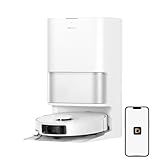
Dreame L40 Ultra
- High-Powered 25,000Pa Suction Performance: Powerfully clean hard floors and carpets with 25,000Pa suction…
- Tackle Corner Messes with Ease: L40 Ultra Gen 2 extends its brush and mop to reach corners and under…
- Less Manual Maintenance: All-in-one self-cleaning dock streamlines the autonomous cleaning experience…
$499.98
Check Today’s Price on Amazon
A Dreame flagship built to maximize how much ground it covers before it needs to recharge.
Why we picked it:
- Covers up to 1,948 sq ft (181 m²) on a single charge, the best coverage-per-charge figure of the five picks.
- Stores up to four floor maps, ideal for three-story homes.
- LiDAR plus 3D structured light and an RGB camera for precise obstacle avoidance at speed.
Real-world scenario:
You’ve got a sprawling single-level 1,900 sq ft ranch with an open floor plan and a couple of area rugs.
The L40 Ultra can realistically clear the whole home in one charge, lifting its mop pads automatically when it crosses onto carpet.
Pros:
- Best-in-test coverage per charge among the five picks, well-suited to sprawling single-level layouts.
- Automatic mop pad lift on carpet is well-liked by owners.
- Strong pet-hair avoidance and handling reported by multiple owners.
Cons:
- Weaker, less consistent performance on patterned or thick carpet.
- Larger debris and loose cables can jam the roller and trigger errors.
Best for:
Large single-level homes and owners who want maximum coverage without a mid-cleaning recharge stop.
Roborock Qrevo Curv 2 Flow: Best for Mopping Mixed Floors and Rugs

Roborock Qrevo Curv 2 Flow
- 𝐒𝐩𝐢𝐫𝐚𝐅𝐥𝐨𝐰 𝐑𝐞𝐚𝐥-𝐓𝐢𝐦𝐞 𝐒𝐞𝐥𝐟-𝐂𝐥𝐞𝐚𝐧𝐢𝐧𝐠 𝐌𝐨𝐩: The robot vacuum delivers spotless floors with eight precise…
- 𝟐𝟎,𝟎𝟎𝟎 𝐏𝐚 𝐏𝐨𝐰𝐞𝐫𝐟𝐮𝐥 𝐒𝐮𝐜𝐭𝐢𝐨𝐧 & 𝐓𝐚𝐧𝐠𝐥𝐞-𝐅𝐫𝐞𝐞 𝐃𝐞𝐬𝐢𝐠𝐧: This robot vacuum and mop delivers…
- 𝐀𝐈-𝐏𝐨𝐰𝐞𝐫𝐞𝐝 𝐃𝐢𝐫𝐓𝐞𝐜𝐭 & 𝐃𝐫𝐲-𝐰𝐞𝐭 𝐒𝐭𝐫𝐚𝐭𝐞𝐠𝐲 𝐂𝐥𝐞𝐚𝐧𝐢𝐧𝐠: Equipped with intelligent sensors, the…
Roborock’s first robot vacuum with a roller mop instead of spinning pads, and a strong fit for large homes where hardwood or tile and area rugs share the same rooms. If you’ve been mopping around your rugs by hand, this is the robot that handles those transitions for you.
Why we picked it:
- The SpiraFlow roller mop cleans itself as it turns, presses down with 15 N of force, and extends to reach along edges (manufacturer claim, per Roborock’s CES 2026 announcement).
- Rugs stay dry: according to the Qrevo Curv 2 Flow user manual, the robot retracts the roller on carpet, and a roller cover slides out automatically when it rolls onto a rug and retracts when it rolls off.
- LiDAR navigation saves maps for up to 4 floors (manufacturer claim), and recharge-and-resume runs on a 14.4 V, 5,200mAh battery: when the battery runs low, the robot returns to the dock and resumes where it left off (user manual).
- The dock auto-empties into a bag for up to 65 days hands-free, washes the roller with water heated up to 75°C (167°F), dries it with 55°C (131°F) warm air, and refills the robot’s water tank (manufacturer claims).
- Roborock rates suction at 20,000Pa (manufacturer claim) and says its main and side brushes are SGS-certified for zero hair tangling.
Roborock publishes no runtime or coverage-per-charge figure for the Curv 2 Flow, so in a large home, plan on at least one recharge-and-resume stop per full clean.
Real-world scenario: Your 2,400 sq ft home has hardwood in the kitchen and hallways and area rugs in the living room and bedrooms. The Curv 2 Flow mops the hardwood, covers its roller as it rolls onto each rug, vacuums the rug, and picks up mopping again on the other side. You don’t have to roll up the rugs or draw no-go zones around them first.
Pros:
- Early owners with multiple pets report no hair tangling on the brushes a few months in.
- The roller mop leaves no swirl marks, a common gripe with spinning-pad mops.
- Mapping, navigation, and quiet running get regular praise from owners.
Cons:
- At 11.9 cm (4.7 in) tall (manufacturer claim), it’s no low-profile robot, and owners often report it can’t fit under low sofas, beds, or cabinet toe-kicks. If low furniture is your main problem, the slimmer Eufy Omni C20 below is the better pick.
- Some early owners find the app less intuitive than expected, and Roborock is still fixing software bugs through updates.
- It only connects to 2.4 GHz Wi-Fi (user manual), so a 5 GHz-only mesh network needs its 2.4 GHz band turned on.
Best for: Large homes that mix hard floors and area rugs, and pet owners who want mopping and tangle-free vacuuming from one robot.
Already own the Roborock Qrevo Curv S5X? Our Roborock Qrevo Curv S5X review stays up for owners.
Eufy Omni C20: Best Value for Large Homes
Sale

Eufy Omni C20
- 𝐀𝐥𝐥-𝐢𝐧-𝐎𝐧𝐞 𝐒𝐭𝐚𝐭𝐢𝐨𝐧: 𝐀𝐮𝐭𝐨 𝐄𝐦𝐩𝐭𝐲, 𝐌𝐨𝐩 𝐖𝐚𝐬𝐡 & 𝐃𝐫𝐲: The Omni Station automatically empties…
- 𝐕𝐚𝐜𝐮𝐮𝐦 𝐚𝐧𝐝 𝐌𝐨𝐩 𝐚𝐭 𝐭𝐡𝐞 𝐒𝐚𝐦𝐞 𝐓𝐢𝐦𝐞: The C20 robot vacuum and mop combo vacuums and mops simultaneously via the app for…
- 𝟕,𝟎𝟎𝟎 𝐏𝐚 𝐃𝐞𝐞𝐩 𝐂𝐥𝐞𝐚𝐧 + 𝐍𝐨 𝐌𝐨𝐫𝐞 𝐇𝐚𝐢𝐫 𝐓𝐚𝐧𝐠𝐥𝐞𝐬: Boost IQ automatically adjusts suction up to…
An Eufy Omni C20 that hits the large-home feature bar (self-empty, auto-resume, no-go zones) in a simpler, more compact package than the other four picks.
Why we picked it:
- Auto-recharge-and-resume ensures the robot finishes the whole floor even in larger layouts.
- 3.35-inch ultra-slim profile for under-furniture access.
- Omni Station empties into a 3.1L bag good for up to 60 days and self-washes and dries mop pads.
Real-world scenario:
You’re furnishing your first large home and want a simpler, no-frills setup, with a long-haired dog and roughly 2,000 sq ft to cover.
The Omni C20 handles the fur, resumes cleaning after recharging until the floor is done, and only needs attention once every couple of months.
Pros:
- Delivers the full large-home feature set without unnecessary extras.
- Handles long-haired dog fur well with sufficient suction.
- Mopping performance punches above what its compact size suggests, and warranty support has been smooth for owners.
Cons:
- No 5GHz Wi-Fi support, which can matter in larger homes with mesh routers.
- Shorter 60-day auto-empty interval than the premium picks on this list.
Best for:
Busy professionals and first-time large-home owners who want the core large-home features without flagship-level extras.
Common Mistakes When Buying a Robot Vacuum for a Large House
- Buying based on suction Pa alone: Pa numbers are a marketing spec, not a real-world performance indicator.
Focus on coverage per charge and dock capacity instead. - Ignoring floor map storage limits: a robot that only stores one or two maps forces you to re-map every time you move it between floors, which gets old fast in a multi-level home.
- Assuming advertised runtime equals advertised coverage: as shown above, two robots with similar runtimes can cover very different square footage depending on how efficiently they navigate.
- Skipping no-go zones during setup: large homes have more cable clutter, pet bowls, and loose rugs across more rooms, and skipping this step during setup leads to more stuck robots later.
- Choosing dock capacity based on liters instead of days: liters don’t tell you how often you’ll actually be involved; days between empties does.

What Happens If You Choose Wrong
- If you buy based on Pa suction numbers alone → you’ll end up with a robot that sounds powerful on paper but stalls out mid-cleaning in a large home because it can’t cover enough ground per charge.
- If you skip checking floor map storage → you’ll be stuck re-mapping every single time you carry the robot to a different level, which defeats the point of automation.
- If you ignore dock capacity → you’ll be emptying a bin every few days in a large home instead of every couple of months, turning a “hands-off” purchase into a recurring chore.
- If you skip no-go zone setup → you’ll spend your first few weeks rescuing the robot from cables, rugs, and pet bowls instead of enjoying the automation you paid for.
How We Research
We researched specs directly from manufacturer documentation, cross-referenced advertised runtime and coverage claims against independent user forum reports, and reviewed common complaint and praise patterns across verified owner discussions. Every product on this list uses LiDAR-based navigation, which we treat as a minimum requirement for reliable large-home performance.
For our full method and scoring rubric, see our review methodology.
Update history:
October 5, 2026: Replaced the Roborock S8 MaxV Ultra (no longer available) with the Roborock Saros 20 as our best overall pick for large homes.
We also replaced the Roborock Qrevo Curv S5X with the Roborock Qrevo Curv 2 Flow, now our pick for mopping mixed floors and rugs.
Choose in 60 Seconds
- If you have pets and a large home → buy the Ecovacs Deebot X9 Pro Omni.
- If you want the most hands-off setup across a multi-room, multi-floor home → buy the Roborock Saros 20.
- If your home is a sprawling single level → buy the Dreame L40 Ultra.
- If your hard floors and area rugs share the same rooms → buy the Roborock Qrevo Curv 2 Flow.
- If your furniture sits low or you want the large-home essentials in the most compact package → buy the Eufy Omni C20.
- If you want the longest possible time between manual empties → buy the Ecovacs Deebot X9 Pro Omni.
Who This Is For / Not For
This is for you if:
- You live in a home over 1,800 sq ft, on one level or several.
- You want a robot vacuum that finishes the whole home without manual restarts.
- You’d rather empty a bin every couple of months than every couple of days.
- You have pets, multiple floors, or both, and want navigation that handles the complexity.
This is NOT for you if:
- You live in a studio or one-bedroom apartment under 800 sq ft, where a simpler model will do the job.
- You want the simplest possible setup with no automated maintenance and don’t mind hands-on upkeep.
Frequently Asked Questions
How much square footage can a robot vacuum clean on one charge?
It depends heavily on the model, not just the battery size.
Among the five robots in this guide, real-world coverage per charge ranges from roughly 500 to 800 sq ft on the low end to nearly 1,948 sq ft on the high end, even though all five use similar 5,200-6,400mAh batteries.
The gap comes down to navigation efficiency and how much re-cleaning the robot does when it loses its bearings.
For example, the Dreame L40 Ultra can clear up to 1,948 sq ft in a single run thanks to efficient LiDAR-guided pathing, while the Ecovacs Deebot X9 Pro Omni, despite a longer advertised runtime on paper, has been measured closer to 500 to 800 sq ft in independent real-world tests.
If your home is under 1,500 sq ft on a single level, almost any LiDAR-based robot vacuum will finish in one charge.
Above that, look specifically for auto-recharge-and-resume, which lets the robot return to the dock, top off its battery, and pick up exactly where it left off rather than restarting the whole cleaning cycle.
Our recommendation: check independent coverage figures, not just the advertised runtime in minutes, before assuming a robot can handle your square footage in one pass.
Do I need a robot vacuum with LiDAR for a large house, or is vSLAM/camera navigation enough?
For a large house, yes, LiDAR is effectively necessary.
LiDAR uses laser pulses to build a precise, consistent map of your home, and it’s currently the only navigation technology reliable enough to store and switch between multiple floor plans without needing to re-map every time.
Camera-based vSLAM navigation can work fine in a single small room or apartment, where visual landmarks are consistent and lighting doesn’t change much, but it tends to struggle in larger, more complex layouts with varying light conditions across rooms, long hallways, and multiple similar-looking spaces.
All five robot vacuums recommended in this guide, including the Roborock Saros 20 (solid-state 3D time-of-flight LiDAR) and the Dreame L40 Ultra, use LiDAR for exactly this reason.
If you’re shopping for a home over roughly 1,500 sq ft or with more than one floor, treat LiDAR navigation as a non-negotiable spec rather than a nice-to-have upgrade.
It’s the single feature most responsible for whether the robot actually finishes cleaning your whole home reliably.
How many floor maps do I need if my large home has multiple levels?
Plan on needing one stored map per level you want the robot to clean regularly, plus at least one extra for flexibility.
Most large homes are two or three stories, so a robot that stores three to four maps, like the Dreame L40 Ultra, covers the vast majority of layouts without forcing you to re-map every time you move the robot between floors.
Without enough stored map slots, you’ll need to let the robot fully re-scan a level each time you carry it upstairs or downstairs, which can take 15 to 30 minutes before it even starts cleaning.
That adds up fast if you’re moving the robot between levels multiple times a week.
Some households solve this by buying a second robot per floor instead, but that only makes sense once you’re above three levels or want simultaneous cleaning.
For a typical two- or three-story large home, one LiDAR-based robot with 3-4 map storage, like the Dreame L40 Ultra, is the more practical choice.
How often do I need to empty a self-emptying robot vacuum in a large home?
It ranges from about 60 days to as long as 150 days, depending on the model and dock capacity, not the robot itself.
Larger homes generate more debris per cleaning cycle simply because there’s more floor area to cover, so the dock’s bin size matters more here than it does in an apartment.
Among the five picks in this guide, the Eufy Omni C20 needs emptying roughly every 60 days, the Roborock Qrevo Curv 2 Flow goes up to 65 days (manufacturer claim), and the Ecovacs Deebot X9 Pro Omni can go up to 150 days between manual empties, the longest interval of the group.
If you have pets shedding into the mix, lean toward the higher end of that range and prioritize dock capacity over marginal suction differences.
Our recommendation: if minimizing hands-on maintenance is your top priority in a large home, choose a model with at least a 10-week auto-empty interval rather than the shortest one on the market.
Can a robot vacuum clean a whole large house in one session, or does it need to recharge and resume?
For most homes over roughly 1,500 to 1,800 sq ft, the robot will need to recharge and resume at least once to finish the whole space in a single cleaning cycle.
Even the strongest single-charge performer in this guide, the Dreame L40 Ultra, tops out around 1,948 sq ft before needing to return to the dock.
Auto-recharge-and-resume is the feature that makes this seamless: the robot returns to its dock, charges to a usable level, and picks up exactly where it left off on the map instead of restarting the whole job.
Without this feature, a large home cleaning cycle can simply stop partway through, leaving entire rooms untouched until you manually restart it.
All five robots in this guide, including the Roborock Saros 20 and Ecovacs Deebot X9 Pro Omni, support auto-recharge-and-resume. If you’re evaluating any robot vacuum for a home over 1,500 sq ft, confirm this feature is included before you buy.
It’s a bigger factor in whether your whole home actually gets cleaned than the robot’s top-line suction spec.
What’s the difference between suction power (Pa) and actual cleaning performance in big, open floor plans?
Pa (pascals) measures the vacuum’s suction pressure in a lab setting, but it doesn’t capture how efficiently the robot navigates, how well its brush design lifts embedded debris, or how much ground it covers before its battery runs out, all of which matter more in a large, open floor plan.
A robot with 18,500Pa but poor navigation can still leave large sections of an open floor plan uncleaned, while a robot with more modest suction but efficient, methodical pathing can cover the entire space thoroughly.
In this guide, the Roborock Saros 20 has the highest Pa rating of the five picks (36,000Pa, a manufacturer claim), but coverage per charge, dock capacity, and navigation reliability are what actually separate the picks for large-home use, not suction alone.
Brush roll design also matters: anti-tangle features like the Ecovacs ZeroTangle system prevent the kind of clogging that quietly reduces suction efficiency over a long cleaning run.
Our recommendation: use Pa as a tiebreaker between otherwise similar models, not as your primary decision factor.
Are no-go zones necessary for large homes with lots of rooms and furniture?
Yes, and they matter more in large homes than in small apartments simply because there are more rooms, more furniture arrangements, and more potential trouble spots like cables, pet bowls, and loose rugs across the whole footprint.
No-go zones let you mark specific areas on the app’s floor map, like around a pet feeding station or a home office with loose cables, that the robot will avoid entirely.
Without them, a robot vacuum working through a large, multi-room home is statistically more likely to encounter a problem area at some point during a long cleaning cycle simply because it’s covering more total ground.
All five robots in this guide, including the compact Eufy Omni C20, support app-configurable no-go zones.
Setting these up during initial setup, room by room, rather than after the robot gets stuck for the first time, saves real frustration in the first few weeks of ownership.
Our recommendation: walk through every room during setup and mark cable clusters, pet areas, and any low, fragile furniture before you let the robot run unsupervised.
Do robot vacuums for large homes work well with multiple pets?
Yes, provided you prioritize anti-tangle brush design and dock capacity, not just suction power.
Multiple pets in a large home means more shedding spread across more square footage, which fills both the brush roll and the dustbin faster than a single-pet, single-room setup.
The National Institutes of Health has noted that frequent, thorough vacuuming measurably reduces pet allergen load in the home, which matters more in larger, multi-pet-zone households where dander spreads across more rooms.
The Ecovacs Deebot X9 Pro Omni is the strongest pick here, with its ZeroTangle 3.0 system specifically designed to stop long fur from wrapping the brush roll, paired with a 150-day auto-empty interval that keeps pace with heavier pet-hair loads.
The EPA notes that pet dander is a common indoor biological pollutant that benefits from regular removal, reinforcing why consistent, frequent robot vacuum cycles matter more in larger multi-pet homes than in a single-pet apartment.
If you have two or more shedding pets in a large home, the Ecovacs Deebot X9 Pro Omni or the compact Eufy Omni C20, which also handles long-haired fur well, are your strongest options.
Summary: Best Robot Vacuum for Large House
The best robot vacuum for large house cleaning depends on what “large” means for your specific home.
For most multi-room, multi-floor houses, the Roborock Saros 20 offers the best balance of navigation, recharge-and-resume, and fully automated maintenance.
If pets are your bigger challenge, the Ecovacs Deebot X9 Pro Omni goes up to 150 days between manual empties.
Sprawling single-level homes are best matched with the Dreame L40 Ultra‘s class-leading coverage per charge, while homes that mix hard floors and rugs favor the roller-mopping Roborock Qrevo Curv 2 Flow.
If simplicity is the deciding factor, the Eufy Omni C20 still meets every core large-home requirement.
Still unsure?
Start with the Roborock Saros 20, it covers the largest share of large-home use cases on this list.
For more buying guidance, check our robot vacuum buying guide.
If map count matters more than raw coverage for your home, see our breakdown of the best robot vacuums for multiple floors.
Managing pet dander across a bigger home?
Our guide to the best air purifiers for pets can help.
Browse our full vacuum cleaners category or head back to the EverydayHomeComfort home page for more home comfort guides.