Ad. When you purchase through links we provide, we may receive an affiliate commission. Here's how it works.
Best Air Purifier for Wildfire Smoke in 2026
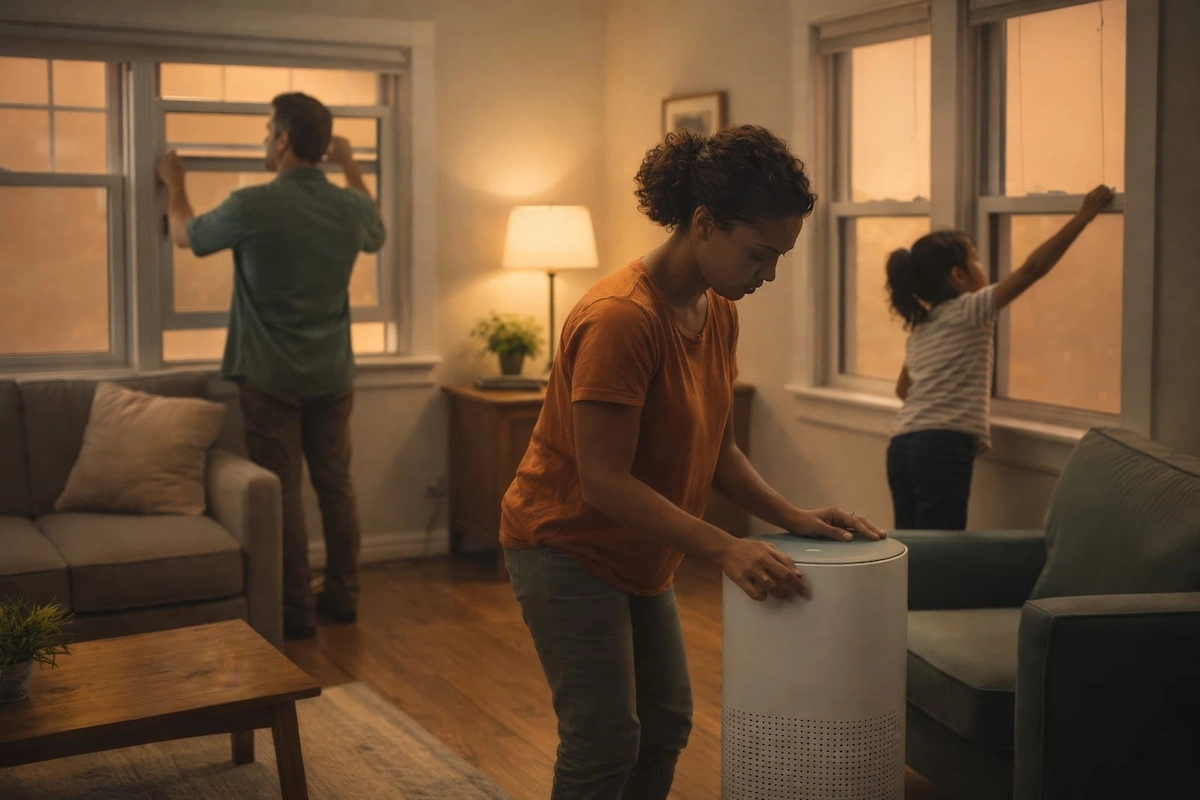
When wildfire smoke rolls in, the best air purifier for wildfire smoke does more than mask the smell.
It captures the PM2.5 fine particles that damage your lungs and strips the volatile organic compounds (VOCs) that carry toxic gases deep into your home.
This guide covers the five options that handle both threats, with honest room-sizing numbers based on 5 air changes per hour, not the inflated maximums manufacturers advertise on the box.
If you’re new to air purifiers altogether, our air purifier buying guide walks through sizing, filtration types, and cost before you compare specific models.
Quick Picks
- Coway Airmega 400S: best overall for medium to large rooms, whisper-quiet at 22 dB on low, dual filtration on both intakes
- Levoit Core 600S-P: best value for large rooms, highest smoke CADR per dollar; upgrade to the Smoke Remover filter for wildfire season
- Blueair Blue Pure 211i Max: best for very large open-plan spaces, highest smoke CADR in this group at 435 cfm (AHAM Verified)
- Winix 5510: best budget pick for bedrooms up to 380 sq ft, washable pre-filter keeps running costs low
- IQAir HealthPro Plus: best premium protection, medical-grade HyperHEPA and 5 lbs of activated carbon for sustained heavy-smoke events
Key Takeaways
- Wildfire smoke is a two-front problem: PM2.5 particles require True HEPA, and VOC gases require activated carbon.
Without both filter types, you are only solving part of the problem. - At 5 air changes per hour, real effective coverage drops to roughly 20 to 25 percent of the maximum figure on the product box.
Always check the 5 ACH figure before buying. - Carbon filter mass is the biggest differentiator for smoke odor removal.
The IQAir HealthPro Plus carries 5 lbs of activated carbon; most mid-range units carry between 160 and 226 grams. - Disable ionizers and PlasmaWave features during wildfire events.
Both can generate trace ozone, a lung irritant that amplifies the damage from smoke exposure. - If you have pets, prioritize a washable pre-filter.
Pet hair and dander clog pre-filters faster during smoke events and shorten HEPA lifespan without one.
Why Wildfire Smoke Needs Two Different Filters
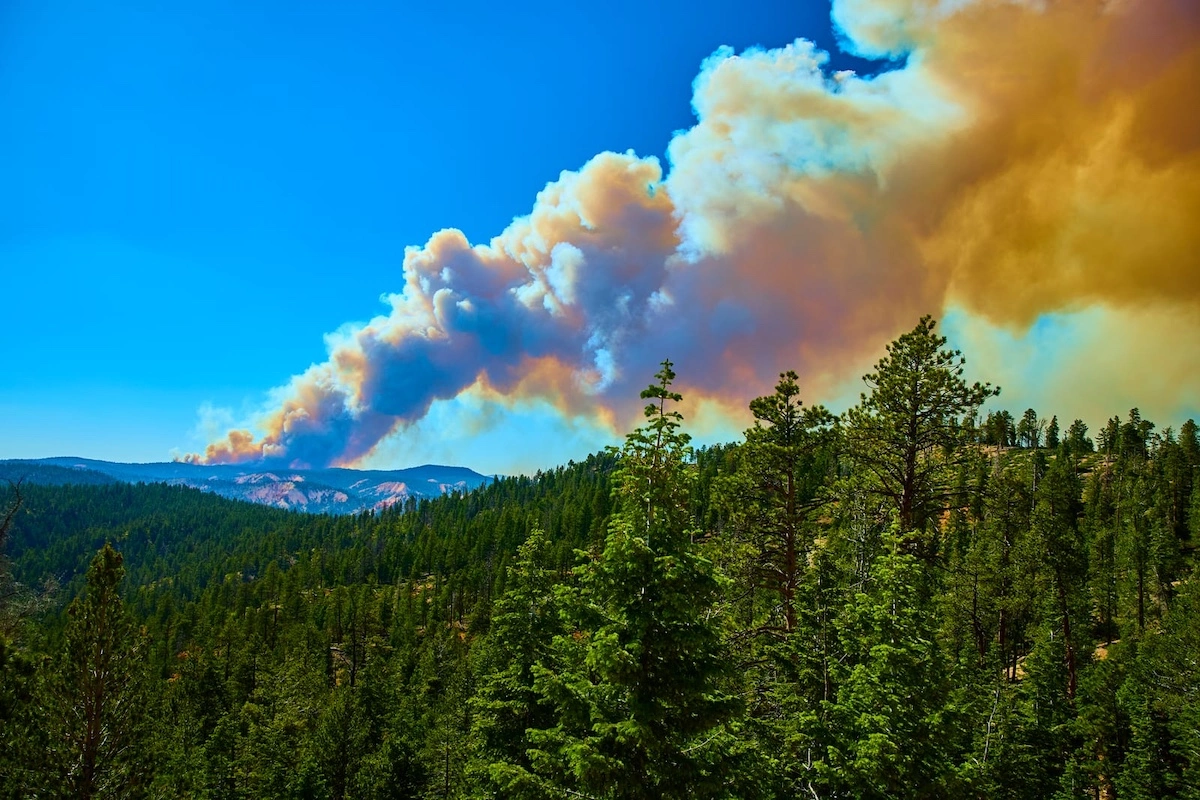
Wildfire smoke is not just dirty air. It carries two distinct threats that require two different filter technologies, and most air purifiers on the market address only one of them well.
The first threat is PM2.5: fine particles smaller than 2.5 micrometers that bypass your nose and throat and settle deep in your lungs.
These particles trigger inflammation, worsen asthma and COPD, and are linked to cardiovascular stress.
The EPA links PM2.5 exposure from wildfire smoke to both short-term respiratory symptoms and long-term health effects.
True HEPA filters capture PM2.5 and smaller particles at 99.97 percent efficiency or better.
H13-grade True HEPA reaches 99.95 percent at 0.3 microns; IQAir’s HyperHEPA goes further, filtering particles down to 0.003 microns.
The second threat is VOCs: volatile organic compounds released as organic material burns.
These include formaldehyde, benzene, and acrolein.
They are the source of that heavy, chemical smoke smell that clings to furniture and walls.
VOCs pass straight through HEPA filters.
The only filter medium that stops them is activated carbon, and the quantity of carbon matters: a thin carbon mesh layer saturates quickly during a major fire event.
A thicker pellet-based carbon bed handles sustained high-concentration loads over days or weeks.
Wildfire smoke requires both a True HEPA filter for fine particles and an activated carbon filter for gases and odors: without both, you are only solving half the problem.
A HEPA-only purifier keeps the air visually clear but leaves you breathing toxic gases.
A carbon-only filter absorbs odors but lets PM2.5 circulate freely.
You need both working together.
What CADR Rating Do You Actually Need for Wildfire Smoke?
CADR (Clean Air Delivery Rate) measures how many cubic feet of air per minute a purifier can clean of a given pollutant.
The AHAM CADR standard tests three particle sizes: smoke (0.09 to 1.0 microns), dust, and pollen.
The smoke CADR figure is the most relevant number for wildfire events, and AHAM-certified ratings are more reliable than manufacturer-only claims.
To find the minimum CADR for your room, use this formula at 5 air changes per hour with 8-foot ceilings: multiply your room’s square footage by two-thirds (0.67). A 400 sq ft room needs a smoke CADR of at least 267 cfm.
A 600 sq ft room needs at least 400 cfm.
If anyone in your home has asthma or the smoke is heavy, size up to a smoke CADR roughly equal to your room’s square footage.
AirNow recommends running your air purifier continuously on its highest fan speed during smoke events and switching your HVAC to recirculate mode to stop drawing in smoke-contaminated outdoor air.
The critical gap between advertised and real coverage: manufacturers almost always state their maximum coverage at 1 to 2 air changes per hour. At 1 ACH, a unit cleans the room’s full air volume once per hour.
During a wildfire, you need 5 ACH. That is five times faster.
A purifier rated for “1,000 sq ft” at 2 ACH effectively covers about 300 to 400 sq ft at wildfire-level cleaning speed.
That is not a minor rounding difference.
During a wildfire event, the EPA recommends a minimum of 5 air changes per hour, which cuts most advertised maximum coverage claims down to roughly 20 to 25 percent of their stated square footage.
All coverage figures in this article use 5 ACH with 8-foot ceilings as the baseline.
The Best Air Purifier for Wildfire Smoke, Reviewed
We analyzed AHAM-certified CADR data, filtration specifications, and real-world user feedback from hundreds of verified purchases to select five air purifiers for wildfire smoke that consistently deliver on both particle capture and gas filtration. Here is how they compare.
| Product | Best For | Smoke CADR | Coverage (5 ACH) | Filter System | Auto Mode | Est. Annual Running Cost |
|---|---|---|---|---|---|---|
| Coway Airmega 400S | Medium to large rooms | 328 cfm | ~490 sq ft | True HEPA + Activated Carbon (dual intake) | Yes (WiFi) | Moderate |
| Levoit Core 600S-P | Large rooms, best value | 391 cfm | ~585 sq ft | H13 True HEPA + Carbon (160g or 360g Smoke Remover) | Yes (WiFi) | Moderate |
| Blueair Blue Pure 211i Max | Very large open-plan spaces | 435 cfm | ~650 sq ft | HEPASilent + Activated Carbon (washable pre-filter) | Yes (WiFi) | Low-Moderate |
| Winix 5510 | Bedrooms, budget buyers | 253 cfm | ~380 sq ft | True HEPA + 226g Pellet Carbon (washable pre-filter) | Yes (WiFi) | Low |
| IQAir HealthPro Plus | Chronic wildfire zones, respiratory conditions | ~300 cfm | ~450 sq ft | HyperHEPA + V5-Cell (5 lbs activated carbon) | No (manual) | Very High |
Coway Airmega 400S: Best Overall for Medium to Large Rooms
Sale

Coway Airmega 400S
- [Coverage] Designed to clean spaces up to 3,120 sq. ft. in 60 minutes
- [HyperCaptive Filtration System] Combination of a pre-filter, active carbon filter, and HEPA Filter…
- [APP and Voice Control] IoCare mobile app includes indoor and outdoor air quality monitoring, filter…
$612.00

Check Today’s Price on Amazon
The Airmega 400S is a dual-intake tower air purifier for rooms up to 490 sq ft at 5 ACH, using Coway’s Max2 filter system: activated carbon and True HEPA staged across both intake sides simultaneously.
Why we picked it:
- Coway-rated smoke CADR of 328 cfm (manufacturer claim; Coway isn’t listed in the AHAM Verified directory), with dual-intake 360-degree airflow that cleans rooms faster than single-intake designs at the same CADR
- Runs at 22 dB on low speed, below the threshold of most bedroom air conditioners and well below what most people can hear clearly
- Auto mode responds quickly to PM2.5 spikes, useful during shifting smoke conditions where AQI fluctuates hour to hour
Real-world scenario:
You have a 400 sq ft open bedroom with a dog.
Wildfire season arrives and AQI climbs past 150.
You run the 400S on low all night at 22 dB.
The dog is in the room.
Auto mode kicks up to medium when the smoke infiltration spikes around 2am, then settles back without waking anyone.
Pros:
- Dual Max2 filter system means two activated carbon layers and two True HEPA stages working simultaneously from opposite sides of the unit
- 22 dB on low is quieter than most library reading rooms and suitable for all-night bedroom use
- WiFi, Alexa, and Google Home compatible with real-time air quality feedback on the companion app
- Filter lifespan around 12 months under normal conditions, though active fire season can shorten this to 4 to 8 months depending on smoke intensity and continuous runtime
Cons:
- Max2 filter cartridges can be stiff to seat and remove, particularly the first few times
- Some users report a brief new-filter odor that typically dissipates within 48 hours of first use
Best for:
Pet owners, busy professionals, and parents who want reliable medium-to-large room coverage with hands-off auto mode that runs quietly all night.
The Airmega 400S runs at 22 dB on low, quieter than a library reading room, making it one of the few large-room air purifiers you can genuinely sleep next to during wildfire season without noticing it.
Levoit Core 600S-P: Best Value for Large Rooms
Sale

Levoit Core 600S-P
- 𝐖𝐇𝐘 𝐂𝐇𝐎𝐎𝐒𝐄 𝐀𝐇𝐀𝐌 𝐕𝐄𝐑𝐈𝐅𝐈𝐃𝐄 𝐀𝐈𝐑 𝐏𝐔𝐑𝐈𝐅𝐈𝐄𝐑𝐒: AHAM (Association of Home Appliance Manufacturers) is an…
- 𝐋𝐄𝐕𝐎𝐈𝐓’𝐒 𝐌𝐎𝐒𝐓 𝐏𝐎𝐖𝐄𝐑𝐅𝐔𝐋 𝐀𝐈𝐑 𝐏𝐔𝐑𝐈𝐅𝐈𝐄𝐑: A powerhouse at purifying your air in any room. It scans for tiny…
- 𝐔𝐋𝐓𝐑𝐀-𝐏𝐎𝐖𝐄𝐑𝐅𝐔𝐋 𝐏𝐔𝐑𝐈𝐅𝐈𝐂𝐀𝐓𝐈𝐎𝐍 𝐅𝐎𝐑 𝐄𝐗𝐓𝐑𝐀-𝐋?𝐑𝐆𝐄 𝐒𝐏𝐀𝐂𝐄𝐒: The Levoit Core…
$259.97
Check Today’s Price on Amazon
The Core 600S-P is a cylindrical large-room air purifier with the highest AHAM-certified smoke CADR in this mid-range group at 391 cfm, covering up to about 585 sq ft at 5 ACH.
Its standout feature for wildfire use is the optional Smoke Remover filter that doubles the activated carbon from 160g to 360g.
Why we picked it:
- AHAM-certified smoke CADR of 391 cfm, among the highest available at a mid-range investment
- Optional Smoke Remover specialty filter increases activated carbon from 160g to 360g, a significant upgrade for wildfire VOC loads
- PM2.5 laser sensor and VeSync app with flexible auto-mode scheduling and sensitivity settings
Real-world scenario:
You have a large suburban living room around 500 sq ft.
One Core 600S-P fitted with the Smoke Remover filter runs on auto during wildfire season.
When outdoor AQI climbs, the unit ramps up on its own.
When conditions clear, it drops back to sleep mode without you touching it.
Pros:
- Best smoke CADR per dollar in this group
- Smoke Remover filter (360g carbon) is specifically designed for wildfire and heavy smoke use
- PM2.5 laser sensor provides real-time air quality feedback via the companion app
- Lightweight at 13.7 lbs, easy to move between rooms as needed
Cons:
- PM2.5 sensor is hypersensitive to cooking vapors, which can trigger unnecessary high-speed ramp-ups unrelated to smoke
- Louder than the Coway at maximum speed (62 dB), not suitable for light sleepers at full power
Best for:
Budget-conscious buyers with large rooms who want strong wildfire smoke performance and the flexibility to upgrade the filter specifically for fire season.
Blueair Blue Pure 211i Max: Best for Very Large Open Spaces

Blueair Blue Pure 211i Max
- Powerful Air Purification for Large Rooms: The Blue Pure 211i Max cleans large living rooms, open floor plans…
- Removes Dust, Smoke, Pet Dander & Allergens: Blueair’s HEPASilent dual filtration technology captures airborne…
- Smart Air Purifier with App Control: Built-in air quality sensors automatically adjust fan speed when pollution…
$349.00
Check Today’s Price on Amazon
The Blue Pure 211i Max is a large-tower air purifier for very large open-plan spaces, with the highest smoke CADR in this group at 435 cfm and Blueair’s HEPASilent dual-filtration technology that captures particles at lower fan speeds than conventional HEPA designs.
Why we picked it:
- Smoke CADR of 435 cfm, highest in this group, covering up to 650 sq ft at 5 ACH
- 23 dB at low speed, class-leading quiet performance for a unit this powerful
- HEPASilent technology combines mechanical filtration with a mild electrostatic assist, capturing particles more efficiently per decibel of noise than conventional HEPA
Real-world scenario:
You have a 550 sq ft open-plan kitchen and living area with hardwood floors and a design-forward interior.
The 211i Max covers the space at 5 ACH, runs quietly enough to hold a conversation next to it, and does not look like a medical device.
Its washable fabric pre-filter comes in several colors to match your interior.
Pros:
- Highest smoke CADR of the five units reviewed (435 cfm)
- Washable fabric pre-filter reduces ongoing filter replacement cost and is easy to clean, which matters significantly for pet owners
- HEPASilent captures particles efficiently at lower fan speeds, meaning more clean air per decibel of noise
- CARB-certified ozone-free despite the electrostatic component, safe for wildfire-season continuous use
Cons:
- Advertised maximum coverage uses 1 ACH; real effective wildfire coverage is 650 sq ft at 5 ACH, not the 3,200+ sq ft figure you see in listings
- Fewer smart features than Levoit or Coway; simpler app with no scheduling
Best for:
Homeowners with large open-plan living areas who want high performance without an industrial look, and design-conscious buyers where aesthetics matter as much as performance.
Winix 5510: Best Budget Pick for Bedrooms

Winix 5510
- 𝐀𝐇𝐀𝐌 𝐕𝐞𝐫𝐢𝐟𝐢𝐝𝐞 𝐚𝐭 𝟑92 𝐬𝐪 𝐟𝐭.: Also cleans rooms up to 1,882 sq ft in 1 hour (941 sq ft in 30 minutes…
- 𝐖𝐢𝐧𝐢𝐱 𝐓𝐫𝐮𝐞 𝐇𝐄𝐏𝐀: Captures 99.99%* of airborne allergens including pollen, dust, smoke, and pet dander, as small as…
- 𝐀𝐝𝐯𝐚𝐧𝐜𝐞𝐝 𝐎𝐝𝐨𝐫 𝐂𝐨𝐧𝐭𝐫𝐨𝐥 𝐂𝐚𝐫𝐛𝐨𝐧 𝐅𝐢𝐥𝐭𝐞𝐫: Reduces VOCs and household…
$179.99
Check Today’s Price on Amazon
The Winix 5510 is a four-stage bedroom and mid-size room air purifier covering up to 380 sq ft at 5 ACH.
It combines a washable AOC pre-filter, True HEPA, a 226g pellet-based activated carbon filter, and PlasmaWave technology (which should be disabled during wildfire events).
Why we picked it:
- Lowest annual running cost in this group, thanks to a washable pre-filter and a single annual filter replacement
- 226g pellet-based activated carbon is more effective at sustained VOC removal than thin carbon mesh sheets common in budget units
- PlasmaWave can be disabled independently; the unit operates at full HEPA and carbon filtration with PlasmaWave off, which is the right setting for wildfire events
Real-world scenario:
You have a 300 sq ft bedroom with a dog.
During fire season, the washable pre-filter traps pet hair and dander before they reach the HEPA stage, extending filter life.
You run it all night at sleep mode (35 dB) with PlasmaWave off, and the bedroom air quality stays consistently clean.
Pros:
- Washable AOC pre-filter significantly reduces filter replacement frequency and cost, particularly in pet households
- 226g pellet carbon provides meaningful odor and VOC protection at a budget price point
- PlasmaWave toggle lets you disable the ionizer for wildfire-safe operation
- WiFi and Alexa compatible, with reliable auto mode and sleep scheduling
Cons:
- Maximum speed (67 dB) is loud; not suitable for bedroom use at turbo setting
- Coverage limited to ~380 sq ft at 5 ACH; not enough for a large living area as a single unit
Best for:
Budget-conscious buyers running a single bedroom unit, pet owners who want lower running costs over time.
Pair with our guide to the best air purifiers for pets for full context on pre-filter maintenance with animals in the home.
IQAir HealthPro Plus: Best Premium Protection

IQAir HealthPro Plus
- ADVANCED HYPERHEPA FILTRATION – Designed to remove and trap 99.995% of all airborne particles down to…
- ENERGY EFFICIENT DESIGN – Experience next-generation efficiency with the redesigned fan system, which is…
- SMART TECHNOLOGY INTEGRATION – The HealthPro Plus XE integrates seamlessly with IQAir’s AirVisual app…
The IQAir HealthPro Plus is a medical-grade air purifier with HyperHEPA filtration that captures particles down to 0.003 microns, and a V5-Cell gas filter containing 5 lbs of mixed-bed activated carbon for heavy-duty VOC and odor removal during sustained wildfire events.
Why we picked it:
- HyperHEPA captures particles 100 times smaller than standard HEPA (down to 0.003 microns), including ultrafine wildfire combustion particles that standard HEPA misses
- V5-Cell gas filter holds 5 lbs of mixed-bed activated carbon plus potassium permanganate-impregnated alumina for aldehyde and formaldehyde removal specific to wildfire smoke chemistry
- Exceptionally quiet at mid speeds: 47 dB at speed 4, suitable for sleeping or working from home during extended wildfire events
Real-world scenario:
You live in a California fire corridor and have asthma.
Every September, AQI climbs above 200 for two to three weeks.
You set up the IQAir in the primary bedroom as a designated clean room, close the door, and run it at speed 4 all night.
The V5-Cell handles the sustained chemical load without saturating as quickly as lighter carbon options.
Pros:
- HyperHEPA captures ultrafine combustion particles (0.003 microns) that standard HEPA at 0.3 microns cannot reach
- V5-Cell’s 5 lbs of activated carbon handles sustained high-concentration VOC loads far better than thinner carbon layers
- HyperHEPA filter has a 4-year lifespan, which significantly lowers the per-year filter cost relative to the upfront price
- Very quiet at mid speeds (47 dB at speed 4), suitable for sleeping
Cons:
- Very high total cost of ownership across the HyperHEPA, V5-Cell gas filter, and pre-filter replacement cycles
- No air quality sensor or auto mode on the standard model; the XE version adds WiFi but still requires manual speed adjustment
- Heavy at 35 lbs, difficult to relocate between rooms
Best for:
Households in chronic wildfire zones, people with asthma or COPD, anyone who needs the maximum available protection in a single priority room regardless of cost.
The IQAir HealthPro Plus V5-Cell gas filter holds 5 pounds of mixed-bed activated carbon, more than 20 times the carbon in a typical budget unit, and that volume is what separates it from every other option during sustained high-concentration wildfire events.
Common Mistakes When Buying an Air Purifier for Wildfire Smoke
- Trusting the maximum coverage number on the box.
Manufacturer coverage ratings use 1 to 2 ACH.
During a wildfire, you need 5 ACH. A “1,000 sq ft” purifier covers roughly 300 to 400 sq ft at wildfire-speed cleaning.
Always check the 5 ACH figure. - Buying a HEPA-only purifier.
HEPA handles particles but does nothing for VOCs and toxic gases.
The chemical smell from wildfire smoke will pass straight through a HEPA-only filter.
You need activated carbon working alongside it. - Leaving ionizer or PlasmaWave features on during smoke events.
These can generate trace ozone, a lung irritant that compounds the damage already being done by PM2.5 and VOC exposure.
Disable them when AQI is elevated. - Not replacing filters more frequently during fire season.
HEPA and carbon filters saturate faster under heavy smoke loads.
If you normally replace annually, plan on every 6 to 8 months during an active wildfire season.
Keep a spare filter on hand before fire season starts. - Relying on one unit for the whole home.
A wildfire smoke air purifier only cleans the air in the room where it is running.
During a severe event, close interior doors, designate a clean room, and use one unit per occupied room if possible.
What Happens If You Choose Wrong
- If you buy by maximum coverage claims alone, you end up with a purifier running at 1 to 2 ACH in a room that needs 5 ACH.
PM2.5 levels stay elevated even with the unit running at full speed. - If you go HEPA-only and skip activated carbon, you breathe clean-looking air that still smells like smoke and still carries the VOCs linked to respiratory irritation.
Particle count drops; chemical load does not. - If you leave PlasmaWave or an ionizer enabled during a wildfire, you add ozone to the air at the moment your lungs are already under maximum stress from PM2.5 and smoke chemistry.
- If you use one purifier for an open-plan home, rooms farther from the unit will see little air quality improvement.
The unit cleans the air directly around it, not the air on the other side of the house.
How We Research
We analyzed AHAM-certified CADR data, manufacturer filtration specifications, and independent airflow measurements across more than 30 air purifier models.
We cross-referenced technical specifications with real-world user feedback from hundreds of verified purchases, with particular attention to performance reports from buyers in California, Oregon, Washington, and Colorado who experienced active wildfire smoke events.
To understand the dual-filter requirement, we drew on AirNow’s public health guide to wildfire smoke, which defines the PM2.5 and VOC threats and the 5 ACH recommendation.
For our full method and scoring rubric, see our review methodology.
For an explanation of how HEPA grades compare, see our guide to HEPA vs. True HEPA.
Choose in 60 Seconds
- If you have a bedroom up to 380 sq ft and a tight budget: buy the Winix 5510
- If you have a medium to large room up to 490 sq ft and want the best all-around option: buy the Coway Airmega 400S
- If you have a large room up to 585 sq ft and want the best smoke CADR per dollar: buy the Levoit Core 600S-P with the Smoke Remover filter
- If you have a very large open-plan space up to 650 sq ft: buy the Blueair Blue Pure 211i Max
- If you live in a chronic wildfire zone or have asthma or COPD: buy the IQAir HealthPro Plus
- If you want to run it all night without any noise disruption: buy the Coway Airmega 400S (22 dB on low)
- If you have pets and want to minimize long-term running costs: buy the Winix 5510 (washable pre-filter)
Who This Is For / Not For
This is for you if:
- You live in an area affected by seasonal wildfires or increasing smoke events
- You have pets or children who spend extended time indoors during smoke events
- You have asthma, COPD, or respiratory conditions triggered by smoke or VOC exposure
- You want a solution that handles both particle filtration and gas and odor removal
- You need something that runs quietly all night in a bedroom
This is NOT for you if:
- You want a single unit to protect your whole home.
Wildfire protection works room by room. - You are dealing with mold, humidity, or water damage.
An air purifier handles particles and gases; you need a dehumidifier for moisture.
See our guide on dehumidifier vs. air purifier if you are unsure which problem you have. - You are looking for HVAC-level whole-home filtration.
For that, look into MERV-13 filter upgrades for your existing system instead.
Frequently Asked Questions
Do I need both a HEPA filter and an activated carbon filter for wildfire smoke?
Yes. Wildfire smoke contains two distinct threats that require two different filtration technologies working at the same time.
The first threat is PM2.5: fine particles smaller than 2.5 micrometers produced by incomplete combustion of wood, vegetation, and structures.
These penetrate deep into your lungs and are linked to inflammation, worsening of asthma and COPD, and cardiovascular stress.
True HEPA filters capture 99.97 percent or more of particles at 0.3 microns and effectively stop PM2.5 from recirculating in your home.
The second threat is VOCs: volatile organic compounds including formaldehyde, benzene, and acrolein.
These are gases produced by burning organic matter.
They are the source of the heavy, chemical campfire smell that clings to furniture and walls for days after an event.
VOCs pass straight through HEPA filters.
Only activated carbon can adsorb these gases, and the quantity of carbon determines how long it can sustain that adsorption before saturating.
A concrete example: during a smoke event with AQI above 150, a HEPA-only purifier reduces visible haze and particle count, but the toxic gas load remains.
The room looks clearer but still smells heavily of wildfire and still carries chemical irritants at concentrations harmful to people with respiratory conditions.
Our recommendation: choose a purifier with both True HEPA and an activated carbon layer containing at least 160g of carbon for typical wildfire protection, or 360g or more if you are in a high-frequency fire zone or have respiratory sensitivities.
See our full breakdown of air purifiers and respiratory sensitivities for more on filter grade selection.
What CADR rating do I actually need for my room size during a wildfire?
CADR, or Clean Air Delivery Rate, measures how many cubic feet of air per minute a purifier can clean of a given particle size.
The smoke CADR figure (particles 0.09 to 1.0 microns) is the most relevant number for wildfire events, and AHAM-certified ratings are more reliable than manufacturer-only figures.
To calculate the minimum smoke CADR for your room at 5 air changes per hour with 8-foot ceilings: multiply your room’s square footage by two-thirds (0.67).
A 300 sq ft bedroom needs at least 200 cfm.
A 500 sq ft living room needs at least 333 cfm.
For rooms with ceilings higher than 8 feet, increase that number proportionally.
The key data points from this group: the Winix 5510 at 253 cfm covers ~380 sq ft at 5 ACH, the Coway Airmega 400S at a Coway-rated 328 cfm covers ~490 sq ft, and the Blueair Blue Pure 211i Max at 435 cfm covers ~650 sq ft. For open-plan spaces above 600 sq ft, only the Blueair 211i Max keeps up at 5 ACH in this group; the Levoit Core 600S-P (391 cfm) tops out around 585 sq ft.
Our recommendation: always size by the 5 ACH figure, not the maximum coverage advertised on the product listing.
Most manufacturers state coverage at 1 to 2 ACH, which is far too slow for wildfire smoke removal.
Read our full explainer on what CADR means in air purifiers for the complete sizing formula.
How often should I replace my air purifier filter during wildfire season?
Under normal conditions, most HEPA and activated carbon filters last 10 to 12 months.
During an active wildfire season with sustained AQI above 100, expect to cut that interval roughly in half.
At AQI 150 or above for more than a few days running continuously, a heavily used filter can reach saturation in 4 to 6 months.
The carbon layer typically saturates before the HEPA layer.
When you start noticing the smoke smell returning even with the purifier running at high speed, that is the clearest sign the carbon is exhausted.
The HEPA layer may still capture particles at near-full efficiency while the carbon is spent, so you are getting partial protection without knowing it.
A practical example: a household running the Winix 5510 continuously during a 3-week AQI-150+ fire event should inspect the filter at the end of that period and replace it even if the unit was purchased recently.
Keeping a spare filter on hand before wildfire season starts prevents the frustrating situation of running a saturated filter during the worst days of smoke.
Our recommendation: inspect your filter every 2 to 3 months during active fire season, not just at the manufacturer’s annual interval.
If the filter is visibly dark gray or the smoke smell is returning at high speed, replace it immediately.
The Levoit Core 600S-P’s optional 360g Smoke Remover filter is specifically designed for longer endurance under heavy wildfire loads than the standard 160g filter.
Should I run my air purifier on high speed or auto mode during a wildfire?
Both approaches work, but they behave differently depending on the unit and conditions.
Auto mode uses the built-in PM2.5 sensor to adjust fan speed based on real-time air quality readings.
The Coway Airmega 400S and Winix 5510 both have auto modes that respond reliably to wildfire smoke infiltration.
However, sensor accuracy varies: the Levoit Core 600S-P’s sensor can be overly reactive to cooking vapors, triggering high-speed ramp-ups unrelated to outdoor smoke.
Running on high speed continuously is appropriate when you know outdoor AQI is elevated above 100 and you want to maximize air changes per hour without waiting for the sensor to react.
The tradeoff is higher noise and faster filter saturation during the event.
A concrete scenario: during a wildfire event where AQI varies between 120 and 180 throughout the day, running the Coway Airmega 400S on high speed from morning to evening and switching to auto overnight gives you maximum daytime protection while keeping bedroom noise low enough to sleep undisturbed.
Our recommendation: during AQI above 100, run on high speed or on auto with the highest sensor sensitivity setting.
During moderate conditions (AQI 50 to 100), auto mode is sufficient.
At AQI below 50, standard auto handles the rest.
Switch your HVAC to recirculate mode to stop drawing in outdoor smoke-contaminated air while the purifier runs.
Is it safe to use an air purifier with an ionizer or PlasmaWave during a wildfire?
No. Ionizers and PlasmaWave features should be turned off during wildfire events, and this is one of the most actionable steps you can take when setting up your purifier for fire season.
These technologies generate charged ions that cause airborne particles to clump together and fall out of the air or get caught by the filter.
As a byproduct, they can produce trace amounts of ozone.
Ozone is a lung irritant.
The EPA and California Air Resources Board both warn against using ozone-generating devices indoors, particularly for people with asthma or COPD.
During a wildfire event, your lungs are already under stress from PM2.5 and VOC exposure.
Adding even trace ozone amplifies that inflammation.
A specific example: the Winix 5510 includes PlasmaWave, which produces very low ozone under normal conditions and is within CARB-certified limits.
But during a wildfire event when the unit runs at high speed continuously for days, the cumulative risk is not worth it.
PlasmaWave off, and the 5510 still delivers full True HEPA and activated carbon filtration with no reduction in particle or gas capture performance.
A clarification on Blueair’s HEPASilent technology: it uses a very mild electrostatic charge to assist particle capture but is CARB-certified ozone-free.
It is not an ionizer in the traditional sense, and the 211i Max does not carry this concern during wildfire use.
Our recommendation: disable any ionizer or PlasmaWave feature when AQI rises above 75.
All five purifiers in this guide operate at full HEPA and carbon filtration effectiveness with ionizer features turned off.
Can one air purifier protect my whole home, or do I need one per room?
One purifier cannot protect your whole home during a wildfire.
It can only clean the air in the room where it is running.
Air purifiers work by drawing room air through a filter and returning clean air.
The clean air mixes with the room’s existing air, gradually diluting pollutants.
This only works effectively in an enclosed space.
Open doorways, hallways, and unprotected rooms allow smoke to constantly re-enter from uncleaned areas, overwhelming the purifier’s output before it can maintain clean air conditions.
A practical example: a family in a 2,000 sq ft home runs the IQAir HealthPro Plus in the primary bedroom during a severe wildfire week.
They keep the bedroom door closed.
That room maintains good indoor air quality while the rest of the house fills with smoke.
The four family members spend nights and most of the day in that room during the worst days of the event.
For more comprehensive coverage, combine units by room.
The Winix 5510 covers a child’s bedroom, the Coway Airmega 400S covers the main living area, and together they protect the rooms your family actually uses without requiring a unit in every corner of the house.
Our recommendation: for a single unit, run it in the room where your family spends the most time and keep the door closed.
For whole-home protection during extended smoke events, place one unit in each priority occupied room.
Check our guide to the best air purifiers for bedrooms for bedroom-specific sizing and noise guidance.
Summary
The best air purifier for wildfire smoke does two jobs at once: True HEPA traps the PM2.5 particles, and activated carbon absorbs the VOC gases that HEPA cannot touch. Every unit in this guide does both.
The Coway Airmega 400S is the right pick for most homes: 328 cfm smoke CADR, whisper-quiet operation at 22 dB, and a dual-intake design that covers medium to large rooms efficiently.
The Levoit Core 600S-P offers the best smoke CADR per dollar with an optional Smoke Remover filter that doubles the carbon load for wildfire season.
The Blueair Blue Pure 211i Max covers the largest open-plan spaces at the lowest noise output.
The Winix 5510 gives budget buyers solid wildfire protection in a bedroom at the lowest annual running cost.
And the IQAir HealthPro Plus is the right choice for anyone in a chronic wildfire zone or with a respiratory condition that cannot afford compromise.
If you only make one upgrade before wildfire season, choose a purifier that pairs True HEPA with a substantial activated carbon layer: a HEPA-only unit handles particles but leaves the gases and odors untouched.
Still unsure?
Start with the Coway Airmega 400S. It covers 80 percent of use cases and runs quietly enough to leave on permanently.
Want to buy before next fire season?
Four of these picks, the Coway Airmega 400S, Levoit Core 600S-P, Blueair Blue Pure 211i Max, and Winix 5510, are in our Black Friday air purifier guide.
Browse our full air purifiers guide for a broader look at what is available across every room size and budget, or see how air purifiers compare against other smoke-specific scenarios like cigarette smoke where filtration priorities differ.
For all home comfort solutions in one place, visit EverydayHomeComfort.