Ad. When you purchase through links we provide, we may receive an affiliate commission. Here's how it works.
HEPA vs True HEPA: What the Difference Actually Means
You’re reading an air purifier box and it says “True HEPA.”
The one next to it just says “HEPA.”
One costs $40 more.
You have no idea which one is actually better — or if the difference is even real.
Here’s what the label actually means, and the one number that matters far more than either of them.
Quick Answer
HEPA vs True HEPA comes down to proof, not phrasing: “True HEPA” isn’t a universal standard, so treat it as a clue.
Then verify a real HEPA grade/definition and size the purifier using CADR (cleaning speed).
A “HEPA” filter with low CADR or a leaky housing can underperform in real homes.
Key Takeaways
- Main fact: “True HEPA vs HEPA” wording matters less than whether the filter meets a real HEPA definition/grade and the purifier has enough CADR.
- Why it matters for homeowners: Real-world results = filter efficiency + airflow (CADR) + sealing (no bypass leaks).
- Typical values / ranges: HEPA is commonly referenced as 99.97% at 0.3 µm, where 0.3 µm is often used as the “worst case” (MPPS).
- What to look for when buying: AHAM CADR, clear HEPA grade/standard, and reasonable filter replacement costs.
- Common mistake to avoid: Buying “True HEPA” but ignoring CADR – result: it cleans too slowly for your room.
For more EverydayHomeComfort resources, start from Home Climate and the Air Purifiers hub.
What is “HEPA vs True HEPA”?
HEPA (High-Efficiency Particulate Air) is a filter performance category.
In consumer use, you’ll often see HEPA described as capturing 99.97% of particles at 0.3 microns (µm).
That 0.3 µm point is used because it’s commonly treated as a “worst case” benchmark (the most penetrating particle size, MPPS): particles larger or smaller can be trapped with even higher efficiency.
True HEPA is frequently a consumer-facing label meant to separate “real HEPA” from vague terms like “HEPA-type.”
The practical move is simple: don’t buy the phrase – verify the spec (HEPA grade/standard/testing) and then check CADR so the unit actually cleans your room fast enough.
How does a HEPA filter work (and why “0.3 microns” matters)?
A HEPA filter is a mechanical, pleated filter designed to capture particles from airflow.
The reason “0.3 µm” appears everywhere is not because HEPA only works at that size, but because it’s commonly used as a difficult test point (MPPS / “worst case”).
If a filter performs at that point, it typically performs as well or better at other particle sizes.
Why this matters in your house: you’re not shopping for a number – you’re shopping for cleaner breathing air.
A strong filter claim doesn’t help if the purifier doesn’t move enough air (CADR) or leaks around the filter.
HEPA vs True HEPA: what’s the real difference (and what’s marketing)?
Here’s how to interpret common labels:
- “HEPA” → should refer to a recognized HEPA definition/grade.
Still verify details (grade/standard/testing) and don’t skip CADR. - “True HEPA” → usually means “not HEPA-type,” but it’s still not a guarantee by itself.
Treat it as a signal to check the fine print. - “HEPA-type / HEPA-style” → not a standard term; performance can vary widely.
Bottom line: For hepa filter vs normal filter, the meaningful question is: Does it meet a real HEPA spec, and is the purifier sized correctly for the room?
Why HEPA vs True HEPA matters in real homes
Cleaning speed (CADR) is the reality check
CADR (Clean Air Delivery Rate) combines airflow + filtration effectiveness into a single, practical number.
AHAM’s rule of thumb: Smoke CADR should be at least two-thirds of the room area (sq ft).
For wildfire smoke, AHAM recommends Smoke CADR about equal to the room area.
Bedroom use is where these differences matter most — see how we applied these criteria in our best air purifier for bedroom guide.
Air purifiers handle what’s floating in the air — but dander that has already settled on floors needs a different solution.
Our guide to the best robot vacuum for pet hair covers the vacuum side of that equation, and a robot vacuum maintenance schedule keeps it performing at that level long-term.
Sealing matters (bypass leaks can waste a good filter)
Even a great filter can underperform if air can slip around it.
Some brands emphasize “sealed” designs to reduce bypass.
If you want a consumer-friendly example of what sealed filtration means in practice, see our article on The Best Bladeless Tower Fans.
Maintenance is performance
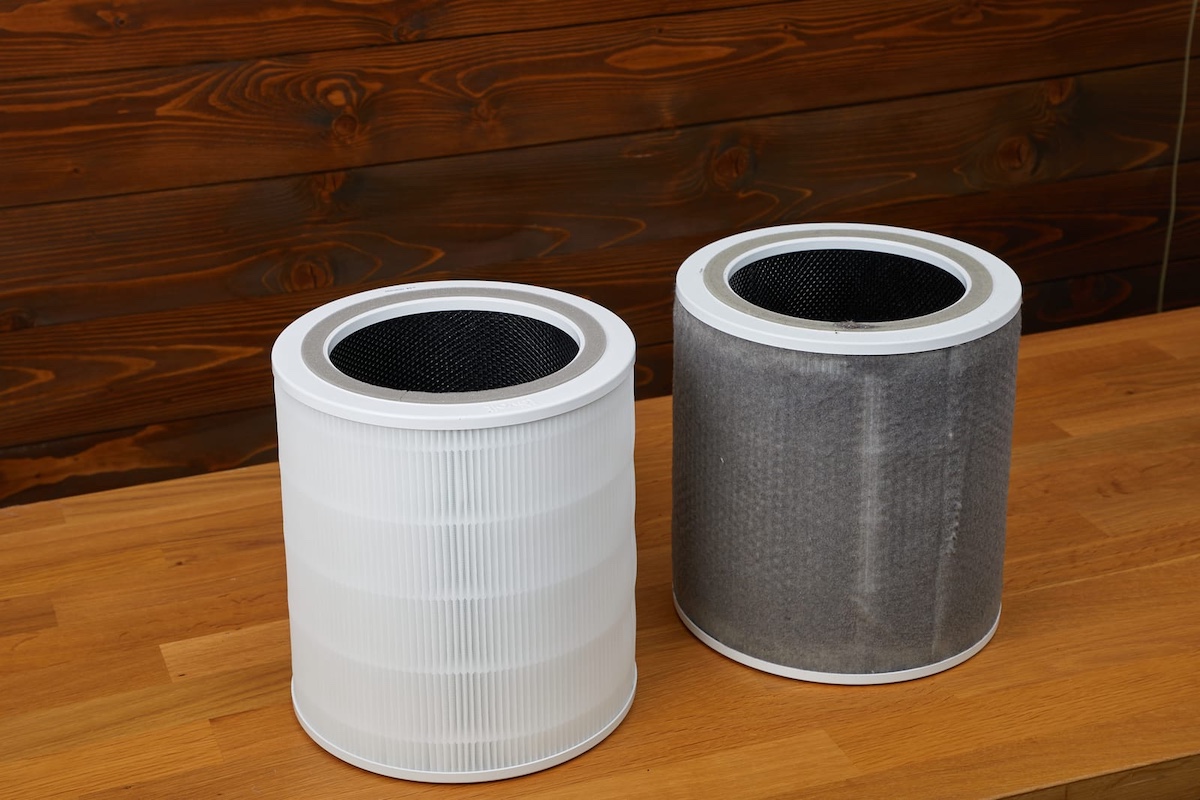
Filter loading increases resistance and can reduce airflow.
If replacements are expensive or hard to find, performance tends to drop over time because people delay maintenance.
For allergy-focused setup tips, read Air Purifier and Allergies: How to Fight Dust Mites.
Typical Values, Standards, and Ranges
| Spec / standard | What it tells you | Typical reference |
|---|---|---|
| HEPA (common U.S. reference) | High-efficiency benchmark at a difficult particle size | ≥ 99.97% at 0.3 µm; 0.3 µm corresponds to worst case (MPPS) |
| H13 / H14 (EU-style classes) | Common HEPA grades in EN 1822 / ISO-derived systems | H13 often shown as ≥ 99.95%, H14 as ≥ 99.995% (MPPS-based) |
| AHAM CADR | Real-room cleaning speed (Smoke/Dust/Pollen) | 2/3 rule; wildfire: Smoke CADR ≈ room area |
| MERV (HVAC filters) | Whole-home filter rating by particle ranges | ASHRAE notes MERV 13 is ≥ 85% at 1–3 µm |
Common Myths and Misunderstandings
Myth 1: 0.3 microns is the smallest particle HEPA can capture
Reality: 0.3 µm is commonly used as the “worst case” (MPPS).
Particles larger or smaller are often captured with even higher efficiency.
Myth 2: True HEPA automatically means the purifier is great
Reality: A “True HEPA” label doesn’t fix low CADR, poor sealing, or bad placement.
Use CADR to verify cleaning speed.
Myth 3: HEPA removes odors and VOCs
Reality: HEPA targets particles.
Odors and many gases generally require activated carbon/adsorbent materials (and enough material to matter) — cigarette smoke is the toughest real-world test of that gap, which is why we built a dedicated best air purifier for cigarette smoke guide around exactly this distinction.
Myth 4: UV-C light in an air purifier kills germs and viruses on its own
Reality: UV-C only treats air that’s already passed through the filter, for a fraction of a second in a portable unit.
See our guide to the best UV light air purifiers for what UV-C can and can’t realistically do.
Myth 5: HEPA filters remove humidity
If you’re unsure whether you actually need an air purifier or a dehumidifier for your space, our guide on dehumidifier vs air purifier walks through exactly that decision. A HEPA filter only traps particles; it doesn’t add or remove moisture from the air. If you want one machine that filters and humidifies, an air purifier and humidifier combo handles both, though it gives up some air-cleaning power compared with a standalone HEPA unit.
How to evaluate HEPA vs True HEPA when buying products
Step 1 – Validate the filter claim (don’t stop at the label)
- Prefer listings that clearly state HEPA grade/standard or recognized definitions.
- If it says “HEPA-type,” assume performance is unknown unless credible test info is provided.
Step 2 – Size it with CADR (fast rule)
- Baseline rule: Smoke CADR ≥ 2/3 of the room area (sq ft).
- Wildfire smoke: Smoke CADR ≈ room area (sq ft).
For units that meet this threshold with dual HEPA + carbon filtration, see our best air purifier for wildfire smoke guide.
For open-concept or great-room spaces above 600 sq ft, see our best air purifier for large rooms guide.
Our air purifier buying guide ties sizing, filtration, and cost together in one place if you want the full picture before shopping
Step 3 – Don’t ignore sealing and airflow path
- Look for designs that emphasize sealed filtration and a clear air path.
- Avoid units where the filter fit looks loose or poorly supported.
Step 4 – Check the true cost: filters + availability
- Replacement frequency and price.
- Availability (will you find filters 12 months from now?).
- Pre-filter design (helps reduce main filter loading).
For verified HEPA models that don’t blow the budget, our best air purifier under $100 guide covers exactly what to look for.
Buying on sale?
Our Black Friday air purifier guide shows how near-identical model names, like the Coway AP-1512HH and AP-1512HHS, can take different filter sets.
Step 5 – Match to your real problem
- Allergies / dust mite debris / dander: verified HEPA-grade + correct CADR + proper placement.
- Smoke / PM2.5: prioritize Smoke CADR and run at a meaningful setting.
- Basement musty air: fix moisture first, then filter (see Best Dehumidifiers for Basements).
Choose in 60 seconds
- If you’re comparing hepa filter vs true hepa labels: choose the model with clear HEPA spec + adequate CADR, even if the wording is less flashy.
- If Smoke CADR is below the 2/3 rule for your room: skip it (too slow).
- If you want quiet performance: buy more CADR than you “need” and run it on medium.
- If you’re relying on HVAC filtration: aim for MERV 13 (if your system can handle pressure drop) and use a portable purifier for bedrooms.
Comparison table: HEPA filter vs True HEPA vs normal filter
| Your goal | Best fit | Why |
|---|---|---|
| Bedroom allergies | Portable purifier with verified HEPA + correct CADR | Fast enough cleaning + strong particle capture |
| Smoke events | Verified HEPA + high Smoke CADR | Smoke CADR predicts real-room cleaning speed |
| Whole-home baseline | HVAC MERV 13 (if compatible) | Strong efficiency in 1–3 µm band |
| “HEPA-type” budget units | Usually not ideal | Label is vague; performance varies |
How We Researched This Guide
We cross-referenced EPA guidance on HEPA definitions, AHAM’s CADR sizing standards, and ASHRAE’s MERV rating framework — then filtered out the marketing language to give you a checklist that actually works in a real home.
For our full method and scoring rubric, see our review methodology.
Practical Examples
Example 1: I bought a True HEPA purifier but don’t feel a difference
Most common causes:
- CADR too low for the room (cleans too slowly)
- Placement blocks airflow (cornered behind furniture)
- Filters are old or not seated properly
Fix: re-check room sizing in our CADR guide.
Example 2: I use MERV 13 in HVAC – do I still need a HEPA purifier?
MERV 13 can be a strong baseline, but a portable purifier helps where people actually breathe:
- Bedrooms at night
- Smoke events
- Rooms with weak circulation
Example 3: My basement smells musty
Start with humidity control (moisture drives a lot of “air quality” problems), then add filtration sized correctly.
Frequently Asked Questions (FAQs)
Not automatically. “True HEPA” is often a marketing phrase. The better buy is verified HEPA spec + correct CADR + good sealing.
“HEPA-type” is not a standardized performance label.
“True HEPA” usually signals “real HEPA,” but you still need to verify the actual spec and CADR.
They solve different problems.
HVAC “normal filters” are rated by MERV; ASHRAE recommends at least MERV 13 when feasible.
HEPA is higher-efficiency for portable units, especially in bedrooms.
HEPA targets airborne particles, including many sizes relevant to dust, pollen, and some aerosols.
In real life, results depend on CADR, placement, and runtime.
Use the AHAM rule of thumb: Smoke CADR ≥ 2/3 of room area (sq ft); for wildfire smoke, Smoke CADR ≈ room area.
Walkthrough: What Is CADR in Air Purifiers and How to Choose the Right Size?.
If odors and gases bother you (cooking smells, pets, VOCs), carbon/adsorbents help.
HEPA is mainly for particles.
Conclusion
For hepa vs true hepa, the winning approach is boring, but it works: verify a real HEPA spec, then confirm CADR is high enough for your room and choose a design that minimizes bypass leaks.
For a complete overview, visit out Home Climate page.