Ad. When you purchase through links we provide, we may receive an affiliate commission. Here's how it works.
Best Dehumidifier for Bedroom in 2026
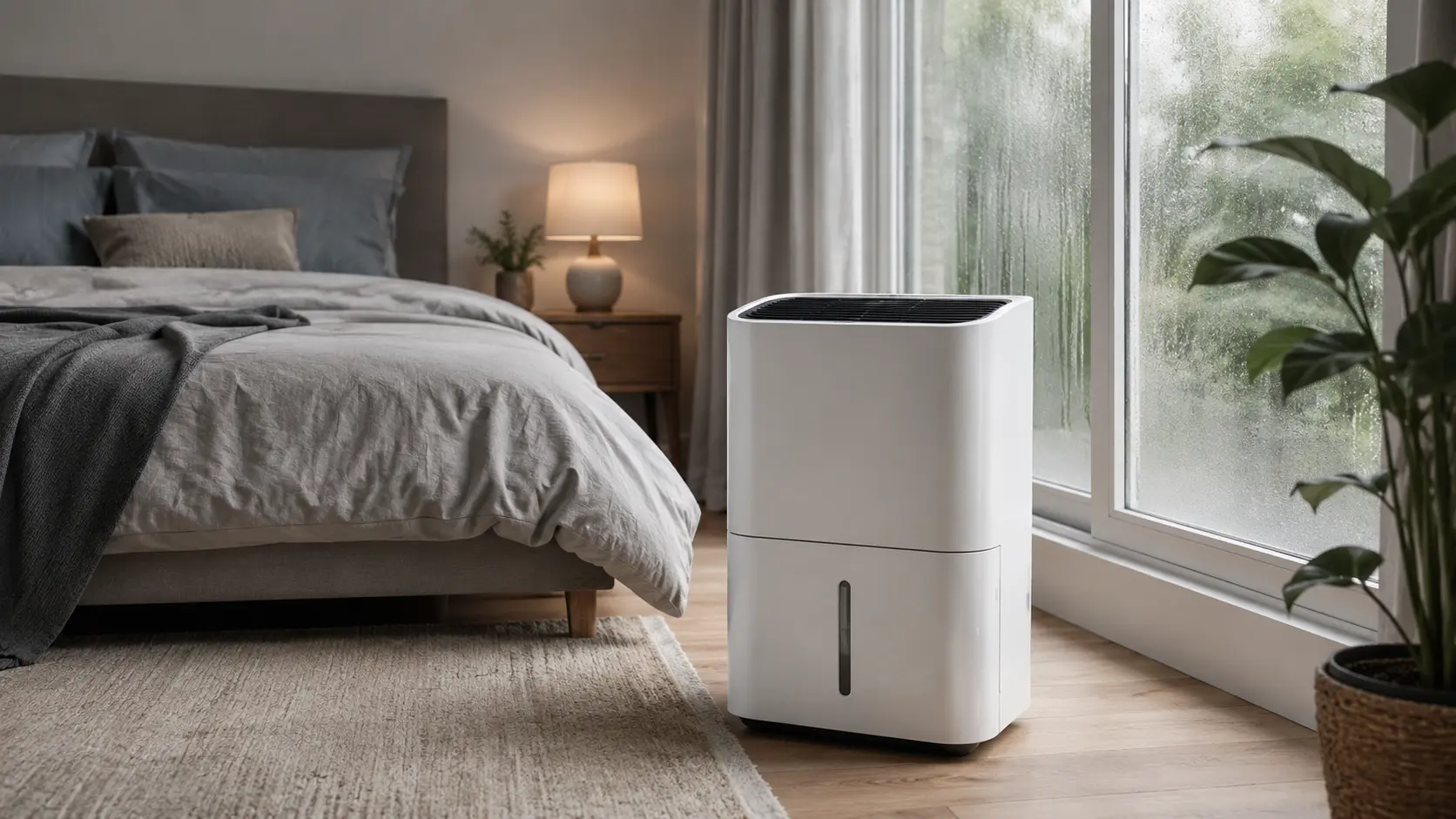
The Dreo Smart Dehumidifier is the best dehumidifier for bedroom use for most people: it removes 22.09 pints a day under the DOE test (ENERGY STAR), has the lowest noise rating among our picks that publish one (40 to 45 dBA, Dreo user manual), and you can switch its display off and adjust it from your phone without getting out of bed.
Quick Picks: Best Bedroom Dehumidifiers
- Dreo Smart Dehumidifier: best overall, with 22.09 pints/day of DOE-rated capacity, Wi-Fi app control, and a display you can switch off at night
- Whirlpool WHAD251AW: best energy-efficient pick, with the most DOE-rated capacity in this group, ENERGY STAR Most Efficient status, and a Sleep mode on simple push-button controls
- Midea Cube MAD20S1QWT: best for fast moisture pull-down and infrequent tank emptying, with the largest tank in its class
- Frigidaire FHDD2233W1: best set-and-forget option with auto mode that cycles without manual adjustment
- Levoit Smart Dehumidifier: best for large master bedrooms and open-plan sleeping areas where a 22-pint unit falls short, with 24.54 pints/day of DOE-rated capacity and the only built-in pump in this group for rooms without a floor drain
Key Takeaways
- The EPA recommends keeping indoor relative humidity between 30% and 50%. Above 50%, dust mites thrive.
Above 60%, mold can form within 24 to 48 hours. - The Dreo Smart Dehumidifier removes 22.09 pints/day under the DOE test (ENERGY STAR) at a manufacturer-stated 40 to 45 dBA. Be wary of compact units sold on 33 to 35 dB claims: the two we previously recommended, sold as 30 and 34 pint units, remove only 9.20 and 10.16 pints/day under the same test.
- The Whirlpool WHAD251AW removes 24.84 pints/day under the DOE test, the most in this group, and is ENERGY STAR Most Efficient (ENERGY STAR). It has a Sleep mode but no app.
- After the 2019 DOE test standard change, a unit labeled “30 pint” before 2019 is now labeled “22 pint.”
Old and new pint ratings are not interchangeable. - The Levoit Smart Dehumidifier removes 24.54 pints/day under the DOE test (ENERGY STAR) and is the only pick with a built-in pump. If your bedroom exceeds 400 sq ft or includes a connected sitting room or dressing area, a 20 to 22 pint unit will run continuously without reaching your target RH.
The best dehumidifier for bedroom use is not the most powerful one.
It is the one quiet enough to run while you sleep, sized correctly for your room, and easy enough to maintain that you keep it running through the months that matter.
High humidity above your bed feeds dust mites, worsens allergies, and creates the conditions for mold growth.
The right unit removes that threat without adding a new one in the form of noise.
Why Bedroom Humidity Control Matters
The EPA recommends keeping indoor relative humidity between 30% and 50%.
Above that range, the biology of your bedroom shifts.
Dust mites, the most common year-round allergy trigger, need relative humidity above 50% RH to survive and reproduce.
At 60% RH and above, mold can begin forming within 24 to 48 hours, even on surfaces that look and smell completely clean.
For pet owners, humid air compounds the problem.
Pet dander particles become stickier and stay airborne longer when relative humidity is elevated.
If your dog or cat shares your sleeping space, you breathe a higher concentration of allergens per breath than you would in a properly controlled room.
Pairing a bedroom dehumidifier with a quality air purifier addresses allergen exposure from two directions at once.
Our guide to the best air purifier for bedroom covers the filtration side of that equation.
For homeowners with hardwood or engineered wood floors, bedroom humidity control has a financial dimension too.
Most hardwood manufacturers specify 35 to 55% RH as the safe operating range.
Sustained humidity above that causes boards to absorb moisture, expand, and eventually buckle or gap.
A bedroom dehumidifier running consistently in summer protects your floors as much as your air quality.
If you are trying to decide between a dehumidifier and an air purifier for your bedroom, they solve different problems.
Our breakdown of dehumidifier vs. air purifier helps you understand when you need one, the other, or both.
How to Choose the Best Dehumidifier for Your Bedroom
Noise level: the bedroom-specific filter
In a bedroom, noise is the first and most important filter.
A dehumidifier that removes moisture efficiently but runs at 58 dB is not a bedroom dehumidifier.
Compressor-based units typically operate between 33 and 62 dB depending on the model and fan setting.
The practical target for nighttime use is under 50 dB measured at 10 feet.
One important caveat: manufacturer noise specs are almost always measured at 3 feet in controlled conditions.
Independent testing at 10 feet shows values 5 to 10 dB lower in absolute terms but still higher than marketing claims.
Use independently measured values wherever possible rather than spec sheets.
Capacity and room size
For most bedrooms (150 to 400 sq ft with moderate humidity), a 20 to 25 pint unit is sufficient.
For bedrooms above 500 sq ft, or rooms with poor ventilation or significant humidity intrusion, step up to 25 to 35 pints.
A unit too small runs continuously without reaching your target RH and wears out faster.
A unit too large short-cycles, hitting target RH quickly and cycling on-off repeatedly, which can make noise more noticeable and adds compressor wear.
After the 2019 DOE testing standard change, a unit labeled “30 pint” before 2019 is now labeled “22 pint” — old and new pint ratings are not comparable.
ENERGY STAR explains this capacity label change in detail.
If you are comparing an older model to a newer one, check which test standard was used before drawing any conclusions about size.
Tank size and drain options
Tank size determines how often you interact with the unit.
The math is simple: divide your unit’s actual daily extraction rate by the tank capacity in gallons.
If the result is 2 to 3, you empty the tank 2 to 3 times per day.
In a humid bedroom extracting 8 to 10 pints daily, a 1-gallon tank needs emptying every day.
A 3-gallon tank stretches to every 2 to 3 days.
If you have a floor drain, utility sink, or can route a hose to a bathroom, always use continuous drain.
It eliminates the tank entirely and removes the risk of the unit shutting off at full capacity while you sleep.
Energy efficiency
A bedroom dehumidifier running through summer adds meaningfully to your electricity bill without ENERGY STAR certification.
ENERGY STAR certified dehumidifiers use at least 20% less energy than standard models and must include a built-in humidistat that shuts the unit off when target humidity is reached.
ENERGY STAR Most Efficient models, the highest tier, offer up to 45% savings versus conventional units.
For a device running overnight from May through September, that gap adds up across a season.
Best Dehumidifier for Bedroom at a Glance
| Product | Best For | Capacity | Noise Level | Energy Certification |
|---|---|---|---|---|
| Dreo Smart Dehumidifier | Most bedrooms, app control | 73 pint label | 40 to 45 dBA (manufacturer claim) | ENERGY STAR Certified |
| Whirlpool WHAD251AW | Energy efficiency, simple controls | 25 pint (DOE-tested: 24.84) | 43 dBA low, 47 dBA high (manufacturer spec) | ENERGY STAR Most Efficient |
| Midea Cube MAD20S1QWT | Fast moisture removal, large tank | 20 pint | 58-60 dB (measured) | ENERGY STAR Certified |
| Frigidaire FHDD2233W1 | Busy professionals, auto mode | 22 pint | Not published | ENERGY STAR Certified |
| Levoit Smart Dehumidifier | Large master bedrooms, rooms without a floor drain | 25 pint (DOE-tested: 24.54) | 46 dB on low (manufacturer claim) | ENERGY STAR Most Efficient |
Dreo Smart Dehumidifier: Best Overall

Dreo Smart Dehumidifier
- 𝐏𝐨𝐰𝐞𝐫𝐟𝐮𝐥 𝟕𝟑-𝐏𝐢𝐧𝐭 𝐃𝐞𝐡𝐮𝐦𝐢𝐝𝐢𝐟𝐢𝐞𝐫 – 𝐅𝐚𝐬𝐭 𝐌𝐨𝐢𝐬𝐭𝐮𝐫𝐞 𝐑𝐞𝐦𝐨𝐯𝐚𝐥: Removes up to 73-pint(95℉, RH90%) of moisture…
- 𝐄𝐍𝐄𝐑𝐆𝐘 𝐒𝐓𝐀𝐑 𝟐𝟎𝟐𝟓 𝐂𝐞𝐫𝐭𝐢𝐟𝐢𝐞𝐝 – 𝐒𝐚𝐯𝐞 𝐄𝐧𝐞𝐫𝐠𝐲 & 𝐋𝐨𝐰𝐞𝐫 𝐁𝐢𝐥𝐥𝐬: Uses 30% less energy than standard DOE models…
- 𝟒𝟏𝐝𝐁 𝐔𝐥𝐭𝐫𝐚-𝐐𝐮𝐢𝐞𝐭 𝐎𝐩𝐞𝐫𝐚𝐭𝐢𝐨𝐧 – 𝐏𝐞𝐚𝐜𝐞𝐟𝐮𝐥 𝐂𝐨𝐦𝐟𝐨𝐫𝐭 𝐃𝐚𝐲 & 𝐍𝐢𝐠𝐡𝐭: Runs at just 41dB to provide quiet…
$279.99

Check Today’s Price on Amazon
The Dreo Smart Dehumidifier (model DR-HDH003S, which Dreo also sells as the 733S) is a Wi-Fi compressor dehumidifier with app and voice control and ENERGY STAR certification. It is our pick for most bedrooms because it pairs real, DOE-tested capacity with the night-time controls you actually use: a display-off button, muted beeps, and humidity changes from your phone.
Why we picked it:
- Real capacity behind the label: 22.09 pints/day under the DOE test, per its ENERGY STAR listing. That puts it within 3 pints of the largest units in this group. The extra headroom lets it pull your room down to target and then cycle off, instead of running all night to keep up.
- Built-in night controls: a display button turns off both the panel and the humidity-colored ambient light, and a 5-second press mutes the button tones, per the Dreo user manual. The manual names fan level 1 as the setting for quieter operation.
- App and voice control: the Dreo app adds a 0 to 24 hour timer and a Custom mode that sets humidity targets by room temperature, and it works with Alexa and Google Home (Dreo user manual). You can lower the target from bed at 2 AM instead of walking over to the unit.
- ENERGY STAR certified, with an Integrated Energy Factor of 1.75 liters per kWh and an estimated 271 kWh per year (ENERGY STAR). Integrated Energy Factor is how much water the unit removes per unit of electricity, so higher is better.
Real-world scenario: Your bedroom sits at 60% RH from June through September and you wake up stuffy. You set 45% in the app, pick fan level 1, switch the display off, and mute the tones. Before bed you empty the 6.5-liter tank, or, if a floor drain sits lower than the unit, you run a standard garden hose to it and stop thinking about the tank at all.
Pros:
- 22.09 pints/day DOE-tested capacity, plenty for most bedrooms
- Display-off button and muted tones for a dark, silent room
- Wi-Fi app, Alexa and Google Home, 0 to 24 hour timer
- Owner reviews consistently describe it as quiet, including people who run it overnight
- Washable mesh filter, so there are no replacement filters to buy (Dreo user manual)
- Auto-defrost, and it keeps your settings after a power cut (Dreo user manual)
Cons:
- The most common owner complaint is a humidity sensor that reads high, often 3 to 20 points above a separate hygrometer, so check it against one and set the app’s calibration offset before you trust its readings overnight.
- No dedicated sleep mode. Dreo rates it at 40 to 45 dBA without naming the setting or distance (Dreo user manual), and the compressor starts and stops around your target, with the fan running 3 minutes after each stop. If you want a dedicated Sleep mode, the Whirlpool WHAD251AW below has one.
- Gravity drain only, no pump: the drain point must sit lower than the outlet. The manual lists a 6.5-liter tank, smaller than the 1.85 gallons in Dreo’s marketing, so plan on emptying it daily in a damp room.
- Big for a bedroom: 33.3 lb and about 24.7 inches tall, with 8 to 12 inches of clearance needed around it, and the manual rules out extension cords (Dreo user manual).
- The “73 pint” on the listing is a maximum at 95°F and 90% RH (manufacturer claim), not the DOE test point, so compare it with other units only by the 22.09 figure.
- New for 2026 with a 12-month warranty (Dreo user manual). US owner reviews start in July 2026 and the Amazon rating pool is shared with a larger sibling model, so long-term reliability is still unproven.
Best for: Most bedrooms, from a guest room up to a large primary bedroom, if you want to manage humidity from your phone and need more capacity than a compact “30 pint” unit delivers.
If you want the most efficient unit with plain push-button controls, choose the Whirlpool; if your room has no drain and you never want to empty a tank, the Levoit’s pump is worth the extra size.
Whirlpool WHAD251AW: Best Energy-Efficient Pick

Whirlpool WHAD251AW
- Improve Air Quality in Your Space: This Whirlpool dehumidifier helps remove moisture and keeps the air in…
- Move From Room to Room: Use the dehumidifier’s built-in caster wheels or top carry handles for to…
- Simple Operation & Maintenance: This dehumidifier is equipped with electronic controls, an adjustable…
$229.99
Check Today’s Price on Amazon
The Whirlpool WHAD251AW is a 25-pint compressor dehumidifier with push-button controls, a Sleep mode, and ENERGY STAR Most Efficient certification. It is our pick if you want the most moisture removal in this group from a unit you set once and leave alone, with no app or Wi-Fi involved.
Why we picked it:
- The most capacity in this group: 24.84 pints/day under the DOE test, per its ENERGY STAR listing. That headroom lets it reach your target humidity and cycle off instead of running all night.
- ENERGY STAR Most Efficient, with an Integrated Energy Factor of 1.85 liters per kWh and an estimated 283 kWh per year (ENERGY STAR). Most Efficient is the program’s top tier, and only this unit and the Levoit reach it among our picks.
- Built for nights: a Sleep mode next to Dry and Laundry, and a color-coded humidity light you can switch off by holding the Timer button for 3 seconds (Whirlpool manual). Whirlpool rates it at 43 dBA on low (Whirlpool spec sheet).
- Easy to live with: 27.7 lb and 19.7 inches tall, with caster wheels and side handles, a 10.93-pint bucket, a 24-hour timer, and auto-restart after a power cut (Whirlpool spec sheet).
Real-world scenario: Your bedroom sits above 60% RH from June through September. You set 45%, choose Sleep mode, and switch the humidity light off. At its DOE rate, 8 hours of nonstop running removes about 8 pints (our estimate), so the 10.93-pint bucket usually outlasts the night and you empty it with your morning coffee. If a floor drain sits lower than the unit, you thread on a garden hose under 3.2 feet long, set the display to CO for continuous drain, and stop emptying it at all (Whirlpool manual).
Pros:
- 24.84 pints/day DOE-tested, the most in this group
- ENERGY STAR Most Efficient, 1.85 L/kWh
- Sleep mode and a humidity light you can switch off
- 10.93-pint bucket that typically lasts a full night (estimate based on its DOE rate)
- 27.7 lb with casters and side handles
- Washable filter, auto-defrost down to 41°F, auto-restart (Whirlpool spec sheet)
Cons:
- This listing is too new for an owner-review pattern: it had only 15 Amazon ratings at our last update, so reliability and real-world noise are not yet confirmed by owners.
- Not the quietest on paper: 43 dBA on low and 47 dBA on high (Whirlpool spec sheet), against 40 to 45 dBA for the Dreo. Whirlpool publishes no separate figure for Sleep mode.
- No Wi-Fi, app, or voice control.
- Gravity drain only, no pump, and the garden hose for continuous drain is not included (Whirlpool spec sheet).
- 1-year limited warranty, issued by licensee XLS Products rather than Whirlpool itself (Whirlpool manual).
Best for: Medium to large bedrooms where you want the most efficient unit in this group and prefer buttons to an app.
If you want to adjust settings from bed, choose the Dreo; if your room has no drain below the unit and you never want to empty a bucket, the Levoit’s pump is the better fit.
Midea Cube MAD20S1QWT: Best for Fast Moisture Removal

Midea Cube MAD20S1QWT
- 1,500 Sq.Ft. OF COVERAGE – Midea dehumidifier with drain hose is able to collect 20 pint (Similar to…
- SMALLER FORM, LARGER CAPACITY – Up to 3X larger water tank allows the Midea Cube dehumidifier to operate…
- DEHUMIDIFIER WITH DRAIN HOSE allows CONTINUOUS DRAIN OPTION – Versatile, no-bucket option provides more…
$179.99
Check Today’s Price on Amazon
The Midea Cube MAD20S1QWT is a 20-pint smart dehumidifier in a compact cube form factor, notable for its 3.2-gallon tank (the largest in its capacity class) and the fastest moisture removal time in independent testing.
Why we picked it:
- In independent testing, it pulled humidity from 90% to 40% RH in 13 minutes and 25 seconds, the fastest pull-down time in its class.
Right for rooms that spike after rain events or during muggy weather. - The 3.2-gallon tank is more than twice the capacity of the next competitor in the same class.
In a moderate-humidity bedroom, you may only empty it every 2 to 3 days. - Wi-Fi connectivity with Alexa and Google Home integration.
If you are building a connected home setup, see our guide to home automation hubs for pairing options.
Real-world scenario:
Your coastal bedroom runs at 65 to 70% RH after heavy rain.
You run the Midea Cube on high for 30 minutes to pull humidity down fast, then drop it to low for the rest of the night.
The large tank means you rarely think about emptying it, and the Wi-Fi integration lets you check the humidity reading from your phone without getting out of bed.
Pros:
- Fastest moisture pull-down in its class
- 3.2-gallon tank, the largest in any 20-pint unit
- ENERGY STAR certified, 20.16 pints/day DOE-tested (ENERGY STAR)
- Wi-Fi, Alexa, and Google Home compatible
- Continuous drain hose included
Cons:
- Independent noise measurements show 58 to 60 dB, significantly louder than the manufacturer’s 45 dB claim.
Suitable for moderate-to-heavy sleepers, not a first choice for light sleepers. - No built-in pump for upward drainage.
- 1-year warranty only.
Best for:
Busy professionals who want smart home integration, homeowners in coastal or high-humidity climates who need fast pull-down after weather events, and anyone who prioritizes large tank capacity over the quietest possible noise level.
Frigidaire FHDD2233W1: Best Set-and-Forget Pick
Sale

Frigidaire FHDD2233W1
- Wi-Fi Enabled: Effortlessly control your dehumidifier from anywhere with the Frigidaire app or connect it…
- Energy-Efficient Performance: This Energy Star-certified dehumidifier uses less energy to deliver…
- Convenient Drainage Options: Choose between two hassle-free water drainage methods – use the easy-carry…
$199.00
Check Today’s Price on Amazon
The FHDD2233W1 is a 22-pint ENERGY STAR certified compressor dehumidifier with one standout feature: an auto mode that cycles the unit on and off based on your live humidity readings.
You set a number once and the unit manages itself from there.
Why we picked it:
- Auto mode cycles the unit based on live RH readings rather than requiring manual fan speed or timing adjustments.
This makes the FHDD2233W1 the most hands-off pick in this group for pure humidity maintenance, with no ongoing input needed once the target is set. - Auto-defrost extends its seasonal range down to 41°F, useful in poorly heated spare bedrooms during shoulder seasons.
- ENERGY STAR certified with 3 fan speeds, continuous drain, washable filter with replacement alert, and auto-restart.
Real-world scenario:
You are a parent who spends minimal time managing appliances.
You set 45% RH on the FHDD2233W1, route the drain to the bathroom, and the unit runs when humidity rises and stops when it does not.
You have not touched it in three weeks.
Pros:
- Auto mode: no manual adjustments once the humidity target is set
- Auto-defrost for cold-weather operation down to 41°F
- ENERGY STAR certified
- Continuous drain, washable filter with alert, auto-restart
Cons:
- No published noise spec. Noise performance is unconfirmed, which is a real limitation for light sleepers.
Assess noise tolerance before committing to overnight use without a drain hose in place. - Newer model with a smaller verified review pool compared to the other picks in this group.
- 1-year warranty only.
Best for:
Busy professionals and parents who want a set-and-forget approach and will not manually monitor humidity levels.
Also worth considering if you plan to use continuous drain from day one and do not need a confirmed nighttime noise spec before buying.
Levoit Smart Dehumidifier: Best for Larger Bedrooms and Master Suites

Levoit Smart Dehumidifier
- Energy Star Efficiency: ENERGY STAR Most Efficient 2025 Certified and officially recognized by the U.S…
- 4-Way Drainage: Use the gravity drain, garden hose, water pump or water tank for hassle-free moisture…
- Washable Removable Pump: The washable, removable water pump provides reliable drainage to higher set…
$299.99
Check Today’s Price on Amazon
The Levoit Smart Dehumidifier (model LDH-H251S-WUS) is a compressor dehumidifier with a built-in removable pump, Wi-Fi app control, and ENERGY STAR Most Efficient certification. It is the pick for master suites and open-plan sleeping areas where a smaller unit runs all night and never reaches your target humidity.
Why we picked it:
- Large-room capacity: 24.54 pints/day under the current DOE test (per its ENERGY STAR listing), just behind the Whirlpool WHAD251AW’s 24.84 and ahead of every other pick. Pint labels are not all measured the same way: the Dreo Smart Dehumidifier is sold on a 73 pint figure, but ENERGY STAR lists it at 22.09 pints/day under the same DOE test. For a large sleeping area, that gap decides whether the unit cycles normally or runs nonstop.
- The only pick here with a built-in pump. Levoit rates it to push water up to 10 feet (manufacturer claim), so you can drain into a bathroom sink or out a window when there is no floor drain below the unit. A gravity hose and a garden-hose connector are also in the box, per the Levoit user manual.
- ENERGY STAR Most Efficient, with an Integrated Energy Factor of 1.88 liters per kWh and an estimated 281 kWh per year (ENERGY STAR). Integrated Energy Factor is how much water the unit removes per unit of electricity, so higher is better.
- Quiet mode runs the fan on low and mutes the button tones, and a display-off setting keeps the panel dark at night. It also has auto-defrost, auto-restart after a power cut, and VeSync app control with Alexa and Google Home, per the Levoit user manual.
Real-world scenario: Your master suite (sleeping area, sitting nook, and walk-in closet) sits at 62% RH from June through September, and the nearest drain is the ensuite sink, which sits higher than the floor. You set 45% in the app, switch on Quiet mode, turn the display off, and run the pump hose up into the sink. The tank never fills overnight, so you never wake up to a unit that shut itself off at 2 AM.
Pros:
- 24.54 pints/day DOE-tested capacity for large rooms
- Built-in pump plus gravity hose: drains upward or downhill
- ENERGY STAR Most Efficient, 1.88 L/kWh
- Wi-Fi app, Alexa and Google Home, 1 to 24 hour timers
- 2-year limited warranty (Levoit user manual), double the 1-year coverage on the Midea and Frigidaire picks
- MERV 11 air filter plus a washable pre-filter (manufacturer claim)
Cons:
- Levoit rates the unit for spaces up to 4,500 sq ft and 46 dB on its lowest dehumidify setting (both manufacturer claims), so in a bedroom under 300 sq ft it will short-cycle and sound louder than the Dreo: buy it only for a large or very damp sleeping area.
- The pump only starts when the tank is full, so drainage comes in bursts rather than a steady trickle. Early owner reviews mention pump and tank-sensor faults, though the pool is still small.
- New for 2026, with fewer than 50 owner ratings on Amazon USA as of October 2026. That is too few to judge long-term reliability, so treat it as the least proven pick in this group.
- Big for a bedroom: 22.3 inches tall and 33.1 lb (Levoit user manual), though it rolls on casters. The 1.1-gallon tank is far smaller than the Midea Cube’s.
- No dedicated sleep mode; Quiet mode is the closest setting.
Best for: Homeowners with large master bedrooms, connected sitting rooms, open-plan sleeping areas, or damp rooms where a 20 to 22 pint unit cannot maintain target RH, especially if there is no floor drain and you need to pump water up to a sink. Also a strong fit for protecting premium floors across a large sleeping area. For a full bedroom air quality approach, see our guide to air purifiers and allergies.
Common Mistakes When Buying a Bedroom Dehumidifier
- Trusting the manufacturer’s noise spec.
Manufacturer specs are measured at 3 feet in a test chamber.
Your bedroom is not a test chamber.
Look for independently measured noise levels at 10 feet.
They give a more accurate picture of what you will actually hear from your bed. - Comparing pint ratings across different years.
The 2019 DOE test standard change shifted capacity labels significantly.
A “30-pint” unit from 2017 and a “22-pint” unit from 2024 may have equivalent real-world output.
Comparing raw pint numbers across production years leads to buying the wrong size. - Ignoring tank size when you have no drain option.
A 0.6-gallon tank on a unit extracting 10 pints per day means emptying it twice daily, including potentially at 3 AM when it fills and shuts off.
If you cannot set up continuous drain, prioritize tank size in your buying decision. - Placing the unit directly against a wall or in a corner.
Dehumidifiers need at least 6 inches of clearance on all sides for airflow.
Blocking the intake reduces extraction efficiency and can cause the unit to overheat.
Position it in an open area of the room, not tucked into a corner. - Buying a basement-capacity unit for a bedroom.
Large 50-pint units designed for basements typically run at 55 to 65 dB.
Fine for a utility space, not for sleeping.
Bedroom dehumidifiers are sized and engineered for quiet low-speed operation.
Bigger is not better here.
What Happens If You Choose Wrong
- If you trust manufacturer noise specs without independent verification, you will install a unit that sounds acceptable in a product demo and keeps you awake at home.
Most returns in this category are noise-related. - If you buy a compact unit for its 33 dB spec without checking its DOE-tested capacity, you can end up with about 10 pints/day of real moisture removal.
That kind of unit runs all night in a humid bedroom and never reaches your target, so check the pints/day figure on the ENERGY STAR listing, not the box. - If you undersize and buy a 10 to 12 pint unit for a 400 sq ft bedroom with significant humidity problems, the unit runs continuously, never reaches your target RH, and wears out ahead of schedule.
A properly sized unit cycles.
That is how dehumidifiers are designed to work. - If you skip ENERGY STAR and run a standard-efficiency unit from May through September in a humid climate, you pay meaningfully more in electricity for the same result.
The efficiency gap between ENERGY STAR and non-certified units is 20 to 45%.
How We Researched These Picks
We evaluated 10-plus bedroom dehumidifier models against five criteria: independently measured noise levels at 10 feet (not manufacturer specs), coverage area appropriate for bedroom size, ENERGY STAR certification status, and tank capacity relative to daily extraction rate.
Capacity claims were cross-referenced against DOE 2019 test standard conditions.
User sentiment was drawn from review pools of 500 or more verified purchases per model, except for three newer listings: the Levoit Smart Dehumidifier, which had fewer than 50 ratings at our last update; the Dreo Smart Dehumidifier, whose roughly 250 ratings date from July 2026 and are shared with a larger sibling model; and the Whirlpool WHAD251AW, which had 15. For all three, owner notes are early signals rather than an established pattern.
The GE ADEL30LR was excluded due to widespread user complaints about a disruptive alarm chime that activates at full tank, including during the night.
The hOmeLabs HME020031N was excluded as a 70-pint basement unit unsuitable for bedroom sizing or noise requirements.
For our full method and scoring rubric, see our review methodology.
Update history:
October 9, 2026: Replaced the TOSOT GDN35BB with the Levoit Smart Dehumidifier (LDH-H251S-WUS) as our pick for larger bedrooms and master suites. Replaced our top pick, the Kesnos CTH30B, with the Dreo Smart Dehumidifier (DR-HDH003S).
Replaced the Waykar PD160B-PRO with the Whirlpool WHAD251AW as our energy-efficient pick.
Choose in 60 Seconds
- If you want the best all-round bedroom unit with app control, buy the Dreo Smart Dehumidifier (22.09 pints/day DOE-tested and the lowest published noise rating here, with display-off and muted tones for night use)
- If you want the most efficient unit here with simple push-button controls, buy the Whirlpool WHAD251AW (24.84 pints/day DOE-tested, ENERGY STAR Most Efficient, with a Sleep mode)
- If you have pets or need fast humidity pull-down in a humid climate, buy the Midea Cube MAD20S1QWT (fastest moisture removal and the largest tank in its class)
- If you want fully hands-off operation after initial setup, buy the Frigidaire FHDD2233W1 (auto mode cycles without any manual input)
- If you have a large master bedroom or open-plan sleeping area above 400 sq ft, buy the Levoit Smart Dehumidifier (24.54 pints/day DOE-tested, plus the only built-in pump here for rooms without a floor drain)
Who This Is For and Who It Is Not
This is for you if:
- Your bedroom RH runs above 50% in summer months
- You or a household member has dust mite allergies, asthma, or wakes up congested regularly
- You have hardwood, engineered wood, or laminate flooring that requires humidity management
- You have pets sleeping in or near the bedroom
- You notice condensation on windows, a musty smell, or moisture marks on walls
This is NOT for you if:
- Your bedroom humidity consistently stays below 50% RH without intervention. That points to dry air, not excess moisture, and calls for adding humidity rather than removing it. An air purifier and humidifier combo covers that plus filtration in one unit, though it trades off some cleaning power for the convenience.
- Your humidity problem is in a basement, crawl space, or large open-plan area.
Our guide to the best dehumidifiers for basements covers the right tools for that job. - Your primary concern is particulates, odors, or VOCs in the air.
That is a filtration problem, not a humidity problem.
Our guide to the best air purifier for pets is a good starting point for that need.
Final Thoughts
The best dehumidifier for bedroom use comes down to one question: can you sleep through it running?
For most bedrooms, our pick is the Dreo Smart Dehumidifier.
It is ENERGY STAR certified, removes 22.09 pints a day under the DOE test, and owners consistently describe it as quiet enough to sleep through, with a display you can switch off.
If you want the most efficient unit here and prefer buttons to an app, the Whirlpool WHAD251AW removes 24.84 pints a day under the DOE test and carries ENERGY STAR Most Efficient status (ENERGY STAR)
For hands-off convenience, the Frigidaire FHDD2233W1 eliminates daily management entirely with its auto mode.
And for large master bedrooms or connected sleeping areas where a 20 to 22 pint unit cannot keep up, the Levoit Smart Dehumidifier brings 24.54 pints/day of DOE-rated capacity and the only built-in pump in this group.
Whatever you choose, pair it with a hygrometer to track actual RH progress.
The numbers tell you when the unit is working and when to adjust.
Browse our full humidity control guide for more, or visit EverydayHomeComfort for the full range of home climate coverage.
Frequently Asked Questions
What size dehumidifier do I need for a bedroom?
For most bedrooms, 150 to 400 sq ft with moderate humidity, a 20 to 25 pint unit is sufficient.
If your bedroom is larger than 500 sq ft, has poor ventilation, or deals with significant humidity intrusion from a crawl space or exterior wall, step up to 25 to 35 pints.
A unit too small runs continuously without reaching your target RH, wasting energy and accelerating wear.
A unit too large short-cycles, hitting target RH quickly and toggling on and off repeatedly, which can make noise more disruptive and adds compressor stress.
For the typical bedroom, the 20 to 22 pint range hits the sweet spot.
One important note: after the 2019 DOE test standard change, pint ratings shifted significantly.
A current 22-pint unit is roughly equivalent in real-world output to a 30-pint unit sold before 2019.
Always confirm which standard the model was rated under before comparing two units from different years.
What humidity level should I keep my bedroom at?
The EPA recommends keeping indoor relative humidity between 30% and 50%.
For sleep quality, 40 to 45% RH is the practical target.
At 45% RH, dust mite activity drops significantly because dust mites cannot survive and reproduce in environments where humidity consistently stays below 50%.
Going below 35% RH can cause dry throat, dry skin, and static electricity buildup.
The sweet spot for most bedrooms is 40 to 45% RH during sleeping hours.
Set your dehumidifier’s humidistat to 45% and let it cycle to maintain that range.
If you have hardwood floors, check your flooring manufacturer’s specifications.
Most specify 35 to 55% RH for the flooring warranty to remain valid, which aligns well with the sleep quality target.
A simple hygrometer placed on your nightstand gives you a live reading and tells you whether your dehumidifier is actually hitting target humidity.
Humidity is only half of a sleep-friendly bedroom.
Light exposure matters just as much.
Our best smart bulbs picks cover circadian, tunable-white bulbs that wind down with you at night.
Should I run a dehumidifier all night in my bedroom?
Yes.
If your bedroom humidity is consistently above 50% RH, running a bedroom dehumidifier overnight is safe and effective.
Modern units are built for continuous operation, cycling on and off based on the humidistat as they maintain your target RH.
They draw relatively low power, typically 250 to 300 W, and are designed for exactly this use case.
The key practical consideration is noise: a unit running at 58 dB all night will disturb light sleepers, while one at 44 to 45 dB will be largely unnoticeable.
The Dreo Smart Dehumidifier has the lowest manufacturer noise rating in this group at 40 to 45 dBA, and its owners consistently describe it as quiet enough for overnight use. The Whirlpool WHAD251AW is rated at 43 dBA on low and adds a dedicated Sleep mode.
If you use any unit with a small tank, set up continuous drain before running it overnight.
A full tank shuts the unit off mid-cycle and the benefit stops until you empty it, potentially for hours.
With continuous drain, the unit runs uninterrupted.
Do bedroom dehumidifiers help with allergies?
Yes, specifically for dust mite and mold allergies.
Dust mites are the most common indoor allergen trigger, and they have a direct humidity dependency: they cannot survive in environments where relative humidity consistently stays below 50%.
Running a bedroom dehumidifier that keeps your room at 40 to 45% RH removes the conditions that allow dust mites to thrive in mattresses, pillows, and carpet fibers.
The benefit is especially strong for pet owners.
Humid air extends the time pet dander stays airborne and makes it stickier, raising your total allergen exposure during sleep.
For a more complete approach to bedroom allergen reduction, pairing a dehumidifier with a HEPA air purifier addresses both the humidity driver and the airborne particles simultaneously.
See our guide to air purifiers and allergies for filtration recommendations.
A dehumidifier will not help with VOC sensitivity, chemical odors, or smoke.
Those require filtration, not moisture control.
Where should I place a dehumidifier in a bedroom?
Position the unit at least 6 inches from all walls and furniture to allow unrestricted airflow through the intake and exhaust.
Avoid placing it behind curtains, in corners, or inside a closet.
Restricted airflow reduces extraction efficiency and can cause the unit to overheat over time.
For noise management, placing the unit as far from the bed as possible helps, ideally near the door rather than the headboard wall.
If you are using a continuous drain hose, position is constrained by where the hose can run, typically near a bathroom doorway or a closet with floor access.
Do not place a bedroom dehumidifier near an air conditioning vent.
Cool air from the vent lowers the temperature at the unit’s sensor and causes it to underperform.
A central wall position or near the room’s main airflow path gives the best moisture coverage across the full room.
What is the difference between a compressor and a desiccant dehumidifier for bedrooms?
All five picks in this article use compressor (refrigerant) technology, which is the standard for bedroom use in warm, humid conditions.
Compressor dehumidifiers work by drawing air over a cold coil, condensing moisture out of the air, and collecting it in a tank.
They are highly efficient at room temperatures above 60°F, which covers most US bedrooms from spring through fall.
Desiccant dehumidifiers absorb moisture chemically using a hygroscopic rotor rather than refrigerant coils.
They work effectively at lower temperatures, including below 40°F, and can be quieter at their lowest setting.
However, they generate mild heat as a byproduct and are significantly less energy-efficient than compressor units at warmer temperatures.
For a bedroom dehumidifier running in a climate-controlled home above 65°F, a compressor unit is almost always the better choice on both efficiency and operating cost grounds.
Desiccant units are better suited for cold storage rooms, crawl spaces, or very cold climates where compressor performance drops off sharply.