Ad. When you purchase through links we provide, we may receive an affiliate commission. Here's how it works.
Best Air Purifier and Humidifier Combo: 5 Picks for 2026
The Short Answer
The best air purifier and humidifier combo for most homes is the Sharp KCP110UW. It uses a detachable True HEPA filter and manages air quality and humidity on one auto setting, and it carries an AHAM Verifide Clean Air Delivery Rate of 347 for smoke, 352 for dust, and 443 for pollen at an AHAM suggested room size of 538 square feet. The Sharp KCP110UW is the best air purifier and humidifier combo for most homes because it is the only model here that pairs an AHAM-verified clean-air rating with a replaceable True HEPA filter.
Quick Picks
These are the five best air purifier and humidifier combo picks covered in this guide.
- Sharp KCP110UW: best overall. AHAM-verified True HEPA plus humidification for rooms up to 538 sq ft. For busy households that want one auto setting.
- InvisiClean AquaNova: most affordable pick. True HEPA claimed at 99.97 percent, with optional Wi-Fi scheduling and a 1-gallon tank. For budget buyers who want smart control.
- Turonic PH950: best large-room pick. True HEPA 13 with a claimed 624 sq ft reach on 95 watts. For allergy households.
- Afloia Miro Pro 2-in-1: best for bedrooms and nurseries. A compact 3-stage filter tower Afloia rates at 22 to 24 dB, with mist-free humidification.
- Venta LW25 Original: best humidification output. A filter-free “air washer” with zero filters to ever replace, rated for up to 430 sq ft. For very dry climates.
Key Takeaways
- Only the Sharp KCP110UW carries an independent AHAM Clean Air Delivery Rate; Turonic and InvisiClean publish manufacturer claims only.
- The EPA puts the safe indoor humidity band at 30 to 50 percent, and says never to humidify past 50.
- Every air purifier and humidifier combo is a compromise, giving up some air-cleaning power for the convenience of one box. Per the HEPA standard, “True HEPA” has no legal meaning, so check the tested grade.
- The Venta LW25 is filter-free and makes no HEPA claim at all: Venta states only a vague “reduction of pollen and house dust particles,” with no percentage or CADR.
Dry indoor air and poor air quality peak in the same weeks, and a combo promises to fix both with one plug and one appliance. The real question is how much air-cleaning power that convenience costs you.
Is an Air Purifier and Humidifier Combo Worth It?
A combo makes sense in a narrow set of cases: one room to treat, no space for two appliances, moderate air quality needs, and daily upkeep you will actually do. There, a 2-in-1 air purifier and humidifier uses less space and power than two machines.
If anyone in your home has asthma or a strong pollen allergy, buy a standalone high-CADR purifier and a separate humidifier, because every combo trades away some air-cleaning power for the convenience of one box. The same applies in a humid climate, or if you will not empty a tank every day.
There is also a moisture-and-filter tension: damp air moving through a HEPA filter shortens its life and, if the unit is neglected, gives mold a surface to hold.
The EPA says indoor relative humidity should sit between 30 and 50 percent, and you should never run a humidifier past 50 percent, because damp air feeds mold and dust mites. Its mold guidance adds that materials left damp for 24 to 48 hours can grow mold, and the CPSC and CDC both warn that standing tank water grows microorganisms the mist carries indoors.
A combo only stays safe if you empty and dry the tank every day and deep-clean it every third day, or that standing water can grow bacteria the mist sprays into the air you breathe.
To go the other way, see our guide to dehumidifiers versus air purifiers.
Air Purifier and Humidifier Combo Comparison
| Product | Best For | Key Spec | EHC Score | Annual Upkeep |
|---|---|---|---|---|
| Sharp KCP110UW | Most homes, hands-off use | AHAM CADR 347 / 352 / 443; 538 sq ft | 8.5 | Low: one filter set about every 2 years; descale the humidifier tray monthly |
| InvisiClean AquaNova | Budget buyers who want app control | True HEPA claimed 99.97%; 182 CFM CADR (manufacturer claim) | 6.4 | Low: 5 to 25 W draw; filter interval not published |
| Turonic PH950 | Large rooms, allergy households | True HEPA 13; 488 m³/h CADR (manufacturer claim); 95 W | 7.4 | Medium: filter about every 6 months; clean the tank weekly |
| Afloia Miro Pro 2-in-1 | Bedrooms and nurseries | 3-stage filter, no tested HEPA grade published; about 219 sq ft, 22 to 24 dB (Afloia) | 6.6 | Medium: filter every 3 to 6 months; clean the humidifier module weekly |
| Venta LW25 Original | Very dry climates | Filter-free evaporative humidifier; no CADR or HEPA claim published (Venta) | 5.3 | Low: 3 to 8 W draw; no filters to ever replace |
EHC Score is the EverydayHomeComfort Score Overall for each pick. Annual Upkeep covers consumables and cleaning effort only, with no purchase price.
Sharp KCP110UW Review
Sale

Sharp KCP110UW
- SMART HOME FEATURES: Monitor your air quality and adjust settings remotely using the SHARP AIR App…
- HUMIDIFIER: Auto Mode monitors air quality and adjusts air purification and humidity levels.
- TRIPLE FILTRATION: The triple filtration system helps clean the air that passes through the filters in…
$617.49

Check Today’s Price on Amazon
EverydayHomeComfort Score
| Sub-score | Rating (1 to 10) |
|---|---|
| Clean-Air Delivery (35%) | 9.0 |
| Filtration (25%) | 9.0 |
| Noise (15%) | 7.0 |
| Running Cost & Upkeep (15%) | 8.0 |
| Ease of Use (10%) | 8.5 |
| Overall Rating | 8.5 |
A large-room air purifier with a built-in evaporative humidifier and Sharp’s Plasmacluster ion mode.
Why we picked it:
- It is the only combo here with an AHAM Verifide Clean Air Delivery Rate of 347 smoke, 352 dust, and 443 pollen, at an AHAM suggested room size of 538 square feet, and Sharp lists it as CARB certified.
- Per Sharp’s published specification, the detachable True HEPA filter captures 99.97 percent of particles at 0.3 microns and larger, sits behind a washable pre-filter and carbon layer, and lasts up to 2 years.
Real-world scenario:
You have an open-plan living room and kitchen of about 500 square feet, a dog, and dry winter heat, so you set auto mode and refill the tray each morning.
Pros:
- Verified large-room air cleaning, not a marketing figure.
- Long 2-year filter life, and CARB certified for low ozone.
- App and voice control with a set-and-forget auto mode.
Cons:
- Sharp does not publish a humidification output rate or tank capacity for this model.
- The humidifier tray needs regular descaling in hard water, and the unit is large and heavy to move.
Best for:
Busy households and parents who want one appliance, one auto setting, and few filter changes.
InvisiClean AquaNova Review

InvisiClean AquaNova
- 𝐃𝐔𝐀𝐋 𝐅𝐔𝐍𝐂𝐓𝐈𝐎𝐍𝐀𝐋𝐈𝐓𝐘: Combines air purifier and humidifier into one space-saving unit. Innovative…
- 𝐀𝐃𝐕𝐀𝐍𝐂𝐄𝐃 𝐅𝐈𝐋𝐓𝐑𝐀𝐓𝐈𝐎𝐍: Equipped with a multi-stage filtration system, including a pre-filter, true…
- 𝐒𝐌𝐀𝐑𝐓 𝐅𝐄𝐀𝐓𝐔𝐑𝐄𝐒: Set up alerts for your phone or watch when water needs to be refilled. The optional WiFi allows…
EverydayHomeComfort Score
| Sub-score | Rating (1 to 10) |
|---|---|
| Clean-Air Delivery (35%) | 6.0 |
| Filtration (25%) | 7.0 |
| Noise (15%) | 6.0 |
| Running Cost & Upkeep (15%) | 6.0 |
| Ease of Use (10%) | 7.5 |
| Overall Rating | 6.4 |
A compact 2-in-1 tower purifier and humidifier with optional Wi-Fi control.
Why we picked it:
- InvisiClean rates the True HEPA filter at 99.97 percent capture at 0.3 microns and claims a CADR of 182 CFM, covering 229 square feet at a practical 4.8 air changes per hour (manufacturer claim, not AHAM verified).
- The 1-gallon tank feeds up to 16 ounces of humidification per hour, and power draw scales from 5 watts on low to 25 watts on turbo.
- Optional Wi-Fi lets you schedule it remotely, and a sleep mode dims the display and drops it to its lowest speed.
Real-world scenario:
You want app-schedulable purifying and humidifying for a bedroom or home office without paying flagship money, and you are fine buying it knowing a couple of specs are not published.
Pros:
- A genuine True HEPA claim at the lowest price point in this group.
- Optional Wi-Fi scheduling that most budget combos skip.
- Low power draw across all four speeds.
Cons:
- No AHAM-verified CADR, and InvisiClean does not publish a noise rating or a filter replacement interval, so there is no maker’s schedule to plan around.
- The practical coverage of 229 square feet is modest next to the “1,100 sq ft” headline figure, which only holds at a much weaker one air change per hour.
Best for:
Budget-conscious buyers who want app control and can live with a couple of unpublished specs.
Turonic PH950 Review
Turonic PH950
- Powerful air purifier for home large room smoke – breathe clean in every corner. With a CADR of…
- The air purifier that sucks up pet hair with 8-stage filtration. True HEPA, Activated Carbon, Cold…
- Whole house air purifiers just got smarter: 8-stage air purifier with activated carbon filter and…
EverydayHomeComfort Score
| Sub-score | Rating (1 to 10) |
|---|---|
| Clean-Air Delivery (35%) | 7.0 |
| Filtration (25%) | 8.0 |
| Noise (15%) | 8.0 |
| Running Cost & Upkeep (15%) | 6.0 |
| Ease of Use (10%) | 8.5 |
| Overall Rating | 7.4 |
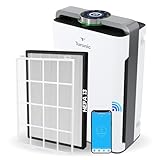
A tall tower stacking a True HEPA 13 filter, carbon, a cold-catalyst layer, a UV lamp, an ionizer, and an evaporative humidifier.
Why we picked it:
- Turonic claims a CADR of 488 cubic meters per hour and coverage up to 624 square feet on just 95 watts, with 36 decibels in sleep mode (manufacturer claim, not AHAM verified).
- The True HEPA 13 filter is rated at 99.97 percent, though Turonic quotes that at 0.1 microns rather than the standard 0.3-micron test point, so read it as HEPA-class. A laser particle sensor and Wi-Fi app are included.
Real-world scenario:
You rent a large open apartment, spring pollen wrecks you, and you want one machine that covers the whole space and adds humidity.
Pros:
- High claimed coverage for a single tower.
- Quiet at night, and efficient at a listed 95 watts.
- Deep filter stack, app control, and a real particle sensor.
Cons:
- Turonic lists a filter life of only about 6 months or 3,000 hours, so filter changes come around faster than with the Sharp.
- The UV lamp and ionizer can produce trace ozone, and we found no CARB certification, so skip it if you are ozone-sensitive.
- Coverage claims vary between the maker’s site and retail listings, so treat 624 square feet as optimistic.
Best for:
Allergy households that need large-room coverage from one combo and can live with more frequent filter changes.
Afloia Miro Pro 2-in-1 Air Purifier and Humidifier Review
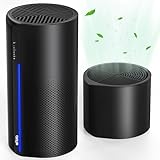
Afloia Miro Pro 2-in-1
- Innovative Dual-Function Design: The MIRO PRO seamlessly integrates an air purifier and humidifier into a…
- Advanced 3-in-1 Filtration System: Featuring a sophisticated 3-stage filtration process—including a…
- Mist-Free Humidification Technology: Employing cutting-edge evaporative technology, the humidifier…
EverydayHomeComfort Score
| Sub-score | Rating (1 to 10) |
|---|---|
| Clean-Air Delivery (35%) | 6.0 |
| Filtration (25%) | 5.0 |
| Noise (15%) | 9.0 |
| Running Cost & Upkeep (15%) | 7.0 |
| Ease of Use (10%) | 8.0 |
| Overall Rating | 6.6 |
A compact tower with a 3-stage filter and an evaporative humidifier module in one small footprint.
Why we picked it:
- It uses a 3-stage filter (pre-filter, activated carbon, and a high-efficiency stage), though Afloia doesn’t state a tested HEPA percentage, so treat any “True HEPA” claim for this unit as unconfirmed.
- The humidification is evaporative and mist-free, so there is no white mineral dust and no puddle risk near a crib, and Afloia rates it at 22 to 24 decibels, quiet enough for a nightstand.
Real-world scenario:
You live in a one-bedroom apartment with a cat and want clean, lightly humidified bedroom air without a bulky machine or a noisy fan.
Pros:
- Compact 3-stage filtration in a nightstand-sized unit.
- Among the quietest combos sold.
- Mist-free humidification avoids white dust and damp patches.
Cons:
- Neither Afloia nor Amazon’s own listing publishes a tested HEPA percentage or a CADR, and rated coverage is only about 219 square feet at five air changes per hour, so treat the filtration claim as unconfirmed and the unit as single-room only.
- Afloia calls for a filter change every 3 to 6 months.
- The humidifier module and tank need weekly cleaning.
Best for:
Apartment dwellers, pet owners, and parents who need one quiet unit for a bedroom or nursery.
Venta LW25 Original Review

Venta LW25 Original
- Mist-free evaporative humidification for spaces up to 600 ft² including adjoining spaces that cannot be…
- Healthy air humidified to an optimal 40-60%. As a disk stack rotates in the water reservoir, clean water…
- Cold evaporative humidification without the use of filters.
EverydayHomeComfort Score
| Sub-score | Rating (1 to 10) |
|---|---|
| Clean-Air Delivery (35%) | 3.0 |
| Filtration (25%) | 3.0 |
| Noise (15%) | 9.0 |
| Running Cost & Upkeep (15%) | 9.0 |
| Ease of Use (10%) | 7.5 |
| Overall Rating | 5.3 |
A German-made “air washer” that humidifies by cold evaporation and has no filter of any kind.
Why we picked it:
- Venta rates it for spaces up to 430 square feet, running on just 3 to 8 watts across its three speeds, with no filter to ever buy or replace.
- Venta lists noise at 24, 34, and 44 decibels across its three speeds, and the 2-gallon tank needs only tap water.
Real-world scenario:
You live somewhere genuinely arid, want a humidifier you never have to buy filters for, and treat any air-cleaning benefit as a bonus rather than the point.
Pros:
- No filter to ever buy, replace, or forget about.
- Very low power draw and quiet operation.
- Simple to fill, run, and clean.
Cons:
- Venta publishes no CADR, no capture percentage, and no test standard behind its “pollen and dust reduction” claim, so treat any air-cleaning benefit as unverified.
- Venta’s own marketing targets 40 to 60 percent humidity, which runs past the 50 percent ceiling this guide’s EPA source recommends; keep it at the low end of that range, not the top.
- As an air purifier, it is outclassed by every other pick here.
Best for:
People in very dry climates who want low-maintenance, filter-free humidification and treat air cleaning as a bonus.
Common Mistakes Buyers Make
These are the mistakes we see most often when someone shops for an air purifier and humidifier combo.
- Buying a combo when you actually need high CADR: shoppers assume a 2-in-1 cleans as hard as a standalone purifier, so a household with an asthmatic child never clears the spring pollen load. Match the AHAM room size to your space; if it is tight, run two devices.
- Trusting the word “HEPA” on the box: “HEPA-type” and “HEPA-like” are not an H13 or True HEPA filter, so you end up with a mat that leaks fine particles. Check the rated capture percentage and the particle size behind it.
- Skipping daily tank maintenance: a combo runs quietly in the corner and gets ignored, and within days the standing water grows a biofilm the mist sprays across the room. Empty and dry the tank every morning; deep-clean every third day.
- Filling with tap water: hard tap water scales the wick and, with ultrasonic units, coats every surface in fine white dust that gets inhaled. Use distilled or previously boiled and cooled water, as the CDC advises.
- Over-humidifying the room: chasing a “cozy” 55 or 60 percent invites mold on cold window frames and cupped hardwood boards by spring. Keep a hygrometer in the room and hold 30 to 50 percent.
How We Researched This Guide
We evaluated every air purifier and humidifier combo from manufacturer spec pages and manuals, then checked each clean-air claim against the AHAM Verifide directory, EPA humidity and mold guidance, CARB listings, and CPSC and CDC humidifier safety advice, labeling any vendor-only figure as a manufacturer claim. We ranked every pick on five things, in order: verified clean-air performance, filter grade, humidification output and tank size, measured noise, and upkeep. We then read verified-owner reviews in volume, coded by issue type and months of ownership, to catch reliability patterns that specs do not show. We did not run hands-on lab tests; we analyzed published data and owner-reported outcomes.
For our full method and scoring rubric, see our review methodology. For the full category picture beyond combos, see our air purifier buying guide.
Who This Is For and Who It Is Not
This is for you if:
- You have one room to treat and no floor space for two appliances.
- Your winters are dry and your air quality needs are moderate, not medical.
- You will commit to emptying and drying the tank daily.
- You are a pet owner or parent who values one simple machine over peak performance.
This is not for you if:
- Someone in the home has asthma or a serious allergy and needs maximum CADR.
- You live in a humid climate and need to remove moisture for part of the year.
Read our bedroom dehumidifier guide instead. - You know you will not keep up with daily tank cleaning.
Frequently Asked Questions
Is an air purifier and humidifier combo better than buying the two separately?
For convenience, yes. For peak performance, no.
A combo unit saves a plug, a footprint, and a second machine, and for one bedroom with moderate needs that is a fair trade. The catch is that combining both jobs in one airflow path forces compromises, so a combo rarely cleans as hard as an equivalent standalone purifier. The Sharp KCP110UW is the strongest combo here, at an AHAM Clean Air Delivery Rate of 347 for smoke, yet comparable standalone purifiers post higher numbers because they carry no water tank and wick.
Buy separates if anyone in the home has asthma or a strong pollen allergy, if you need to cover an open-plan space above about 500 square feet, or if you may need a dehumidifier for part of the year. Choose a combo only for a single room, ideally a bedroom under about 250 square feet, where you value one simple machine over the last slice of air-cleaning power.
Can running a humidifier ruin the HEPA filter in a combo unit?
It can shorten filter life and, if you neglect the unit, invite mold.
A HEPA filter is a dense mat of glass fibers, and when damp air passes through it the fibers hold moisture, dust cakes faster, and airflow drops. A well-designed combo puts the humidifier downstream of the filter so the filter sees room air, not mist, but simpler units place the two closer together.
The bigger danger is biological: the EPA warns that microorganisms often grow in tanks with standing water, and a damp filter downwind gives them somewhere to settle. Hold the room at 30 to 50 percent relative humidity, never above 50, so the filter meets less moisture, and replace it on the maker’s schedule: up to 2 years for the Sharp, about 6 months for the Turonic, 3 to 6 months for the Afloia. If a filter smells musty or airflow drops off, replace it now rather than waiting for the scheduled date.
What humidity level should I set to prevent mold?
Keep indoor relative humidity between 30 and 50 percent, and never run a humidifier past 50 percent. That range comes from the EPA, which also notes that materials left damp for 24 to 48 hours can grow mold and that condensation on windows means the air is too wet.
For example, in a 65-degree bedroom on a cold night, humidity above about 45 percent will often fog the lower corners of single-pane windows, and that film is enough to seed mold on the frame within weeks. Buy a cheap hygrometer, place it across the room from the combo rather than right beside it, and target 40 percent in winter. Homes with solid hardwood floors should stay near the low end, around 40 to 45 percent, because sustained higher moisture can cup the boards.
If the number keeps climbing past 50 percent with the humidifier off, you have a moisture source to fix, not a level to chase.
Do these combos actually use true HEPA filters?
Most of our picks make a HEPA-style claim, but the evidence behind each one differs, and the label alone will not tell you which to trust. Our explainer on HEPA versus True HEPA covers why.
The Sharp KCP110UW is the only pick with independently verified clean-air performance behind its detachable True HEPA filter, rated at 99.97 percent at 0.3 microns. The InvisiClean AquaNova and the Turonic PH950 both claim 99.97 percent, but neither is independently verified, and Turonic quotes its figure at a nonstandard 0.1 microns rather than the usual 0.3-micron test point. The Afloia Miro Pro is the weakest link here: neither Afloia nor its Amazon listing states a tested HEPA percentage at all, only a vague “high-efficiency” filter stage. The Venta LW25 is the outlier in a different way: it has no filter at all, by design, so there is no HEPA claim to evaluate in the first place.
Per the HEPA standard, “True HEPA” has no legal meaning, while DOE HEPA and EN 1822 H13 both require at least 99.95 to 99.97 percent efficiency at the hardest particle size.
When you shop, ignore the word on the box, and treat “high efficiency” with no stated number as a red flag.
Will a humidifier combo help or hurt my hardwood floors?
It helps if you hold the humidity in range and hurts if you overshoot.
Solid wood flooring is happiest between about 30 and 50 percent relative humidity, and makers commonly target 40 to 45 percent. In a dry heated house that drops to 20 percent in January, boards shrink and gaps open between planks; a combo that lifts the room to 40 percent closes those gaps.
If you have solid hardwood floors, cap the humidity at 40 to 45 percent, because sustained moisture above that range can cup or crown the boards.
Cupping, where each board’s edges rise above its center, is the sign of too much ambient moisture and can take months to reverse. Keep a hygrometer near the floor, since cooler air there reads a higher relative humidity than mid-room, and pick a unit with a precise humidistat, such as the Sharp KCP110UW’s auto mode, set to a hard 45 percent ceiling.
For more, see how to clean hardwood floors.


The Bottom Line
The safest default in this best air purifier and humidifier combo guide is the Sharp KCP110UW: the only pick with an AHAM-verified clean-air rating, a detachable True HEPA filter, and a 2-year filter interval. Use the comparison table above to check its AHAM room size against your space, and step to another pick only when its column speaks to your situation. Whichever you choose, hold the room between 30 and 50 percent humidity and clean the tank on schedule.
Still unsure?
Start with the Sharp KCP110UW; it covers the large majority of homes that want clean, comfortable air from one machine.
If your needs are severe, skip the combo and pair a purifier built for pet dander with a standalone humidifier, or see more picks on the Seasonal Comfort hub and the EverydayHomeComfort home page.