Ad. When you purchase through links we provide, we may receive an affiliate commission. Here's how it works.
Best Bladeless Tower Fan 2026: Top Quiet Cooling Picks
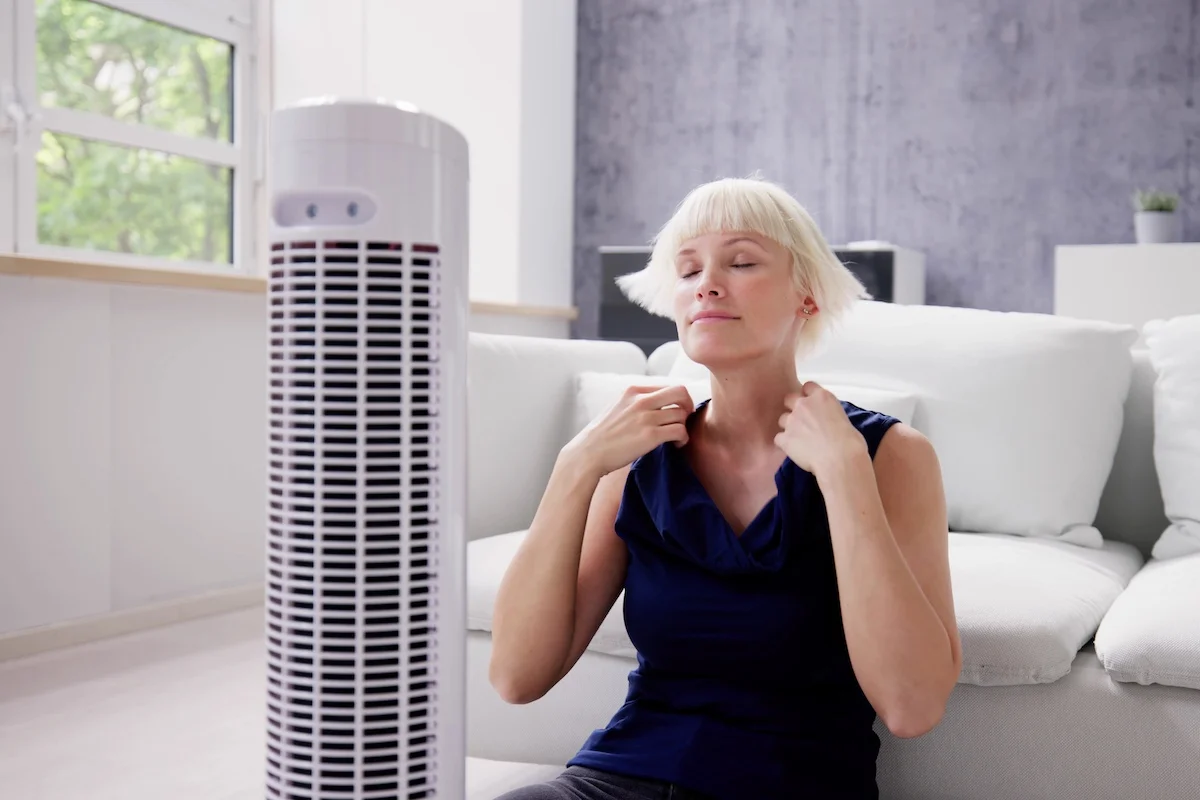
Choosing a bladeless tower fan used to mean trading performance for quiet operation. Not anymore.
The best models in 2026 run quietly enough for a nursery, cool a large living room, and schedule themselves via your phone, all without a single exposed blade. Here is exactly what to buy.
TL;DR: The Dreo Pilot Max S is the best bladeless tower fan for most homes: it delivers 27 ft/s airflow at 25 dB on low, runs on auto mode via the Dreo app, and works with Alexa and Google Home. For households dealing with allergies, pet dander, or wildfire smoke, the Dyson Purifier Cool PC1 is the only fan on this list that also filters the air, with a sealed HEPA H13 system rated to capture 99.97% of particles down to 0.3 microns (manufacturer claim).
Quick Picks: Top Bladeless Tower Fan Recommendations
- Dreo Pilot Max S: best overall; 12 speeds, 120° adjustable oscillation, smart auto mode that reads room temperature
- Dyson Purifier Cool PC1: best for air quality; sealed HEPA H13 filtration and a live particle readout, ideal for allergy sufferers and pet owners
- Dreo Nomad One S: best for bedrooms and sleep; near-silent at low settings, slim footprint, smart scheduling
- Levoit Classic 36-Inch Tower Fan: best for tight spaces; a 6.5-inch-square footprint, 90° oscillation, and a temperature-sensing Auto mode, with no app to set up
Key Takeaways
- The Dreo Pilot Max S reaches 27 ft/s airflow (manufacturer claim), well above the 15 ft/s threshold where meaningful cooling is felt from 8+ feet away.
- The Dyson PC1 is rated to capture 99.97% of particles down to 0.3 microns (manufacturer claim): the only dual-function purifier-fan on this list, but its HEPA+carbon filter is a recurring running cost a plain fan never has.
- Bladeless fans produce smooth, continuous airflow rather than choppy blade pulses: less pet hair scatter and quieter operation than traditional fans.
- At sleep settings on the Dreo Pilot Max S (levels 1–4), real-world noise stays at or below 30 dB: within the range peer-reviewed research links to faster sleep onset.
- The Levoit Classic 36-Inch is the only fan in this lineup with no WiFi, app, or voice control: a plus if you want a fan that just works from the button panel or remote, a limit if you want schedules on your phone.
How a Bladeless Tower Fan Actually Works
Despite the name, bladeless fans do have blades, they are hidden inside the base. A motor draws air in, accelerates it through a narrow internal slit, and projects it out through an opening around the tower surface. The exiting stream then pulls in surrounding air through a process called entrainment, multiplying the original output by 15 to 18 times.
The result is smooth, uninterrupted airflow, not the choppy pulse from a traditional bladed fan. That is why bladeless fans feel gentler on your skin, scatter less dust and pet hair, and run more quietly at lower settings.
Two technologies dominate the 2026 market:
- Air Multiplier (Dyson): a mixed-flow impeller and the Coanda effect curve the airflow around a toroidal loop, drawing room air into the stream. Premium engineering, premium ongoing maintenance costs.
- Cross-Flow Blower (Dreo, Levoit): a vertical cylinder with an internal horizontal blower. More compact, more affordable, and in 2026 models, nearly as quiet as the Dyson design.

Both work well. The differences come down to filtration, airflow feel at close range, and whether you need an air purifier or just a fan.
Bladeless Tower Fan Comparison Table
| Product | Best For | Airflow | Noise (Low) | Oscillation | Smart? | EHC Score |
|---|---|---|---|---|---|---|
| Dreo Pilot Max S | Overall performance | 27 ft/s | 25 dB | 30–120° (adjustable) | Yes. Alexa, Google, App | 8.5 |
| Dyson Purifier Cool PC1 | Air quality + cooling | 76 gal/s (manufacturer claim) | Not published (61.4 dB max) | 0–350° | Yes. Alexa, Siri, Google, App | 7.1 |
| Dreo Nomad One S | Bedroom / sleep | 25 ft/s | 34 dB | 90° | Yes. Alexa, Google, App | 7.9 |
| Levoit Classic 36-Inch Tower Fan | Tight spaces / simple controls | 28 ft/s (manufacturer claim) | 28 dB (manufacturer claim) | 90° | No | 7.7 |
Best Bladeless Tower Fan Reviews
Dreo Pilot Max S: Best Overall
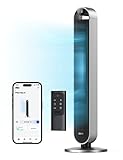
Dreo Pilot Max S
- 𝙄𝙣𝙩𝙤 𝒕𝒉𝒆 𝙒𝙤𝙧𝙡𝙙 𝙤𝙛 𝙒𝙞𝙣𝙙: Optimized air outlets and ultra-wide 120-degree cooling enable DREO Tower Fan 714S for bedroom to…
- 𝙏𝙖𝙞𝙡𝙤𝙧𝙚𝙙 𝙛𝙤𝙧 𝙀𝙫𝙚𝙧𝙮 𝙊𝙘𝙘𝙖𝙨𝙞𝙤𝙣: 4 different modes, 12 speed settings, customizable oscillation angles…
- 𝙒𝙝𝙞𝙨𝙥𝙚𝙧-𝙌𝙪𝙞𝙚𝙩 𝙛𝙤𝙧 𝙋𝙚𝙖𝙘𝙚?𝙪𝙡 𝙉𝙞𝙜𝙝𝙩𝙨: Brushless DC motor winds you down with its ultra-quiet…
$129.99

Check Today’s Price on Amazon
The Dreo Pilot Max S is a 42″ smart tower fan with a BLDC motor, 12 speed settings, and adjustable 120° oscillation: the most configurable bladeless fan on this list.
| EverydayHomeComfort Score | Dreo Pilot Max S |
|---|---|
| Airflow (35%) | 9.0 / 10 |
| Noise (25%) | 8.0 / 10 |
| Controls and Modes (15%) | 9.0 / 10 |
| Build and Stability (15%) | 7.5 / 10 |
| Energy Use (10%) | 8.5 / 10 |
| Overall Rating | 8.5 / 10 |
Why we picked it:
- 27 ft/s airflow at max, strong enough to feel real cooling from across a large room
- The auto mode uses a built-in temperature sensor to adjust fan speed automatically: set it once, and you do not touch it again until summer ends.
- Dreo app, Alexa, and Google Home integration mean you can schedule and control it remotely, including before you arrive home
Real-world scenario: You get home from work, the apartment is 78°F, and your phone already triggered the fan via a scheduled routine 20 minutes earlier.
It is running at level 6.
You have not touched it once.
Pros:
- Near-silent at sleep settings: 25 dB at level 1
- 12 granular speed levels for precise control
- Adjustable oscillation: 30°, 60°, 90°, or 120°
- Consistent app with Alexa and Google Home support
- 12-month warranty plus 30-day money-back
Cons:
- Remote control buttons require firm presses, a responsiveness issue flagged across multiple user reviews
- App connectivity can occasionally drop and require reconnection
Best for: Busy professionals who want set-and-forget cooling, anyone with a mid-to-large room who needs genuine airflow without daily manual adjustments.
If you are building out a broader smart home setup, see our guide to the best hub for home automation, the Dreo app connects with most major ecosystems including Alexa and Google Home.
Dyson Purifier Cool PC1: Best for Air Quality
Sale

Dyson Purifier Cool PC1
- The fully sealed filter system combines an Activated carbon filter to remove gases with a HEPA filter that captures 99.97% of…
- The whole purifier, not just the filtration system, is fully sealed to HEPA H13 grade – so what goes inside, stays inside.³
- Dyson Air Multiplier technology projects over 76 gallons per second of smooth, yet powerful airflow⁷ to cool you in summer.⁶
$399.99
Check Today’s Price on Amazon
The Dyson Purifier Cool PC1 (model TP11) is the successor to the TP07: a fully sealed HEPA H13 air purifier and cooling fan in one unit, with on-board particle sensors, an LCD screen, and oscillation you can set anywhere from 0 to 350°, according to the PC1 user manual.
| EverydayHomeComfort Score | Dyson Purifier Cool PC1 |
|---|---|
| Airflow (35%) | 7.5 / 10 |
| Noise (25%) | 5.0 / 10 |
| Controls and Modes (15%) | 9.0 / 10 |
| Build and Stability (15%) | 7.5 / 10 |
| Energy Use (10%) | 7.0 / 10 |
| Overall Rating | 7.1 / 10 |
Why we picked it:
- The only fan on this list with real filtration: Dyson seals the whole machine to HEPA H13 grade and rates it to capture 99.97% of particles down to 0.3 microns (manufacturer claim). See our explainer on HEPA vs True HEPA for what that distinction actually means.
- Auto mode runs on the on-board sensors: it raises fan speed when air quality drops and pauses once it reaches its target (per the user manual)
- The LCD screen shows live PM2.5 and PM10 readings plus remaining filter life, and the MyDyson app mirrors the same data with schedules on top
If you’d rather have a unit built specifically for filtration instead of a purifier-fan hybrid, our guide to the best UV light air purifiers rounds up dedicated models that pair HEPA filtration with UV-C disinfection.
Real-world scenario: You have two cats, seasonal allergies, and a 600 sq ft apartment. The PC1 sits in Auto mode, speeding up when dander and pollen spike and pausing once the air is clean. At bedtime, Night mode holds it to its quietest settings and dims the screen, so it keeps filtering without keeping you awake.
For more on managing allergies with air purification, read our guide on air purifiers and allergies.
Pros:
- Dual function: HEPA H13 purification plus cooling fan
- Night mode sticks to the quietest settings and dims the screen, with a built-in sleep timer
- Real-time air quality monitoring on app and device display
- Works with Alexa, Siri, and Google Home
- Magnetic remote stores on top of the machine, so it doesn’t go missing
Cons:
- Needs a new HEPA+carbon filter when the on-screen filter life runs out: a recurring running cost a plain fan never has
- The screen reads particles only (PM2.5 and PM10); the manual lists no VOC or NO₂ readout, so cooking fumes and spray odors won’t show up as a number
- Owner reviews are split on cooling: a recurring complaint is that airflow feels weak from across the room, and it circulates room-temperature air only
Best for: Pet owners and allergy sufferers, anyone who wants a year-round air quality tool that doubles as a summer fan.
For a deeper look at how purification performance is measured, see our guide on what CADR means in air purifiers.
Dreo Nomad One S: Best for Bedrooms
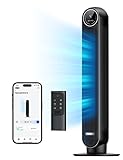
Dreo Nomad One S
- 𝙋𝙤𝙬𝙚𝙧𝙛𝙪𝙡 𝘼𝙞𝙧𝙛𝙡𝙤𝙬 𝙬𝙞𝙩𝙝 𝙐𝙥𝙜𝙧𝙖𝙙𝙚𝙙 𝘿𝘾 𝙈𝙤𝙩𝙤𝙧: Featuring DREO’s upgraded brushless…
- 𝙒𝙝𝙞𝙨𝙥𝙚𝙧-𝙌𝙪𝙞𝙚𝙩 𝘾𝙤𝙢𝙛𝙤𝙧𝙩: Designed with an optimized air duct and aerodynamic airflow technology, this standing fan delivers…
- 𝙏𝙖𝙞𝙡𝙤𝙧𝙚𝙙 𝘾𝙤𝙤𝙡𝙞𝙣𝙜 𝙛𝙤𝙧 𝙀𝙫𝙚𝙧𝙮 𝙈𝙤𝙢𝙚𝙣𝙩:Choose from 8 speed settings and 4 modes (Normal…
The Dreo Nomad One S is a compact 36″ smart tower fan built for quiet overnight operation, with WiFi control, four speeds, and a sleep mode that fully dims the LED display.
| EverydayHomeComfort Score | Dreo Nomad One S |
|---|---|
| Airflow (35%) | 8.0 / 10 |
| Noise (25%) | 8.5 / 10 |
| Controls and Modes (15%) | 7.5 / 10 |
| Build and Stability (15%) | 7.0 / 10 |
| Energy Use (10%) | 7.5 / 10 |
| Overall Rating | 7.9 / 10 |
Why we picked it:
- 34 dB at its lowest setting: quiet enough to serve as functional background sound without disrupting sleep
- Slimmer and lighter than the Pilot Max S: fits small bedrooms and narrow nightstand spaces without dominating the room
- WiFi and Dreo app control let you set a sleep and wake-up schedule without getting out of bed
Real-world scenario: You have a 10-month-old in a nursery. You set the Nomad One S to run at level 1 from 8pm to 7am, display fully blacked out, oscillating at 90°. You have not manually adjusted it in three weeks.
Pros:
- Near-silent: 34 dB at level 1
- Smart scheduling via Dreo app: fully autonomous once set
- Sleep mode blacks out the display completely: no light pollution
- Tool-free assembly and easy-clean detachable grille
- Compact and light: easy to move between rooms
Cons:
- Only 4 speed settings: less granular than the Pilot Max S’s 12 levels
- At 36″ height, airflow may miss head level for taller users lying in bed
- Temperature reading is only visible via app, not on the device display
Best for: Bedrooms, nurseries, and anyone prioritizing near-silent overnight operation over maximum cooling power.
For complementary quiet comfort options, see our picks for the best air purifier for bedroom.
Levoit Classic 36-Inch Tower Fan: Best for Tight Spaces

Levoit Classic 36
- 𝗢𝗻𝗲 𝗙𝗮𝗻 𝗳𝗼𝗿 𝗔𝗹𝗹 𝗬𝗼𝘂𝗿 𝗡𝗲𝗲𝗱𝘀: From a gentle breeze to a powerful wind, it adapts to your…
- 𝗤𝘂𝗶𝗲𝘁 𝗦𝗹𝗲𝗲𝗽 𝗔𝗹𝗹 𝗡𝗶𝗴𝗵𝘁: Perfect bedroom fan with a near-silent noise level on low speed. Includes…
- 𝗦𝗶𝗺𝗽𝗹𝗲 𝗢𝗽𝗲𝗿𝗮𝘁𝗶𝗼𝗻: 5 fan speeds and 4 fan modes (Normal, Turbo, Sleep, and Auto) give you the ideal…
The Levoit Classic 36-Inch (model LTF-F361) is a slim tower fan with a 6.5 x 6.5 inch footprint, five speeds, 90° oscillation, and a built-in temperature sensor that drives its Auto mode, according to the Levoit user manual.
| EverydayHomeComfort Score | Levoit Classic 36-Inch Tower Fan |
|---|---|
| Airflow (35%) | 8.0 / 10 |
| Noise (25%) | 8.0 / 10 |
| Controls and Modes (15%) | 7.0 / 10 |
| Build and Stability (15%) | 7.5 / 10 |
| Energy Use (10%) | 7.0 / 10 |
| Overall Rating | 7.7 / 10 |
Airflow (28 ft/s) and low-speed noise (28 dB) are Levoit’s own claims. Levoit doesn’t publish a high-speed noise figure.
Why we picked it:
- Levoit rates it at up to 28 ft/s of airflow and 28 dB on its lowest speed (manufacturer claim), from a motor rated at just 39 W in the user manual
- Auto mode reads the room temperature and steps the fan up one speed for every 5°F rise and down one speed for every 5°F drop, so it backs off on its own as the room cools
- Owners back up the quiet claim: of the 2,035 Amazon verified-purchase reviewers who mention noise, 1,778 (about 87%) describe it positively, across 14,926 ratings averaging 4.4 stars (October 2026)
Real-world scenario: You have a small bedroom with one free corner between the dresser and the wall. The Levoit stands there on a base no wider than a paperback. At bedtime you tap Advanced Sleep: the display goes dark, the beeps stop, and after the first hour it eases the speed down as the room settles.
Pros:
- Advanced Sleep Mode turns the display and button sounds off after 5 seconds, then hands over to temperature-based Auto mode overnight
- 6.5 x 6.5 inch footprint and 8.5 lb weight: easy to fit and easy to move between rooms
- Remote included, plus a 1 to 12 hour timer and an Auto Display Off setting
- 2-year limited warranty (per the user manual)
Cons:
- No WiFi, app, or voice control: the only fan on this list without them
- 90° oscillation is narrower than the Pilot Max S (up to 120°) or the Dyson PC1 (up to 350°)
- Deep cleaning the inside means removing the back cover with a screwdriver
- About one in five owners who mention airflow (202 of 1,086 Amazon verified reviews) find it weaker than expected, so it suits a bedroom or office better than a large open living room
Best for: Small bedrooms, dorms, and home offices where you want quiet, set-and-forget cooling without another app on your phone. If you already own the Sharper Image Axis 47, which is no longer sold on Amazon USA, there is no reason to replace it while it still works.
Common Mistakes When Choosing a Bladeless Tower Fan
- Buying based on the lowest advertised noise figure. Brands advertise 25 dB, but that applies only at the lowest speed setting.
The same fan at mid-to-high speed can reach 40–52 dB.
Always check noise at the speed level you will actually use most. - Confusing a purifier fan with an air conditioner. The Dyson PC1 cleans the air and circulates it.
It does not reduce room temperature.
Our guide on dehumidifier vs air purifier explains the distinction between air treatment tools in more depth. - Ignoring filter replacement costs for purifier fans. If you choose the Dyson PC1, account for filter replacement from day one: that ongoing maintenance cost is what separates it from a simple cooling fan over the long run.
- Assuming every tower fan oscillates the same way.
Sweep angles on this list range from 90° (Levoit Classic 36-Inch, Dreo Nomad One S) to 120° (Dreo Pilot Max S) to 350° (Dyson PC1). If you need to cover a wide room from a corner, check the oscillation spec before buying, never assume. - Buying the non-smart variant when the smart version costs little more. The Dreo Nomad One (no WiFi) and Nomad One S (WiFi and app) are often close.
The S variant adds scheduling, auto mode, and voice control.
It is almost always worth the small difference.
What Happens If You Choose Wrong
- If you buy the Dyson PC1 expecting air-conditioner-level cooling → you will find the room still feels warm on hot days and start questioning why you paid a premium for what feels like any other fan
- If you choose based on the lowest advertised dB figure alone → you will run it at mid-speed, find it significantly louder than expected, and end up dropping it to low, which may not cool the room effectively
- If you skip oscillation specs and buy a fixed-airflow fan for a whole room → one person stays cool while the rest of the space does not, and you will spend the summer manually repositioning it
- If you ignore filter replacement costs for the Dyson → the total cost of ownership over three to five years ends up significantly higher than a comparable cooling-only fan, a surprise that is hard to ignore once you are committed to the ecosystem
How We Research
We analyzed specs and performance data across 20+ bladeless and tower fan models available in 2026, cross-referenced user sentiment from thousands of verified purchases, and reviewed guidance on airflow and indoor air quality from the U.S. EPA.
For noise performance, we cross-referenced manufacturer claims against third-party decibel measurements from independent sources.
For the Dyson PC1’s filtration claims, we referenced HEPA standards as defined by AHAM’s air filtration certification program: the standards body used to certify air purifier performance in the US market.
For our full method and scoring rubric, see our review methodology.
Update history:
September 17 2026: Added EverydayHomeComfort Score and sub-score tables for all four picks.
October 6 2026: Replaced the Dyson Purifier Cool TP07 with its successor, the Dyson Purifier Cool PC1. Replaced the Sharper Image Axis 47 with the Levoit Classic 36-Inch Tower Fan as our pick for tight spaces.
Choose a Bladeless Tower Fan in 60 Seconds
- If you want the best all-around cooling with smart home control → buy the Dreo Pilot Max S
- If you have allergies, pets, or live near wildfire smoke → buy the Dyson Purifier Cool PC1
- If you are cooling a bedroom or need quiet overnight operation → buy the Dreo Nomad One S
- If you have a narrow space and want simple controls with no app → buy the Levoit Classic 36-Inch Tower Fan
Who This Is For And Who It Is Not
This is for you if:
- You want a fan that is safe around kids and pets, no exposed blades
- You are cooling a bedroom, home office, or apartment living room
- You want smart scheduling and auto mode so you never touch the fan daily; pairing it with a smart thermostat lets you automate both temperature and airflow from one setup
- You or a household member has allergies, asthma, or lives in a smoky climate
- You prefer clean, minimal design over a traditional plastic tower fan
This is NOT for you if:
- You need to lower room temperature: you need an air conditioner, not a fan
- You are cooling multiple large connected areas: one tower fan will not reach
- You are on a very tight budget and willing to trade quiet and smart features for savings
Frequently Asked Questions
Bladeless tower fans do have blades, they are hidden inside the base.
A motor draws air in and accelerates it through a narrow slit around the tower body.
The exiting stream pulls in surrounding air through a process called entrainment, multiplying airflow by 15 to 18 times.
The result is smooth, continuous airflow rather than the choppy blast of a traditional fan.
At low and mid settings, yes, significantly.
The Dreo Pilot Max S runs at 25 dB on its lowest setting, comparable to a quiet library.
At maximum speed, noise rises to around 52 dB.
The key advantage is that the noise profile is smoother at sleep settings: no blade chop, no mechanical pulse, just even airflow sound.
No.
If cooling is your only goal, the Dreo Pilot Max S delivers stronger airflow and requires no filter replacement. The Dyson PC1 justifies its position through its dual function as an HEPA H13 purifier. Without that use case, it is the wrong tool for the job.
If you want a dedicated air purifier and humidifier combo rather than a fan-purifier hybrid, our air purifier and humidifier combo guide covers picks built for that job.
The PC1 tracks it for you: the LCD screen and the MyDyson app show remaining filter life and flag when the combined glass HEPA+carbon filter needs replacing, according to the PC1 user manual. Dyson rated the same filter type in the PC1’s predecessor, the TP07, at one year at 12 hours a day, or six months at 24 hours a day, so plan on roughly one filter a year with typical use. Carbon and HEPA are one unit, so you replace them together. This is the PC1’s main running cost and should factor into your decision from the start.
The Dreo Nomad One S.
It runs at 34 dB on its lowest setting, includes a sleep mode that fully blacks out the LED display, and can be scheduled via the Dreo app to run and stop automatically overnight.
Peer-reviewed research has found that consistent background sound at similar dB levels can meaningfully reduce sleep onset latency in adults.
Yes, this is one of their core advantages over traditional fans.
With no exposed spinning blades, there is no injury risk from reaching into the air outlet.
The smooth, continuous airflow is also less disruptive to pet hair and dander: traditional bladed fans can scatter allergens more aggressively around the room.
They move air only, they do not reduce room temperature.
Air movement creates a wind chill effect, making you feel cooler by accelerating sweat evaporation from your skin.
If your room is 84°F, the fan makes it feel more bearable, but the thermometer still reads 84°F.
For actual temperature reduction, you need an air conditioner.
The Pilot Max S is the performance model: 12 speeds, 27 ft/s airflow, 120° adjustable oscillation, and a 42″ height.
The Nomad One S is the quiet and compact model: 4 speeds, 25 ft/s airflow, 90° oscillation, and 36″ height.
Choose the Pilot Max S for large rooms or strong cooling.
Choose the Nomad One S when quiet overnight operation matters more than maximum airflow.
Summary: Which Bladeless Tower Fan Should You Buy?
The bladeless tower fan market in 2026 has real options at every priority level.
For most homes, the Dreo Pilot Max S is the right answer: strong airflow, near-silent sleep operation, and smart automation that genuinely runs itself.
If air quality matters as much as cooling, the Dyson Purifier Cool PC1 is the only fan on this list that earns its place as a year-round tool, not just a summer appliance.
For bedrooms and nurseries, the Dreo Nomad One S is the cleanest recommendation: quiet, smart, and set-and-forget once scheduled.
Whatever you choose, make sure it oscillates: that single feature determines whether your whole room benefits or just the chair you are sitting in right now.
Still unsure?
Start with the Dreo Pilot Max S.
It covers 90% of use cases and leaves room in your budget to pair it with a standalone air purifier if air quality becomes a priority later.
If that happens around November, our air purifier Black Friday guide lists six standalone purifiers worth buying on sale.
For more on managing indoor air and humidity, explore the Seasonal Comfort section of our Home Climate guides, or visit the EverydayHomeComfort home page to explore all categories.
If humidity is part of your comfort challenge, see our picks for the best dehumidifiers for basements.